SOLAR WIND, INCOMING: A hole in the sun's atmosphere is facing Earth and spewing solar wind in our direction. Estimated time of arrival: Oct. 20-21. The impact is not expected to cause a full-fledged geomagnetic storm, but Arctic Auroras are likely when the solar wind arrives. Aurora alerts: SMS Text.

FOR NO REASON, AURORAS AT SEA: Geomagnetic storms and auroras go together. Northern Lights are the telltale glow of Earth's magnetic field vibrating in response to solar wind. So how do we explain this? There was no geomagnetic storm on October 16th when bright auroras appeared off the coast of Tromsø, Norway. Alan Dyer photographed the display from the deck of the ferry ship Trollfjord:

"Despite the fact that geomagnetic activity was low, we had a crowd-pleasing show of Northern Lights from our position in the Norwegian Sea north of Tromsø," says Dyer. "While the ship is a ferry delivering people, cars and cargo, the majority of passengers are tourists sailing the coast for the spectacular scenery by day and the frequent auroras by night."
The seas around Tromsø are some of the best places in the world to see Northern Lights. The reason is their location beneath Earth's persistent auroral oval. A gentle rain of solar wind electrons, guided to Earth by our planet's curved magnetic field, creates a polar ring of Northern Lights that intersects the latitude of Tromsø. Aurora tour guides and photographers naturally gravitate to the area because of its frequently-green skies--no geomagnetic storm required. Aurora alerts: SMS Text.
Realtime Aurora Photo Gallery
Free: Spaceweather.com Newsletter
A RARE FIREBALL FROM THE BIG DIPPER: On Oct. 16th, a bright meteor disintegrated over Arizona. NASA's network of all-sky meteor cameras tracked it backwards to the Big Dipper, identifying it as a rare "October Ursae Majorid." The fireball was almost as bright as the waning gibbous Moon:

Above: An Ursae Majorid fireball over Mt. Lemmon. See also Kitt Peak and Mt. Hopkins.


This fireball is part of a debris stream discovered in 2006 by observers in Japan. Its origin is unknown. October Ursae Majorid meteoroids travel around the sun in highly elliptical orbits tilted almost perpendicular to the plane of the Solar System. It looks like the orbit of a comet, but the comet itself has not yet been found.
These mysterious meteors number about 1 per hour when the shower peaks in mid-October. The shower is rich in fireballs. If you see a flash of light in the Big Dipper, you might have spotted a October Ursae Majorid.
Realtime Spaceweather Photo Gallery
Free: Spaceweather.com Newsletter
CROWD-FUNDING SPACE WEATHER RESEARCH: Did you know that cosmic rays in Earth's atmosphere are intensifying? It's true. We're monitoring the phenomenon with regular space weather balloon flights to the stratosphere. This student science program is not supported by any government grant or corporate sponsorship. Instead, we raise our research funds by selling these:
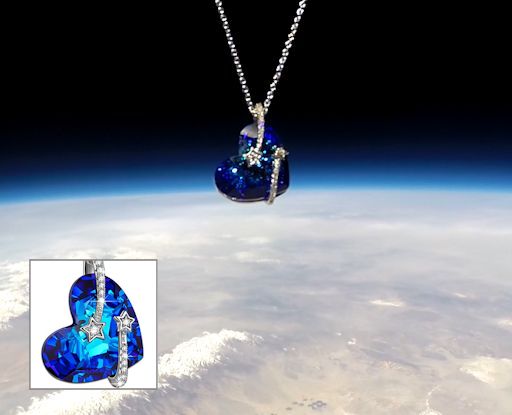
This pendant and others like it have touched the edge of space. We fly them to the stratosphere alongside our cosmic ray sensors for fundraising.
You can have one for $179.95. With a sterling silver backface that says "I Love You to the Moon and Back," these blue jewels make great anniversary, Christmas and birthday gifts. All sales support the Earth to Sky Calculus cosmic ray ballooning program and hands-on STEM research.
Far Out Gifts: Earth to Sky Store
All sales support hands-on STEM education