GEOMAGNETIC STORM WATCH: G1-class geomagnetic storms are possible on Oct. 24-25 when a stream of solar wind hits Earth's magnetic field. The gaseous material is flowing ~700 km/s from a large hole in the sun's atmosphere. Auroras could descend into northern-tier US states from Maine to Washington. Aurora alerts: SMS Text.


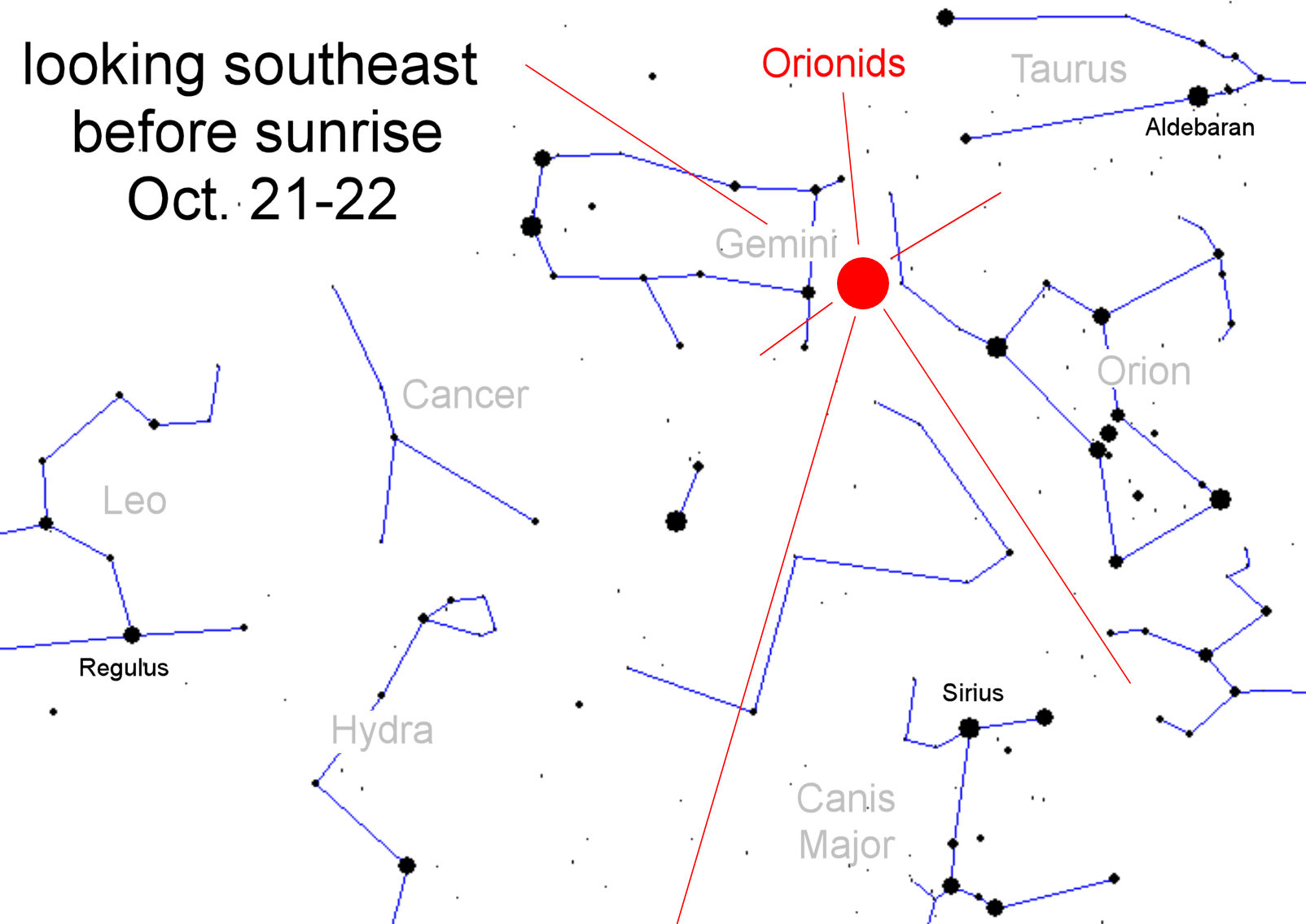
THE ORIONIDS ARE COMING! Imagine waking up before sunrise on a brisk fall morning. The bright stars of Orion twinkle overhead. Flash! A fireball streaks across the sky, its smokey trail twisting in the wind as you sip your coffee. If this sounds like heaven, set your alarm before dawn on Oct. 22nd to catch the peak of the Orionid meteor shower.
Above: Ian Webster created this interactive visualization of Halley's debris stream cutting across Earth's orbit.
Orionid meteors come from Halley's Comet. Every year around this time, Earth passes through a stream of debris from Halley, and meteors fly out of the constellation Orion. Forecasters expect the 2019 Orionids to peak on Tuesday, Oct. 22nd, with as many as 20 meteors per hour. The best time to look is during the hours before local sunrise when Orion the Hunter is high in the sky.
Some other showers produce more shooting stars, but the Orionids are second to none in beauty. They strike Earth's atmosphere traveling 66 km/s or 148,000 mph. Only the Leonids of November are faster at 72 km/s. Orionids often leave glowing "trains" (incandescent bits of debris in the wake of the meteor) that last for minutes, swirling among the glittering stars of Orion, Gemini, and Taurus.
Wake up early and enjoy the show. More: photo gallery, sky map.
Realtime Spaceweather Photo Gallery
Free: Spaceweather.com Newsletter
INTRODUCING THE CORONACAM: All auroras are beautiful, but there is one type of aurora that is more beautiful than the rest: The "corona." Coronas are auroras that seem to rain down from directly overhead. They make you feel wrapped up, dipped in, literally surrounded by Northern Lights.

A corona photographed by Lights over Lapland tour guide Oliver Wright in Abisko, Sweden
Catching coronas in action can be tricky. Soon, though, you'll be seeing more of them. The tour guides at Lights over Lapland are building a "coronacam"--a camera that points straight up, 24/7, throughout the long Arctic night. When coronas appear over Abisko, Sweden, the coronacam will catch them.
"We are really enjoying working on the new webcam," says Chad Blakley of Lights over Lapland. "Designing a camera system that points nearly straight up in the Arctic is not easy, though. For example, we must think of creative ways to keep the lens warm and properly irrigated. Any condensed moisture must drain away from the lens rather than pooling directly on top."

"Also, properly exposing a portion of the sky with no light source other than stars for reference has been a real challenge," says Blakley. "We have found that the settings developed for our original horizon-pointing webcam do not necessarily work with the new system – but we are making progress every day and hope to broadcast the first images from the coronacam soon. With a bit of luck we will be up and running for the next solar wind stream."
Once the coronacam is complete, we plan to feature its images with a live feed on Spaceweather.com. Stay tuned!
Realtime Aurora Photo Gallery
Free: Spaceweather.com Newsletter
HOUSTON ASTROS IN THE STRATOSPHERE: The Astros are in the World Series. Now they're in the stratosphere, too. The students of Earth to Sky Calculus launched this Houston Astros baseball 113,845 feet above Earth's surface using a high-altitude cosmic ray balloon:
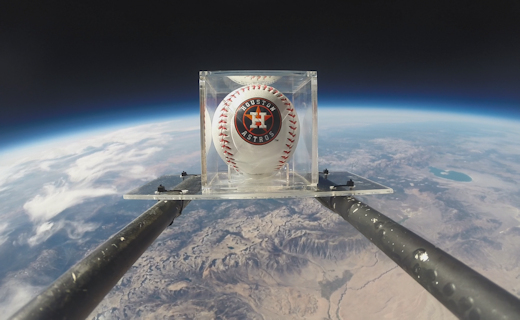
You can have it for $99.95. The students are selling space baseballs to support their cosmic ray ballooning program. Not an Astros fan? No problem. You can also purchase space baseballs for the Yankees, Red Sox, Dodgers, Cubs, Cardinals, Angels, Padres, Giants or--coming soon!--the Nationals!
Each baseball comes with a greeting card showing the ball in flight and telling the story of its journey to the stratosphere. Plus, you'll receive a UV-resistant cubical display case with decorating stickers depicting the ball at the edge of space.
Far Out Gifts: Earth to Sky Store
All sales support hands-on STEM education