DEEP SOLAR MINIMUM: Last year, the sun was blank (without sunspots) for 221 days. That marked 2018 as a year of deep Solar Minimum. This year is shaping up to be even deeper. As of today, the sun in 2019 also has been blank for 221 days--and it's only October. 2019 is blowing past 2018 in the race to the bottom of the solar cycle, and by the end of the year could rank as the deepest Solar Minimum in a century.
SOLAR WIND SPARKS AURORAS IN THE USA: During the night of Oct. 24-25, geomagnetic activity increased to category G2--that is, moderately strong--as Earth moved deeper into a fast-moving stream of solar wind. At the peak of the G2-storm, auroras spilled across the US-Canadian border into Minnesota:

"Last night the Northern Lights made an appearance in northeast Minnesota," reports photographer Travis Novitsky."The air temperature was 19 degrees as I was sitting in the Superior National Forest watching the lights slowly weave their way across the northern sky."
The solar wind is flowing from a large hole in the sun's atmosphere, with speeds currently topping 600 km/s. Forecasters expect our planet to remain inside the gaseous stream for at least 24 more hours. Northern sky watchers should remain alert for auroras through Oct. 26th.

Realtime Aurora Photo Gallery
Free: Spaceweather.com Newsletter
THE SUNFLOWER SPACE PENDANT: Are you looking for a far-out gift? Consider the sunflower space pendant. On Oct. 18, 2019, the students of Earth to Sky Calculus launched a cosmic ray balloon to the stratosphere. This cheerful pendant went along for the ride, 109,923 feet high:
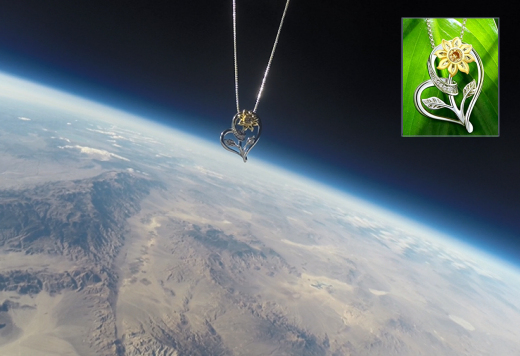
You can have it for $109.92 (its altitude divided by 1000). The students are selling these pendants to support their cosmic ray ballooning program. Each rose gold-plated pendant comes with a greeting card showing the flower in flight and telling the story of its journey to the edge of space and back again. They make great birthday, anniversary and Christmas gifts.
Far Out Gifts: Earth to Sky Store
All sales support hands-on STEM education
A GREEN FLASH IN HAWAII: There was a time when green flashes were thought to be fables, but now we know they are real. On rare occasions, when the sun sets into the waves of a sun-warmed sea, the solar disk disappears with a little luminous *pop* of green light. Benji Barnes saw it himself on Oct. 19th from a beach in Honolulu, Hawaii:

"I've been trying for a long time to capture a good green flash--and this was it!" says Barnes. "It was a bright one."
The Pacific is a great place to find green flashes. Temperature gradients in the air above the sea surface magnify tiny differences in the atmospheric refraction of red and green light, creating a verdant mirage.
Little more than a century ago, many people would've scoffed at Barnes's report. The green flash was "fiction." Ironically, it took one of the greatest fiction writers in history to popularize the green flash as a real phenomenon. In 1882, many people read Jules Verne's novel, "Le Rayon Vert" (The Green Ray), a romance about lovers trying to observe a green flash in Scotland. Among Verne's large audience, disbelief was thereafter suspended--and now people report "Le Rayon Vert" all the time.
Realtime Green Flash Photo Gallery
Free: Spaceweather.com Newsletter