WEAK CME IMPACT TODAY? A faint slow-moving CME that left the sun on Oct. 26th might hit Earth's magnetic field on Oct. 29th or 30th, according to NOAA forecasters. The impact, if any, would be weak, probably causing polar geomagnetic unrest but not full-fledged storms. Aurora alerts: SMS Text.
CLOSE ENCOUNTER WITH A GIGANTIC JET: When you see lightning, run! That’s what NOAA advises in lightning safety brochures. On Oct. 15th, however, pilot Chris Holmes had no place to go when lightning started to crackle in thunderstorms around his aircraft.
"I was flying 35,000 feet over the Gulf of Mexico near the Yucatan Peninsula when a super cell started pulsing with light," he says. "It wasn't just ordinary lightning, though. The cell was creating lots of sprites and jets leaping up from the thunderhead." At a distance of only 35 miles, he video-recorded this:
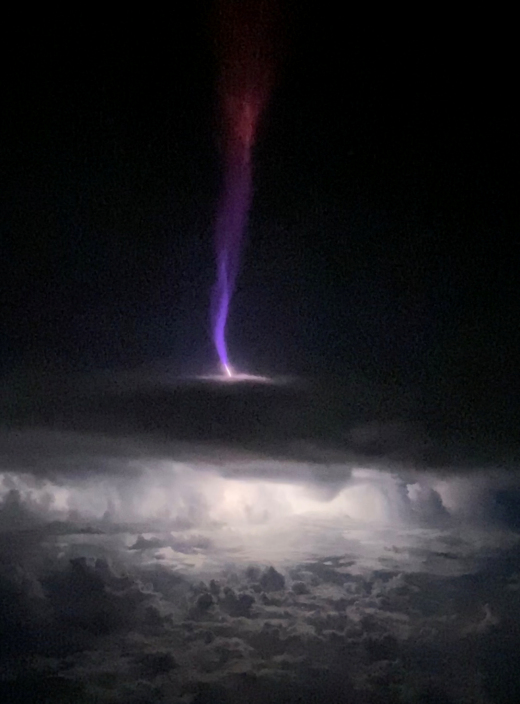
"It was the most amazing thing I've seen in my aviation career," he says.
Holmes had a close encounter with a Gigantic Jet. Sometimes called "Earth’s tallest lightning," because they reach all the way to the ionosphere ~50 miles high, the towering forms were discovered near Taiwan and Puerto Rico in 2001-2002. Since then, only dozens of Gigantic Jets have been photographed. In previous images taken by cameras on the ground, it's almost always impossible to see the base of the jet over the edge of the thundercloud. That’s why Holmes’s video is special. He was filming above the storm at practically point-blank range.
"His clip shows very nicely the top of the cloud where the jet emerges, which is usually hidden from view," says Oscar van der Velde of the Lightning Research Group at the Universitat Politècnica de Catalunya who examined the footage. "I split the video into individual frames so we can see exactly what happens."
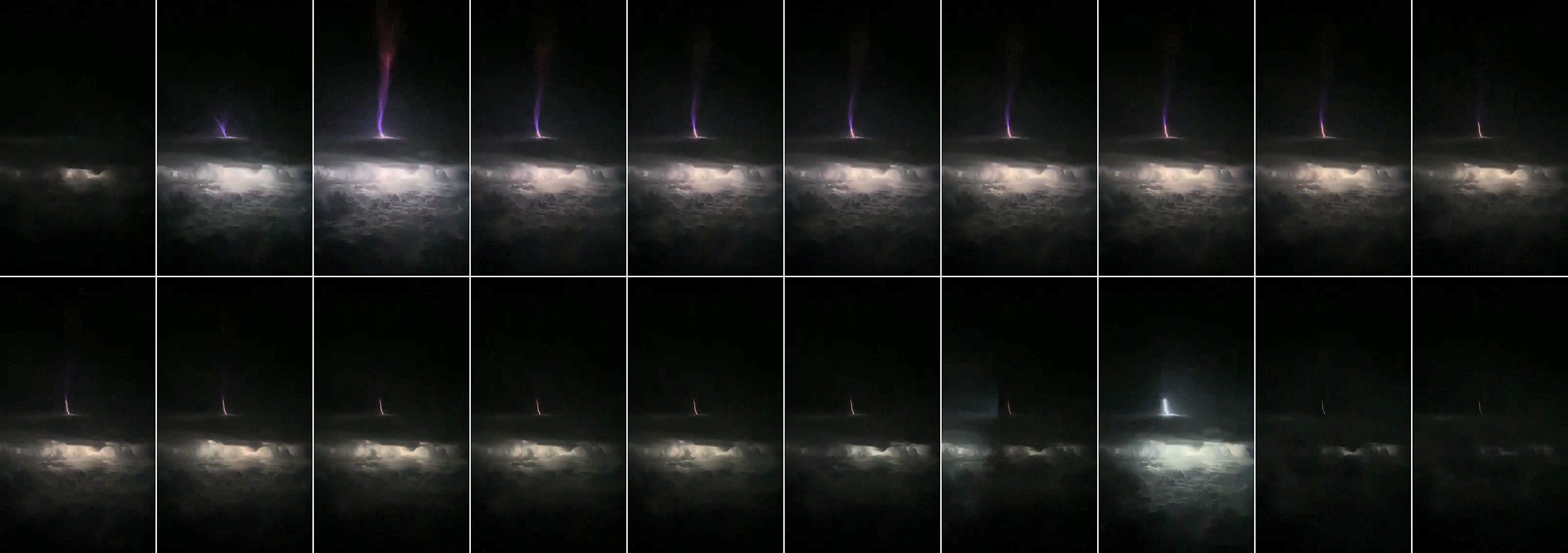
Van der Velde’s deconstruction reveals the order of events: “First, relatively cool blue filaments spring up. These are streamers akin to Saint Elmo’s Fire,” he explains. “Next, after the Jet reaches its maximum height, another feature crawls more slowly out of the cloudtop–a white-hot ‘lightning leader.'”
Turns out, this is a bit of a surprise. For years, some researchers thought that Gigantic Jets could reach such extreme heights only if their streamers got a boost from the lightning leader. Holmes’s video shows just the opposite: The Gigantic Jet reaches the ionosphere before the lightning leader even leaves the cloud.
“This suggests that there may be a much more powerful electric configuration inside the thunderstorm than was previously thought–perhaps as much as 200 million volts," says van der Velde.
It just goes to show, we still have a lot to learn about Gigantic Jets. A sharable version of this story is available here.
Realtime Sprite Photo Gallery
Free: Spaceweather.com Newsletter
THE TAIL OF INTERSTELLAR COMET BORISOV: Interstellar comet 2I/Borisov is coming closer to Earth, giving astronomers a better view of its growing tail. Michael Jäger of Weißenkirchen, Austria took his best picture yet on Oct. 26th, with the tadpole-like comet racing past brilliant Regulus, a strangely-shaped internal lens reflection of Regulus, and multiple satellites:

"I created this image by stacking 38 one hundred second exposures from an 8-inch telescope," says Jäger. "Such long exposure times are required to see this very faint comet."
Jäger says the comet's tail is about 5 arc minutes long. That means it stretches ~540,000 km--more than the distance from Earth to the Moon and almost four times the width of the planet Jupiter. We will get an even better view in the months ahead as the distance to the comet shrinks from 2.5 AU now to 1.9 AU in late December. Stay tuned.
Realtime Comet Photo Gallery
Free: Spaceweather.com Newsletter
THE SUNFLOWER SPACE PENDANT: Are you looking for a far-out gift? Consider the sunflower space pendant. On Oct. 18, 2019, the students of Earth to Sky Calculus launched a cosmic ray balloon to the stratosphere. This cheerful pendant went along for the ride, 109,923 feet high:
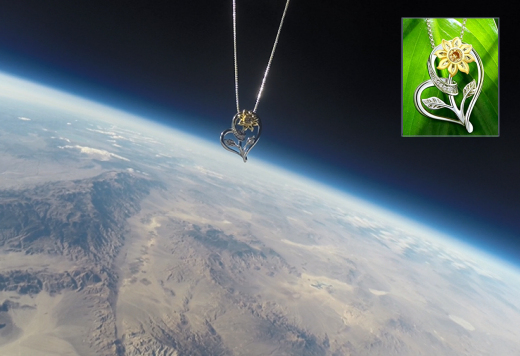
You can have it for $109.92 (its altitude divided by 1000). The students are selling these pendants to support their cosmic ray ballooning program. Each rose gold-plated pendant comes with a greeting card showing the flower in flight and telling the story of its journey to the edge of space and back again. They make great birthday, anniversary and Christmas gifts.
Far Out Gifts: Earth to Sky Store
All sales support hands-on STEM education
Realtime Spaceweather Photo Gallery
Free: Spaceweather.com Newsletter