NO CME? NO PROBLEM: A slow-moving CME that was expected to hit Earth's magnetic field on Oct. 29th has either missed, been delayed, or its impact was too feeble to notice. No CME? No problem. Arctic sky watchers may still see auroras tonight and tomorrow as Earth enters a stream of solar wind flowing from a southern hole in the sun's atmosphere. Aurora alerts: SMS Text.

SPACE PUMPKIN SETS HIGH ALTITUDE RECORD: Every year around Halloween, something spooky happens to the Spaceweather.com/Earth to Sky Calculus cosmic ray ballooning program. It turns into a pumpkin! Launched by students on Oct. 18th, this year's Jack O'Lantern soared 109,908 feet above Earth, breaking the previous high-altitude mark for space pumpkins (set by us in 2017) by more than 2600 feet.

We do this every October. Why? Because it stretches our skills as balloonists. Using a giant orange squash as a payload instead of our usual insulated capsule challenges us to invent ways to keep electronics warm, to mount the cosmic ray sensors, to GPS-track the flight. And it's so much fun!
We have been launching cosmic ray balloons from the Sierra Nevada mountains of California almost once a week since 2015, gathering a unique record of radiation in Earth's atmosphere. Since the launches began, atmospheric radiation has increased almost 20%--a counterintuitive side-effect of Solar Minimum.
Stay tuned for radiation data collected during this flight and an edited video with soundtrack.
Realtime Spaceweather Photo Gallery
Free: Spaceweather.com Newsletter
VENUS-MOON CONJUNCTION: Yesterday at sunset, the whisper-thin crescent Moon passed by Venus in the western sky. Mohammed Alasfoor photographed the conjunction from Bahrain:

"These two bright heavenly bodies were beautiful to see as they set behind the Rashid Alzayyani mosque in Galali," he says.
Observers around the world from China to Arizona and beyond saw the conjunction. Did you miss it? An even better display is coming next month on Nov. 28th when Venus and the Moon meet again--with Jupiter joining the conjunction as well. Mark your calendar and enjoy the show!

THE SHOOTING STAR PENDANT: It's simple. It's elegant. And it's been to the edge of space. On Sept. 27th, the students of Earth to Sky Calculus launched a cosmic ray balloon to the stratosphere. This stainless steel "shooting star" pendant hitched a ride, all the way to 108,245 feet:
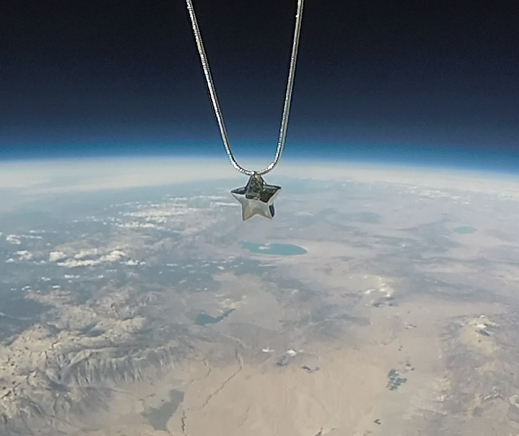
You can have it for $89.95. The students are selling shooting star pendants to support their cosmic ray ballooning program. Each one comes with greeting card showing the item in flight and telling the story of its journey to the edge of space and back again. These make great birthday and Christmas gifts.
Bonus: The star contains a hidden chamber, which you may fill with the ashes of a loved one or anything else you wish to keep close to your heart.

Far Out Gifts: Earth to Sky Store
All sales support hands-on STEM education