SOLAR WIND GRAZES EARTH: A stream of solar wind flowing from a southern hole in the sun's atmosphere is grazing Earth's magnetic field today. This is causing geomagnetic unrest and auroras around the Arctic Circle. The stream is too weak to spark a full-fledged geomagnetic storm, so auroras will be confined to the Arctic. Aurora alerts: SMS Text

A SUNSPOT FROM THE NEXT SOLAR CYCLE: Breaking a string of 28 spotless days, a new sunspot is emerging in the sun's southern hemisphere--and it's a member of the next solar cycle. A picture of the sunspot is inset in this magnetic map of the sun’s surface from NASA’s Solar Dynamics Observatory:

How do we know this sunspot belongs to the next solar cycle? Its magnetic polarity tells us so. Southern sunspots from old Solar Cycle 24 have a -/+ polarity. This sunspot is the opposite: +/-. According to Hale’s Law, sunspots switch polarities from one solar cycle to the next. Today's emerging sunspot is therefore a member of Solar Cycle 25.
This development does not mean Solar Minimum is finished. On the contrary, low solar activity will probably continue for at least another year as Solar Cycle 24 decays and Solar Cycle 25 slowly sputters to life. If forecasters are correct, Solar Cycle 25 sunspots will eventually dominate the solar disk, bringing a new Solar Maximum as early as 2023.
Realtime Spaceweather Photo Gallery
Free: Spaceweather.com Newsletter
A TAURID FIREBALL WITH AURORAS: Photographer and aurora tour guide Oliver Wright couldn't go trick or treating last night. "I experienced some Halloween magic anyway," he says. "I was guiding a group of hikers from Portugal and had just set up my camera near an old sauna in Abisko, Sweden, when --woosh!-- the biggest shooting star I've seen this season flew through the sky."

"It was one of those huge shooting stars where you see little bits disintegrating into the sky--one lucky magic shot!" he says.
This was a Taurid fireball. Every year in late October and early November, Earth passes through a river of debris associated with Comet Encke. Gravelly meteoroids hit our atmosphere at 65,000 mph, producing a slow spray of fireballs from the constellation Taurus. Indeed, that's exactly where Wright's meteor came from.
Taurids are also called "the Halloween fireballs" because they are often noticed by people outdoors after dark on Halloween. In fact, they may be seen at any time from mid October to early November. Typically, Taurid meteor rates are no more than a few per hour, but just one fireball is enough for a magic night.
Realtime Aurora Photo Gallery
Free: Spaceweather.com Newsletter
THE ANTARES PENDANT: Are you looking for a far-out gift? Consider the Antares Pendant. On Aug. 19, 2019, the students of Earth to Sky Calculus launched a cosmic ray balloon to the edge of space, 104,002 ft high. This ruby-red crystal necklace went along for the ride:
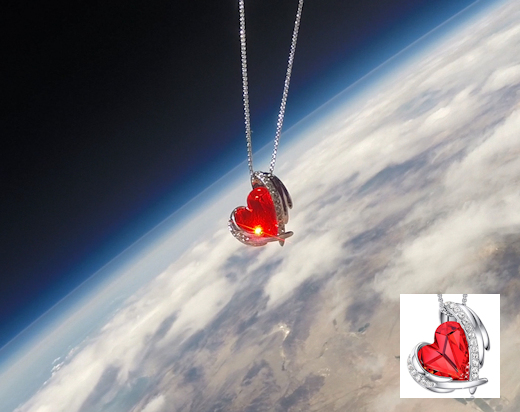
You can have it for $179.95. The students are selling these white gold-plated pendants to support their cosmic ray ballooning program. The glittering Swarovski crystal has a deep ruby hue inspired by the red-supergiant star Antares in Scorpio. Each one comes with greeting card showing the pendant in flight and telling the story of its journey to the edge of space and back again.
Far Out Gifts: Earth to Sky Store
All sales support hands-on STEM education