ALL QUIET ALERT: Solar activity is very low as the solar cycle continues its dip into the nadir of a deep Solar Minimum. There's not even a solar wind stream on the horizon. The next significant gust of solar wind is not expected for at least a week. Stay tuned for quiet. Aurora Alerts: SMS Text.
LOW SOLAR ACTIVITY REVEALS RED AURORAS: Chris Hodgson has seen a lot of green auroras over Abisko, Sweden. He's an aurora tour guide and has taken hundreds of photos of green skies inside the Arctic Circle. Last night, however, was a little different. The green was topped with red:

"It's very rare for us to see red here," says Hodgson. "It persisted for about 10 minutes."
Where did the red come from? The answer, ironically, may be low solar activity.
Abisko is located beneath Earth's persistent auroral oval. A gentle rain of solar wind electrons guided to Earth by our planet's curved magnetic field creates a polar ring of Northern Lights that intersects the latitude of Abisko. The auroral oval glows on most nights--no geomagnetic storm required.
Here's the thing about the auroral oval: It's green on the bottom, and red on the top. (Green is the color of molecular oxygen; red is the color of atomic oxygen.) When the auroral oval shrinks during periods of low solar activity, it's easier for the residents of Abisko to see over the top--that is, to see the red.
Bonus: "We also saw quite a few shooting stars," says Hodgson. This is partly a result of the Taurid meteor shower, which is producing fireballs in Arctic skies.
Realtime Aurora Photo Gallery
Free: Spaceweather.com Newsletter
A TRIPLE CONJUNCTION IN THE SUNSET SKY: On Oct. 31st, the crescent Moon passed by Jupiter, creating a beautiful Halloween conjunction in the evening sky over Europe. Most people noticed only the Moon and Jupiter. Peter Rosén of Stockholm, Sweden, noticed a third member of the conjunction: Ganymede.

"Ganymede is visible to the left of Jupiter," says Rosén. "Coincidentally the 3 other Galilean satellites were in an extremely rare triple transit in front of Jupiter's disc. Otherwise they would have been visible, too."
Ganymede is a worthy addition to any conjunction. The giant moon of Jupiter is actually larger than the planet Mercury, and would dwarf our own Moon if the two were placed side by side. Did you miss the show? The Moon and Jupiter (and Ganymede) will meet up again on Nov. 28th. Mark your calendar! [sky map]

Realtime Spaceweather Photo Gallery
Free: Spaceweather.com Newsletter
THE ANTARES PENDANT: Are you looking for a far-out gift? Consider the Antares Pendant. On Aug. 19, 2019, the students of Earth to Sky Calculus launched a cosmic ray balloon to the edge of space, 104,002 ft high. This ruby-red crystal necklace went along for the ride:
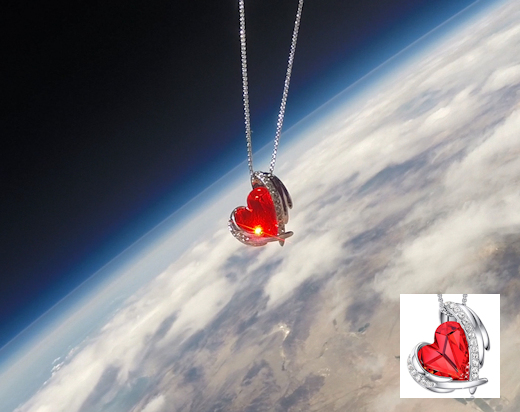
You can have it for $179.95. The students are selling these white gold-plated pendants to support their cosmic ray ballooning program. The glittering Swarovski crystal has a deep ruby hue inspired by the red-supergiant star Antares in Scorpio. Each one comes with greeting card showing the pendant in flight and telling the story of its journey to the edge of space and back again.
Far Out Gifts: Earth to Sky Store
All sales support hands-on STEM education