ALL QUIET ALERT: Solar activity is very low as the solar cycle continues its dip into the nadir of a deep Solar Minimum. There's not even a solar wind stream on the horizon. The next significant gust of solar wind is not expected for at least a week. Stay tuned for quiet. Aurora Alerts: SMS Text.
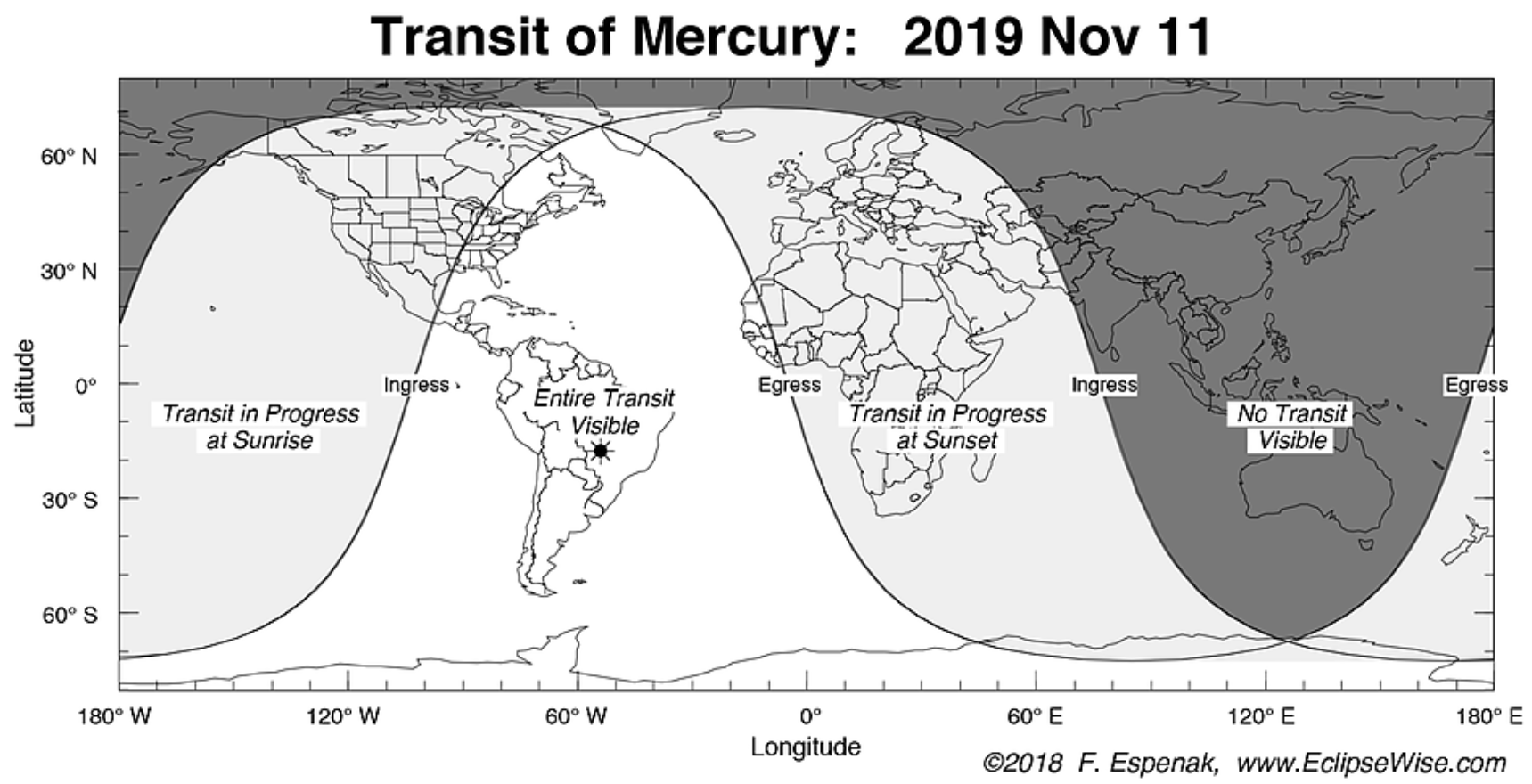
JUST ONE WEEK UNTIL THE TRANSIT OF MERCURY: One of the biggest astronomy events of the year is just one week away: The Transit on Mercury. On Monday, Nov 11th, Mercury will pass directly in front the sun. The rare transit begins at 12:35 UT (7:35 am EST) and lasts for almost six hours. Mercury's tiny form—jet black and perfectly round—will glide slowly across the solar disk, like this:

Credit: Tom Polakis of Tempe AZ made this movie of a previous Mercury transit on May 9, 2016. [more]
People in every continent except Australia can see at least a portion of the crossing. In the USA, the best place to be is on the Atlantic coast, where the entire transit will be visible. On the Pacific coast the transit will already be in progress at sunrise.
Warning! Do not stare at the sun during the transit. Mercury covers only a tiny fraction of the solar disk, so the sun remains as bright as ever. Eye damage can occur.
Ordinary eclipse glasses will keep your eyes safe, but they won't do much to help you see tiny Mercury. The planet is only 1/194th of the sun's apparent diameter. To watch this event, a safely-filtered telescope with a magnification of 50x or more is recommended. Don't have a filter? No problem. Images of the transit may be easily projected onto a wall or screen through an unfiltered telescope. Just do not look through the eye piece!
Nothing beats a telescope equipped with an H-alpha filter. H-alpha filters are narrowly tuned to the red glow of solar hydrogen. They reveal the sun as a boiling inferno cross-crossed by dark seething magnetic filaments. On Nov. 11th, the tiny form of Mercury will navigate this starscape. Here's a sample H-alpha image taken during the last transit of Mercury on May 9, 2016:
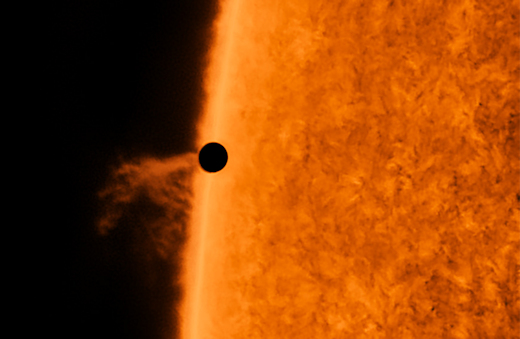
Paul Andrew took the picture from his backyard observatory in St. Margarets at Cliffe, Dover, UK. "The background prominence made Mercury look like it had a comet's tail," he says. More images may be found here and here.
Transits of Mercury occur only 13 times each century. The next one won't occur until Nov. 13, 2032. Don't miss this unusual event!
Realtime Spaceweather Photo Gallery
Free: Spaceweather.com Newsletter
DARTH VADER VISITS THE STRATOSPHERE: Impressive. Most impressive. On Nov. 2nd, the students of Earth to Sky Calculus launched a cosmic ray balloon to the stratosphere. Darth Vader went along for the ride, floating 109,580 feet above the rugged Sierra Nevada mountains of central California:

You can have him for $97.95. The students are selling Vader to support their cosmic ray ballooning program. This 5-inch tall blown glass ornament will look great on your holiday tree. It comes with a greeting card showing the Sith Lord in flight and telling the story of his journey to the edge of space and back again.
Far Out Gifts: Earth to Sky Store
All sales support hands-on STEM education
LOW SOLAR ACTIVITY REVEALS RED AURORAS: For the past two nights, geomagnetic activity has been very low. With no sunspots, no solar flares, and no significant streams of solar wind to disturb our planet's magnetic field, the forecast called for no auroras. Yet, auroras appeared anyway--"and they were crazy red," reports Markus Varik of Tromsø, Norway:

"On Saturday night, Abisko got all red. Sunday was our turn," says Varik. "It was great to see these rare red auroras from our own backyard."
Where did the red come from? The answer, ironically, may be low solar activity.
Varik's backyard is located beneath Earth's persistent auroral oval. A gentle rain of solar wind electrons guided to Earth by our planet's curved magnetic field creates a polar ring of Northern Lights that intersects the latitude of Tromsø. The auroral oval doesn't need a solar storm. It just glows.
Here's the thing about the auroral oval. It's green on the bottom and red on top. (Green is the color of molecular oxygen; red is the color of atomic oxygen.) When the auroral oval contracts during periods of low solar activity, residents of Tromsø can see over the top--that is, they see red.
"Those electrons cooked up something really nice," says Varik--no sunspots required.
Realtime Aurora Photo Gallery
Free: Spaceweather.com Newsletter