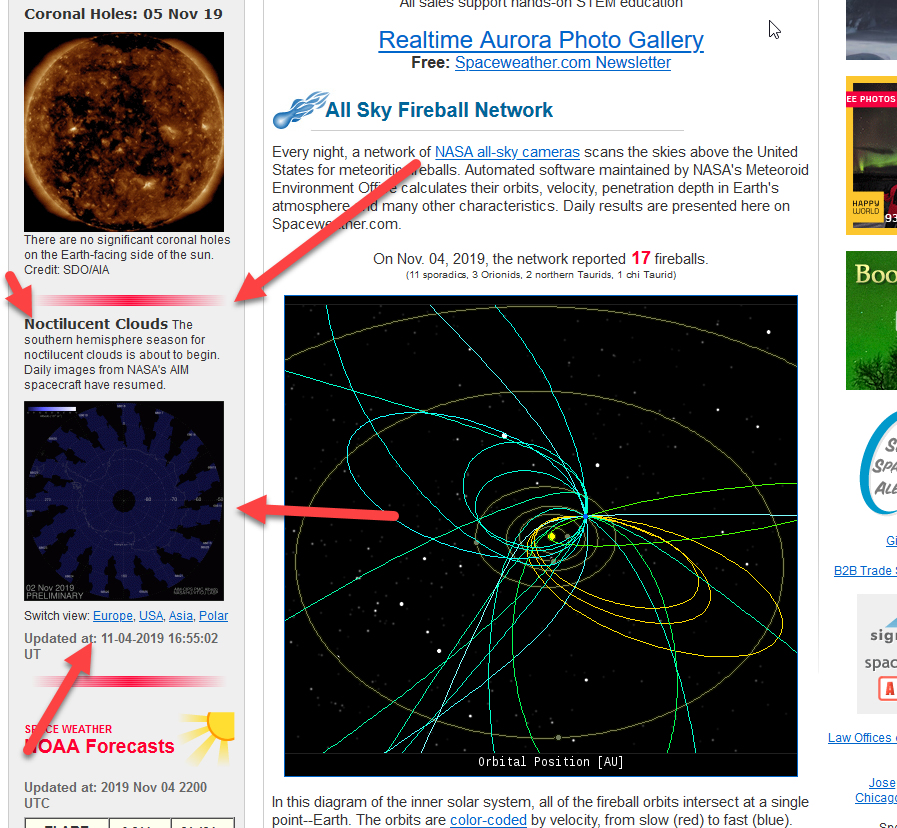
NOCTILUCENT CLOUDS AROUND THE SOUTH POLE: NASA's AIM spacecraft is monitoring the atmosphere above Antarctica. High-altitude weather patterns there are beginning to favor the formation of noctilucent clouds. The electric-blue clouds have not yet appeared, but they could be just days away. Monitor the latest satellite images right here on Spaceweather.com. Aurora Alerts: SMS Text.
PULSATING AURORAS: Living inside the Arctic Circle for a complete 11-year solar cycle, Chad Blakely of Abisko, Sweden, has seen every kind of aurora the sun has to offer. Just before daybreak, on Monday, Nov. 5th, he spotted his favorite: The pulsating aurora. "It wasn't very bright--but it was absolutely amazing," says Blakley. This still image captures one of the pulses:
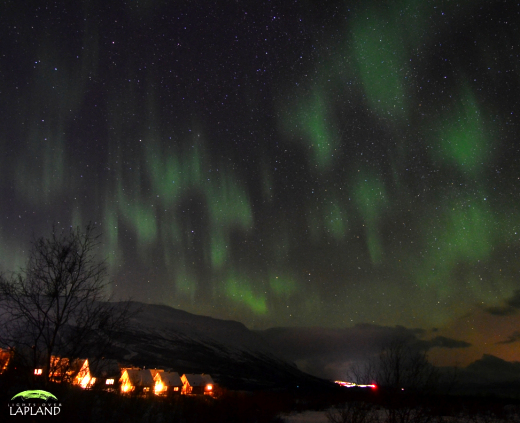
"The best way to describe a pulsating aurora is to imagine the sky as a large checker board," says Blakley. "As the pulsating begins, the black squares on the board would illuminate as a green aurora. Then, in an instant, all the black squares lose their illumination and the red squares on the imaginary checkerboard immediately glow green. I remember seeing lots of these pulsating auroras at the bottom of the last Solar Minimum, and I was always fascinated by the phenomenon," he says.
Pulsating auroras are nothing new. Arctic people have been watching them for hundreds of years. But researchers have only recently figured out what causes them. In the Feb. 14, 2018, issue of Nature, a team led by S. Kasahara of the University of Tokyo conclusively linked pulsating auroras to "chorus waves" in Earth's magnetic field. Chorus waves are electromagnetic oscillations that sound heavenly when played through the loudspeaker of a low frequency radio. Using ground-based cameras and NASA spacecraft, Kasahara's team showed that chorus waves can modulate electrons raining down from space onto Earth's upper atmosphere, causing auroras to blink, pulse and strobe.
"It is one of nature’s greatest light shows," says Blakley, and he should know.
Realtime Aurora Photo Gallery
Free: Spaceweather.com Newslette
THE STRATOSPHERIC CLOUD PENDANT: The most beautiful clouds on Earth are located in the stratosphere: Polar Stratospheric Clouds. Their extraordinary colors inspired this authentic Swarovski pendant--and it has been to the stratosphere! On Nov. 2, 2019, it hitched a ride 109,580 feet high on board an Earth to Sky Calculus cosmic ray balloon:
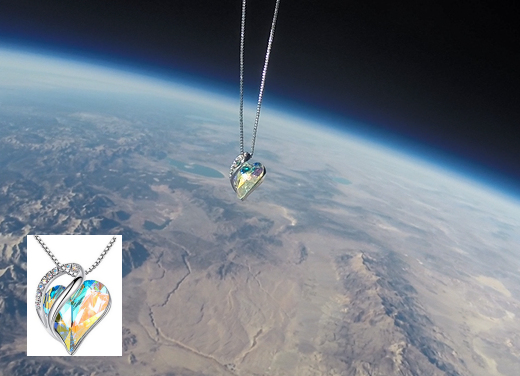
You can have it for $159.95. The students are selling Stratospheric Cloud Pendants to support their cosmic ray ballooning program. Each heart-shaped pendant comes with a card showing it floating through the stratosphere like a real cloud, and telling the story of its journey to the edge of space and back again.
Far Out Gifts: Earth to Sky Store
All sales support hands-on STEM education
TAURID FIREBALLS: This week, Earth is passing through a stream of debris from Comet Encke, source of the annual Taurid meteor shower. Gravel-sized meteoroids are hitting Earth's upper atmosphere at 65,000 mph, creating a slow drizzle of fireballs emerging from the constellation Taurus. Yuichi Takasaka saw one on Nov. 5th over Silver Star Mountain in Vernon, British Columbia:
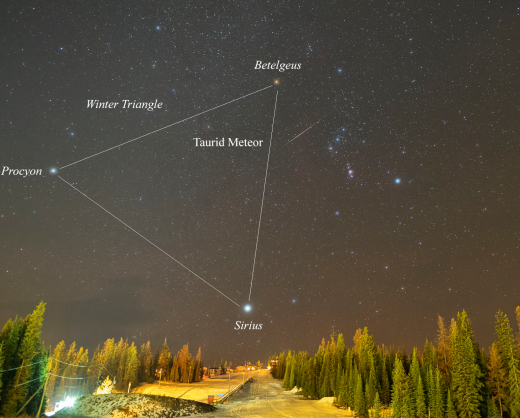
"We saw not only meteors, but also smokey wisps of debris that swirled in the atmosphere for as much as 10 minutes," says Takasaka.
Taurids are also called "the Halloween fireballs" because they are most often noticed by crowds outdoors after dark on Halloween. In fact, they may be seen on any night from mid-October to mid-November. The best time to look is during hours around midnight when Taurus is high in the sky. Typical meteor rates are no more than a few per hour, but sometimes just one fireball is enough...
rRealtime Spaceweather Photo Gallery
Free: Spaceweather.com Newsletter