SOLAR WIND, INCOMING: A new hole is opening in the sun's atmosphere, and it is spewing a stream of solar wind toward Earth. Estimated time of arrival: Nov. 10-11. Arctic sky watchers should be alert for extra-bright auroras on those dates. Aurora Alerts: SMS Text.

SIGNS OF LIFE FROM SOLAR CYCLE 25: Big things have small beginnings. Years from now, observers may look back from the perch of a new Solar Maximum and realize that the action began on Nov. 5, 2019, with a very small solar flare. NASA's Solar Dynamics Observatory recorded the blast:

This is a B1-class solar flare--that is, relatively small, ~1000 times weaker than the intense X-flares of Solar Maximum. It is significant not because of its intensity, but rather because of its origin. It came from AR2750, an active region belonging to the next solar cycle.
Sunspot AR2750 first appeared in the sun's southern hemisphere on Nov. 1st, breaking a string of 28 spotless days. A picture of the emerging sunspot is inset in this magnetic map of the sun's surface from the Solar Dynamics Observatory:

How do we know AR2750 belongs to the next solar cycle? Its magnetic polarity tells us so. Southern sunspots from old Solar Cycle 24 have a -/+ polarity. This sunspot is the opposite: +/-. According to Hale's Law, sunspots switch polarities from one solar cycle to the next. AR2750 is therefore a member of new Solar Cycle 25.
Solar cycles always mix at their boundaries. So far this year, short-lived sunspots likely belonging to Solar Cycle 25 have been reported on May 28, July 1st, July 8th, and Nov. 1st. They were interspersed with a similar number of old Solar Cycle 24 spots. This type of mixing is normal.
The increasing frequency of new cycle sunspots does not mean Solar Minimum is finished. On the contrary, low solar activity will probably continue for at least another year. However, it does mean that new Solar Cycle 25 is slowly sputtering to life--a process that will accelerate in the years ahead. If forecasters are correct, Solar Cycle 25 sunspots will eventually dominate the solar disk, bringing a new Solar Maximum as early as 2023.
Realtime Aurora Photo Gallery
Free: Spaceweather.com Newsletter
A TAURID EXPLODES OVER AUSTRALIA: When the sun set over Swan Hill, Australia, on Nov. 6th, at first the sky began to darken as usual. And then ... it exploded. "I witnessed an incredible twilight fireball just as I just arrived home from work at 8:08 pm AEDT (9:08 UT) 7 minutes after local sunset," reports Michael Mattiazzo. "The fireball's magnitude was at least -8, closer to -10, and multiple outbursts were observed before it completely disintegrated."

"The sonic boom arrived about 3 minutes later, sounding like the rumble of thunder," he adds. "Local dogs were even barking at the sound. The vapour trail (pictured above) lasted about 25 minutes."
Mattiazzo says the fireball streaked from east to west across the sky. The direction marks it as a likely earthgrazing Taurid fireball.
This week, Earth is passing through a stream of debris from Comet Encke, source of the annual Taurid meteor shower. Gravel-sized meteoroids hitting Earth's upper atmosphere at 65,000 mph are creating a spray of bright meteors from the constellation Taurus.
Taurids are sometimes called "the Halloween fireballs" because they are most often noticed by crowds outdoors after dark on Halloween. In fact, they may be seen on any night from mid-October to mid-November. Typical Taurid meteor rates are no more than a few per hour but, sometimes, as Mattiazzo observed, one fireball is enough.
Realtime Spaceweather Photo Gallery
Free: Spaceweather.com Newsletter
THE STRATOSPHERIC CLOUD PENDANT: The most beautiful clouds on Earth are located in the stratosphere: Polar Stratospheric Clouds. Their extraordinary colors inspired this authentic Swarovski pendant--and it has been to the stratosphere! On Nov. 2, 2019, it hitched a ride 109,580 feet high on board an Earth to Sky Calculus cosmic ray balloon:
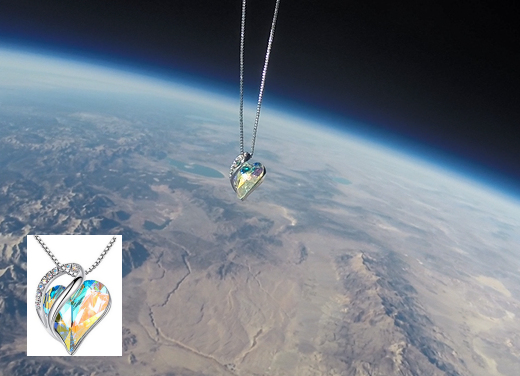
You can have it for $159.95. The students are selling Stratospheric Cloud Pendants to support their cosmic ray ballooning program. Each heart-shaped pendant comes with a card showing it floating through the stratosphere like a real cloud, and telling the story of its journey to the edge of space and back again.
Far Out Gifts: Earth to Sky Store
All sales support hands-on STEM education