GET READY FOR THE TRANSIT OF MERCURY:One of the biggest astronomy events of the year is only days away. On Monday, Nov 11th, Mercury will pass directly in front the sun. The rare transit begins at 12:35 UT (7:35 am EST) and lasts for almost six hours. Get ready: full story, video, photo gallery.
THE SCALE OF MERCURY: What will Monday's transit of Mercury look like? Marek Nikodem has the answer. He watched the previous transit of Mercury (May 9, 2016) from Kcynia, Poland, and photographed the event at sunset:

The black form of the first planet is tiny, indeed. (In case you're still looking, it's here.) Mercury is only 1/194th of the sun's apparent diameter. That's why looking at the sun through ordinary eclipse glasses doesn't work. You need magnification--50x or more is recommended.

A safe way to view a magnified image of the sun is the projection method. This illustration from the European Space Agency says it all:

Any telescope with a stabilizing tripod can be used to project an image of the sun onto a wall, screen or sidewalk. And if you don't look into the eyepiece, it's perfectly safe. Binoculars work, too, as long as you take the same precautions.
Or, just stare at your computer screen! Transit of Mercury webcasts: (1) Royal Observatory Greenwich, UK on Facebook; (2) Timeanddate.com from Stavanger, Norway; (3) Griffiths Observatory TV from Los Angeles
Realtime Spaceweather Photo Gallery
Free: Spaceweather.com Newsletter
THE STRATOSPHERIC CLOUD PENDANT: The most beautiful clouds on Earth are located in the stratosphere: Polar Stratospheric Clouds. Their extraordinary colors inspired this authentic Swarovski pendant--and it has been to the stratosphere! On Nov. 2, 2019, it hitched a ride 109,580 feet high on board an Earth to Sky Calculus cosmic ray balloon:
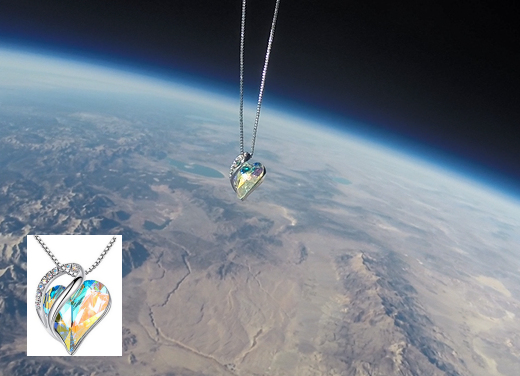
You can have it for $159.95. The students are selling Stratospheric Cloud Pendants to support their cosmic ray ballooning program. Each heart-shaped pendant comes with a card showing it floating through the stratosphere like a real cloud, and telling the story of its journey to the edge of space and back again.
Far Out Gifts: Earth to Sky Store
All sales support hands-on STEM education
SOLAR WIND, INCOMING: A new hole has opened in the sun's atmosphere, and it is spewing a stream of solar wind toward Earth. NASA's Solar Dynamics Observatory photographed the jagged chasm on Nov. 6th:

Gaseous material flowing from this hole is expected to arrive on Nov. 11th or possibly during the late hours of Nov. 10th. Geomagnetic storms are *not* expected when the solar wind reaches Earth, because it is probably a weak stream. Nevertheless, Arctic sky watchers should be alert for extra-bright auroras on Sunday and Monday nights. Aurora Alerts: SMS Text.
Realtime Aurora Photo Gallery
Free: Spaceweather.com Newsletter