ARCTIC AURORA WATCH: Earth is entering a stream of solar wind flowing from a new hole in the sun's atmosphere. The stream appears to be a weak one, so geomagnetic storms are not expected, but it is capable of producing auroras around the Arctic Circle. Stay tuned for Northern Lights mixed with full moonlight. Aurora alerts: SMS Text.

THE TRANSIT OF MERCURY: It won't happen again until 2032. Today, Nov. 11, 2019, Mercury passed directly in front of the sun. The tiny black silhouette of the first planet took nearly 6 hours to cross the otherwise blank solar disk, giving astronomers around the world plenty of time to photograph the transit. Maximilian Teodorescu sends this picture from Magurele, Romania:

"I spent hours photographing the transit through white-light and H-alpha filters," says Teodorescu. "This was my last picture of the day, unfiltered at sunset."
Got an image? Submit it here.
Transit of Mercury Photo Gallery
Free: Spaceweather.com Newsletter
THE STRATOSPHERIC CLOUD PENDANT: The most beautiful clouds on Earth are located in the stratosphere: Polar Stratospheric Clouds. Their extraordinary colors inspired this authentic Swarovski pendant--and it has been to the stratosphere! On Nov. 2, 2019, it hitched a ride 109,580 feet high on board an Earth to Sky Calculus cosmic ray balloon:
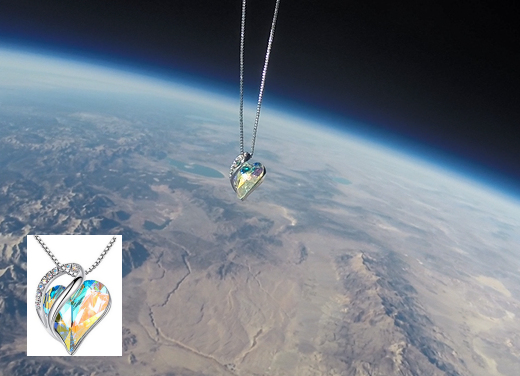
You can have it for $159.95. The students are selling Stratospheric Cloud Pendants to support their cosmic ray ballooning program. Each heart-shaped pendant comes with a card showing it floating through the stratosphere like a real cloud, and telling the story of its journey to the edge of space and back again.
Far Out Gifts: Earth to Sky Store
All sales support hands-on STEM education
THE *OTHER* PLANET NEAR THE SUN: We know where Mercury is today. Transiting the sun. But what about the other inner planet? Heiko Ulbricht spotted Venus last night from Lerchenberg Hill in Saxony, Germany:

"Venus's evening visibility is now clearly increasing," says Ulbricht. "I saw her after sunset on Nov. 10th, less than one day before the transit of her neighbor planet. Venus was clearly visible 2.9° above the southwest horizon."
The view will improve even more in the weeks ahead as Venus continues to separate from the sun, emerging from the glare into deepening evening twilight. This video from science artist Larry Koehn shows what to expect:
Realtime Spaceweather Photo Gallery
Free: Spaceweather.com Newsletter
Realtime Aurora Photo Gallery
Free: Spaceweather.com Newsletter