A NEW SUNSPOT EMERGES: A small new sunspot is emerging over the sun's southeastern limb. It is too soon to say whether it is a member of old Solar Cycle 24 or new Solar Cycle 25. We will know more in the next ~24 hours as the sunspot turns toward Earth, revealing the polarity of its magnetic field. Aurora alerts: SMS Text.

TRANSIT OF MERCURY--OUT OF THIS WORLD IMAGES: Millions of people on Earth witnessed the transit of Mercury yesterday when the tiny black form of the first planet crossed the face of the sun. The best views were out of this world--literally. More than 22,000 miles above Earth's surface, NASA's Solar Dynamics Observatory (SDO) recorded an incredible movie of the transit. Click to play it:

Having trouble playing this movie? An alternate version is available on Vimeo.
This movie is unlike any recorded on Earth. High above our planet's atmosphere, extreme ultraviolet telescopes onboard SDO were able to see Mercury making first contact with the sun's outer atmosphere, the corona. The wavelengths required to gain this view are blocked by air and only visible from space.
While SDO observed the transit from Earth orbit, another spacecraft joined the show in a different way. The Hubble Space Telescope transited the sun alongside Mercury. Thierry Legault captured the rare double transit from the Atacama Desert of Chile:

"I set up my telescope in Machuca (north of San Pedro de Atacama) 4000 m above sea level near a lagoon where flamingo colonies frolic," says Legault. "Hubble was flying at 26,500 km/h, and it crossed the disk of the sun in only 0.9 seconds--so timing was crucial."
In 2016, Legault photographed a simultaneous transit of Mercury and the International Space Station (ISS). "I decided to try something harder this time, something that had never been done," he says. "I did it despite a thick layer of high clouds causing a huge diffusion of sunlight and a sharp drop in contrast."
Astrophotographer Martin Wise captured his own out-of-this-world shot without leaving his home in Trenton, Florida:

"The silhouette of Mercury looked like a hole punched in the surface of the boiling sun," he says. "The resolution of this image is 0.3 arcseconds per pixel, high enough to see solar granulation."
Got an image? Submit it here.
Transit of Mercury Photo Gallery
Free: Spaceweather.com Newsletter
THE STRATOSPHERIC CLOUD PENDANT: The most beautiful clouds on Earth are located in the stratosphere: Polar Stratospheric Clouds. Their extraordinary colors inspired this authentic Swarovski pendant--and it has been to the stratosphere! On Nov. 2, 2019, it hitched a ride 109,580 feet high on board an Earth to Sky Calculus cosmic ray balloon:
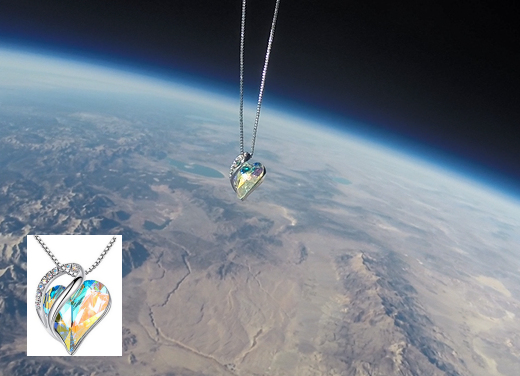
You can have it for $159.95. The students are selling Stratospheric Cloud Pendants to support their cosmic ray ballooning program. Each heart-shaped pendant comes with a card showing it floating through the stratosphere like a real cloud, and telling the story of its journey to the edge of space and back again.
Far Out Gifts: Earth to Sky Store
All sales support hands-on STEM education
Realtime Spaceweather Photo Gallery
Free: Spaceweather.com Newsletter
Realtime Aurora Photo Gallery
Free: Spaceweather.com Newsletter