SOLAR WIND, INCOMING: A hole in the sun's atmosphere is facing Earth and spewing a stream of solar wind in our direction. Estimated time of arrival: Nov. 16-17. Geomagnetic unrest will almost certainly boost Arctic auroras on those dates. A full-fledged geomagnetic storm, however, is unlikely. Aurora alerts: SMS Text.

STARLINK SATELLITES VISIBLE AGAIN: They're back. A new train of Starlink satellites is crossing the night sky following SpaceX's Monday launch of 60 more internet-orbiters. "I saw them last night (Nov. 12th) completely by accident," reports Paul Johnson of Mecca, California. "I was setting up my camera to photograph the moonrise in Box Canyon when the train appeared. They looked like planes flying by."
On the outskirts of Los Angeles, Jim Young saw them as well. "I counted 49 of them," says Young, who couldn't quite fit the entire train in these photos:

"They were easy to see in bright moonlight even with the glare of Los Angeles in the background," says Young. "I estimate their magnitude to be +3 to +4. For comparison, the bright 'star' in the photo above is Jupiter."
The satellites were even brighter over San Diego where Evan Zucker recorded this video on Nov. 12th:
"I've looked very carefully at the stars in my video," says Zucker. "I estimate that the satellites are about as bright as Rasalhague--that is, 2nd magnitude."
Both Zucker and Young used Heavens Above to predict the Starlink flybys. Go to Heavens-Above.com, set your location, and select "Starlink Launch 2" under the "10-day predictions for satellites of special interest" section. "Their predictions were accurate as usual," says Young.
Look now, because these satellites will fade in the nights ahead as they ascend to their operational orbits 500+ km above Earth. Even at that altitude, however, satellites from the first Starlink launch in May are visible at magnitudes ranging from +4 (naked-eye) to +7 (easy for telescopes). So they won't vanish completely. Ultimately, SpaceX hopes to surround Earth with 30,000 Starlink satellites to provide widespread internet access. With that many artificial stars in the offing, astronomers are understandably concerned.
Realtime Spaceweather Photo Gallery
Free: Spaceweather.com Newsletter
ANNIE JUMP CANNON IN THE STRATOSPHERE: Pioneering astronomer Annie Jump Cannon invented the modern system of stellar classification. To honor her, the US Mint has created a $1 American Innovation coin featuring Cannon's silhouette and a spray of stars. On Nov. 11th, the students of Earth to Sky Calculus flew some to the stratosphere, 111,221 feet above the Sierra Nevada mountains of central California:
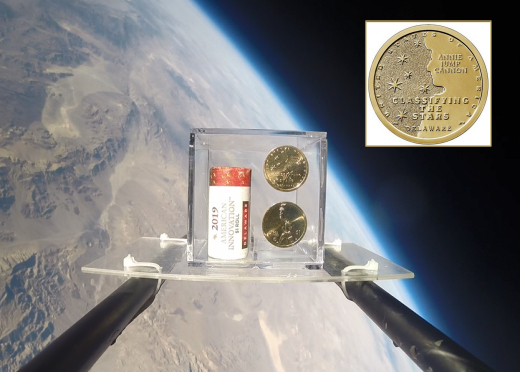
You can have a roll of 25 for $149.95. The students are selling the coins to support their cosmic ray ballooning program. Each roll contains 25 one dollar coins with uncirculated finishes. Cannon is shown on one side and the Statue of Liberty on the other. Individual coins make great Christmas stocking stuffers for young scientists--or give the whole roll as a special gift. Your order comes with a greeting card showing the coins in flight.
Far Out Gifts: Earth to Sky Store
All sales support hands-on STEM education
Realtime Spaceweather Photo Gallery
Free: Spaceweather.com Newsletter
Realtime Aurora Photo Gallery
Free: Spaceweather.com Newsletter