ARCTIC AURORA WATCH: The Arctic Circle could light up on Nov. 16th and 17th when a minor stream of solar wind is expected to buffet Earth's magnetic field. The gaseous material is flowing from a southern hole in the sun's atmosphere. Solar wind speeds could reach ~450 km/s, sparking episodes of bright auroras at Arctic latitudes. Aurora alerts: SMS Text.

THE LEONID METEOR SHOWER: Earth is entering a stream of debris from Comet Tempel-Tuttle, source of the annual Leonid meteor shower. Forecasters expect 10 to 15 meteors per hour to fly out of the constellation Leo when the shower peaks on Nov. 18th.
Above: Ian Webster created this visualization of Comet Tempel-Tuttle's debris cutting across Earth's orbit.
Many people, when they hear "Leonids," think of the great Leonid storms of 1999, 2001 and 2002. In November of those years, thousands of meteors per hour spilled across the skies of Europe and North America as Earth plowed through dense filaments of dust from Comet Tempel-Tuttle.
Bad news: Storms won't happen in 2019. This year, Earth is going to miss the storm-filaments, instead passing through a diffuse haze of dust that fills the space between them. Hourly counts will number in the low dozens, not thousands.
Still, it's a meteor shower. The best time to look is during the hours before sunrise on Monday, Nov. 18th, when the constellation Leo is high in the sky. Some Leonids may also be seen at the same time on Sunday, Nov. 17th: Sky map.

Realtime Spaceweather Photo Gallery
Free: Spaceweather.com Newsletter
ANNIE JUMP CANNON IN THE STRATOSPHERE: Pioneering astronomer Annie Jump Cannon invented the modern system of stellar classification. To honor her, the US Mint has created a $1 American Innovation coin featuring Cannon's silhouette and a spray of stars. On Nov. 11th, the students of Earth to Sky Calculus flew some to the stratosphere, 111,221 feet above the Sierra Nevada mountains of central California:
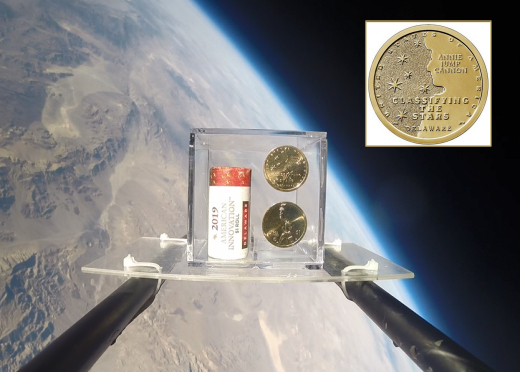
You can have a roll of 25 for $149.95. The students are selling the coins to support their cosmic ray ballooning program. Each roll contains 25 one dollar coins with uncirculated finishes. Cannon is shown on one side and the Statue of Liberty on the other. Individual coins make great Christmas stocking stuffers for young scientists--or give the whole roll as a special gift. Your order comes with a greeting card showing the coins in flight.
Far Out Gifts: Earth to Sky Store
All sales support hands-on STEM education
Realtime Aurora Photo Gallery
Free: Spaceweather.com Newsletter