LOOK FOR LEONID METEORS MONDAY MORNING: Earth is entering a stream of debris from Comet Tempel-Tuttle, source of the annual Leonid meteor shower. Forecasters expect 10 to 15 meteors per hour to fly out of the constellation Leo when the shower peaks on Monday morning, Nov. 18th. The best time to look is during the dark hours before sunrise when Leo is high in the southeast: Sky map.

A RARE HALO AROUND THE MOON: Fans of the Hubble Space Telescope will recall pictures of the Cat's Eye Nebula, a luminous helical structure more than 3000 light years from Earth. Last night in Albany, Missouri, Dan Bush saw something similar just above his own backyard:

"It was a unique halo around the Moon," says Bush. "It appears to be two superimposed halos slightly offset like a helix."
Indeed, that's exactly what it is. Pencil-shaped crystals of ice floating in cirrus clouds above Albany caught rays of bright moonlight, bending them into two concentric shapes: (1) a circular 22-degree halo and (2) an oval circumscribed halo. Circular halos around the Moon are common on crispy autumn nights; circumscribed halos less so. Their rare combination briefly teleported Bush across the galaxy to a helix far, far away.
Realtime Spaceweather Photo Gallery
Free: Spaceweather.com Newsletter
LADY AURORA, MEET BABY AURORA: Last night in Tromsø, Norway, people of all ages watched the sky turn green. "We had one of the youngest aurora chasers ever on our tour," reports Markus Varik. "Luckily, she brought her parents with her. The display was phenomenal and everybody should see something like this at least once in their life."

The display was caused by a minor stream of solar wind emerging from a southern hole in the sun's atmosphere. "Activity picked up a lot when we made first contact with the stream on Nov. 16th," says Varik. "Let's see what tonight brings!" Indeed, it could be even better as the solar wind speed approaches 450 km/s--sufficient for another round of bright Arctic auroras on Nov. 17th.

Realtime Aurora Photo Gallery
Free: Spaceweather.com Newsletter
ANNIE JUMP CANNON IN THE STRATOSPHERE: Pioneering astronomer Annie Jump Cannon invented the modern system of stellar classification. To honor her, the US Mint has created a $1 American Innovation coin featuring Cannon's silhouette and a spray of stars. On Nov. 11th, the students of Earth to Sky Calculus flew some to the stratosphere, 111,221 feet above the Sierra Nevada mountains of central California:
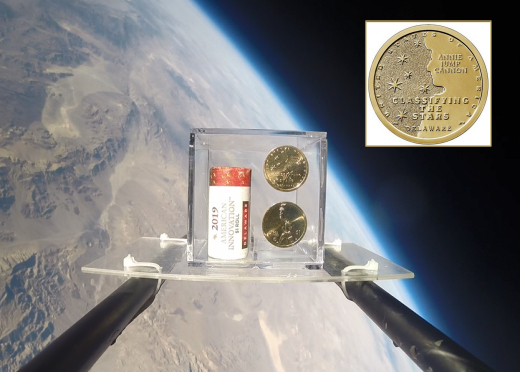
You can have a roll of 25 for $149.95. The students are selling the coins to support their cosmic ray ballooning program. Each roll contains 25 one dollar coins with uncirculated finishes. Cannon is shown on one side and the Statue of Liberty on the other. Individual coins make great Christmas stocking stuffers for young scientists--or give the whole roll as a special gift. Your order comes with a greeting card showing the coins in flight.
Far Out Gifts: Earth to Sky Store
All sales support hands-on STEM education