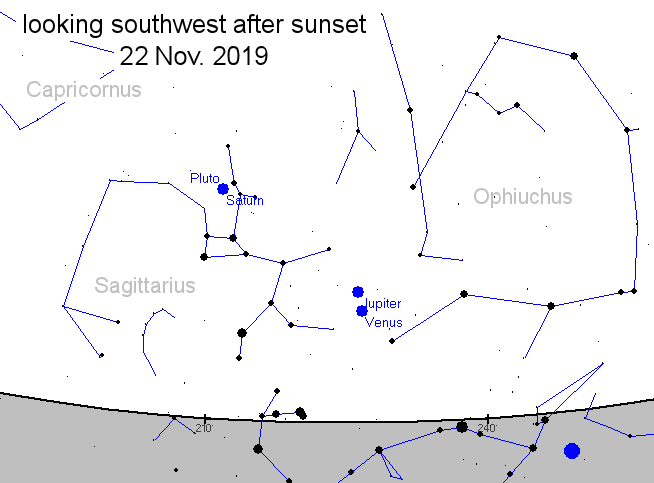
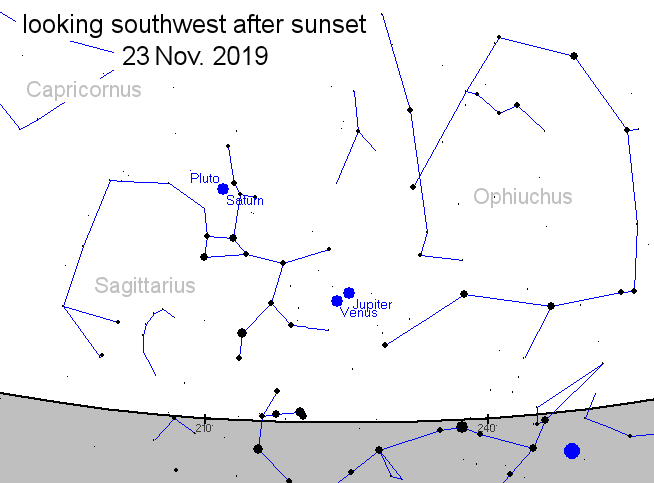
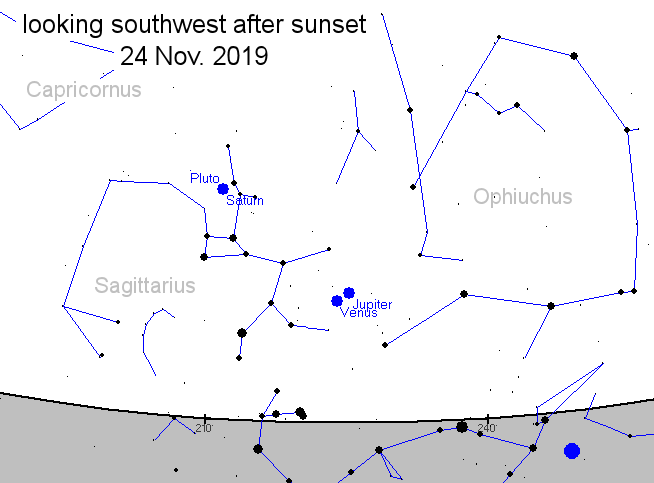
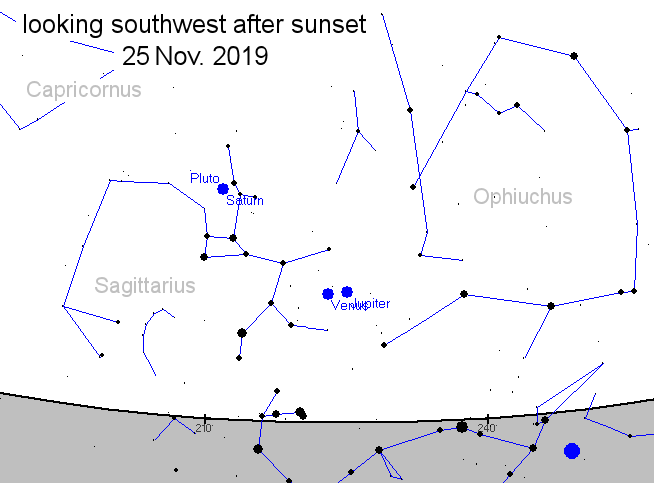
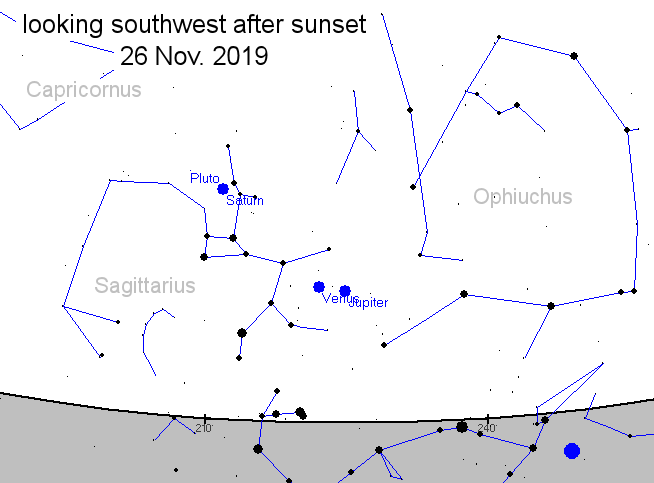
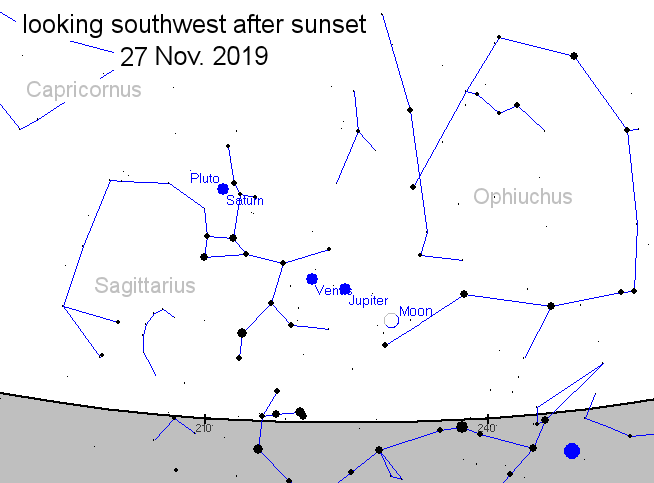
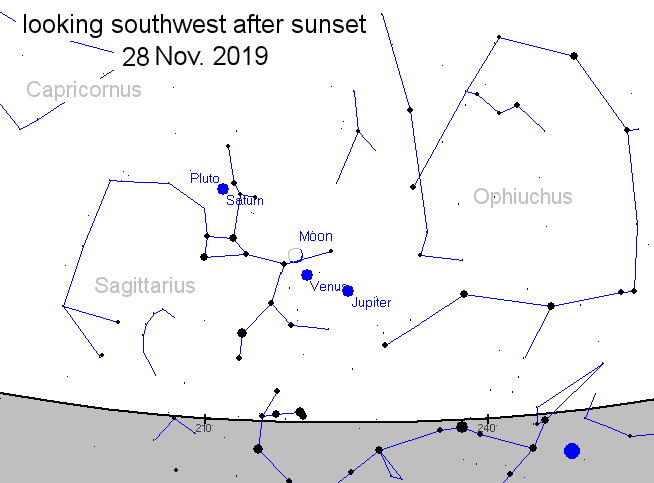
COMING SOON--A SUNSET CONJUNCTION: Planets are gathering in the sunset sky. During the third week of November, Venus and Jupiter will converge for a beautiful conjunction above the southwestern horizon--only 1.4 degrees apart on Nov. 24th. Then, a whisper-thin crescent Moon will join them, forming a celestial triangle on Nov. 27th and 28th. Don't miss it! Sky maps: Nov. 21, 22, 23, 24, 25, 26, 27, 28.

NOCTILUCENT CLOUDS ARE FORMING OVER ANTARCTICA: The southern season for noctilucent clouds (NLCs) is underway, according to new observations from NASA's AIM spacecraft. "On Nov. 15th, AIM detected a small cloud over eastern Antarctica," reports Cora Randall of the University of Colorado's Laboratory for Atmospheric and Space Physics. "This is the earliest we have seen NLCs appear since the AIM mission began in 2007." Note the electric-blue puff over Dronning Maud Land in this image taken by AIM's CIPS instrument:
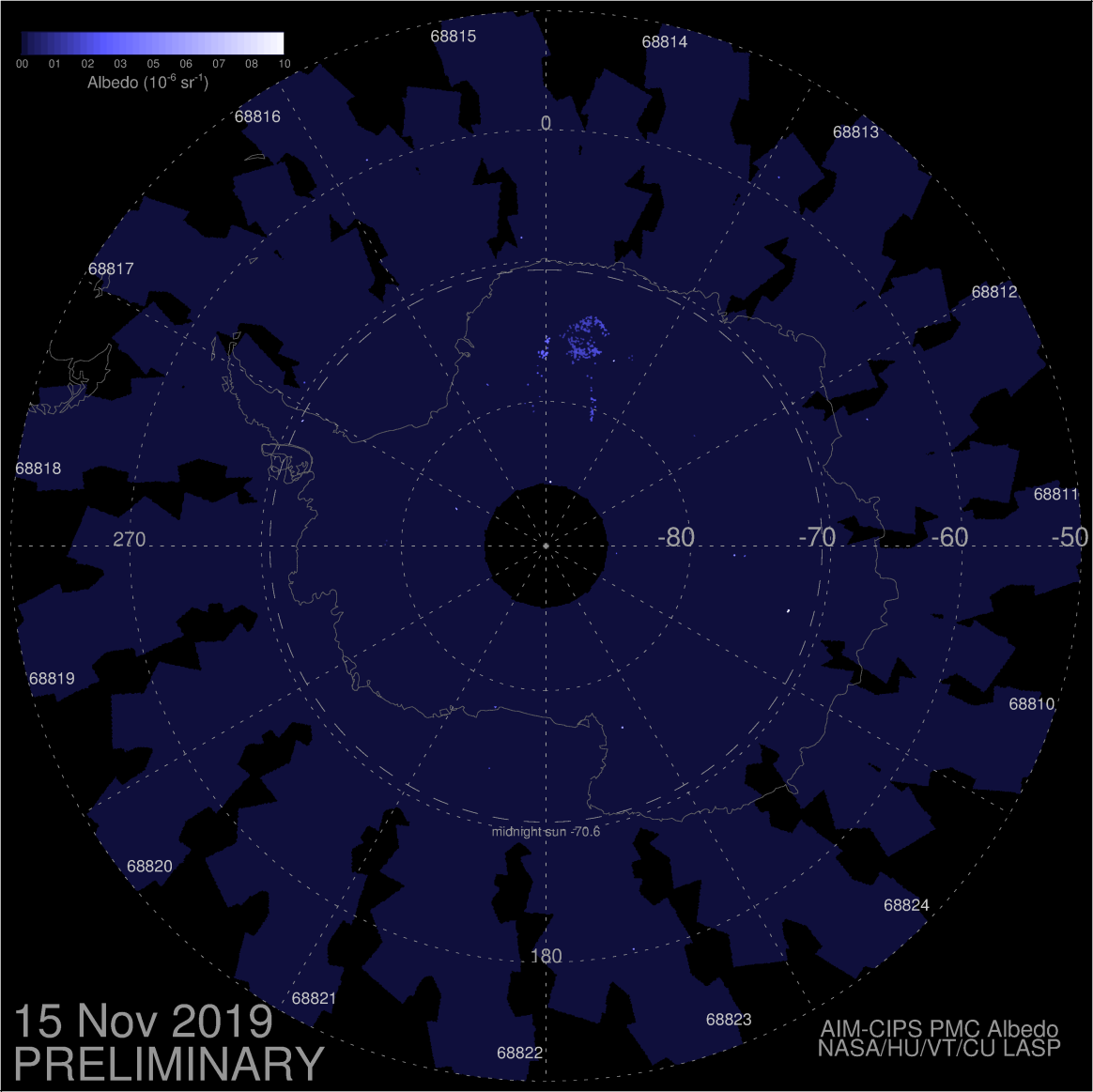
NLCs are Earth's highest clouds. They form around the poles when summertime water vapor billows up into the high atmosphere, crystallizing around specks of meteor smoke at the edge of space. Antarctic NLCs typically appear in mid- to -late November. This year's early apparition on Nov. 15th breaks the earlier mark of Nov. 17th set in 2013 and 2016.
If history is any guide, that little puff of blue is about to expand dramatically. Previous data from AIM spacecraft show that noctilucent clouds are like a great "geophysical light bulb." They turn on in late spring (in this case, austral spring) and reach almost full intensity over a period of no more than 5 to 10 days. A week from now, the entire South Pole could be ringed by electric blue clouds. Stay tuned!
Realtime NLC Photo Gallery
Free: Spaceweather.com Newsletter
THE MAGNETIC AFTERGLOW OF A SOLAR WIND STREAM: This weekend, Arctic skies turned green as a minor stream of solar wind buffeted Earth's magnetic field. Chris Hodgson photographed the geomagnetic glow on Nov. 17th from Abisko, Sweden:
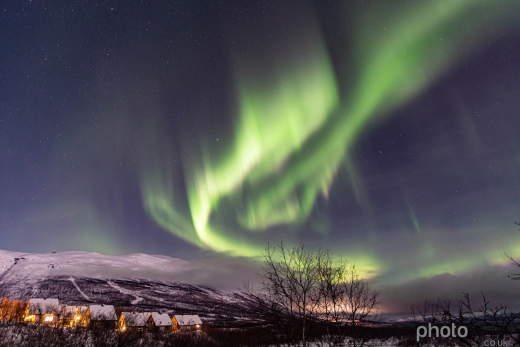
"The tail end of the solar wind stream kicked off a huge display over Abisko," says Hodgson, who is a tour guide for Lights over Lapland. "Our guests got a great show."
How did a minor stream produce such bright auroras? Solar wind speeds never rose above 450 km/s. The answer may be found in this chart recording from a magnetometer in Britain:
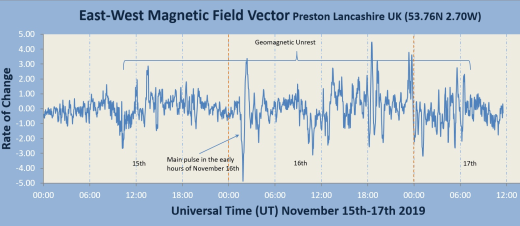
"The wiggles on the chart caused by the passing solar wind stream are plain to see," says Stuart Green of Preston UK, who operates a research-grade magnetic observatory in his back garden. "They show how the geomagnetic field was disturbed--literally shaking back and forth--during the solar wind event."
Although the solar wind stream was not very speedy, it was clearly effective in rattling Earth's magnetic field. And that's why the auroras were so good. Imagine a tree in autumn buffeted by wind, its leaves fluttering to the ground. Likewise, charged particles in Earth's magnetosphere were shaken loose by the action of the wind (in this case, solar wind). They rained down upon the upper atmosphere, causing polar skies to glow.
Realtime Aurora Photo Gallery
Free: Spaceweather.com Newsletter
ANNIE JUMP CANNON IN THE STRATOSPHERE: Pioneering astronomer Annie Jump Cannon invented the modern system of stellar classification. To honor her, the US Mint has created a $1 American Innovation coin featuring Cannon's silhouette and a spray of stars. On Nov. 11th, the students of Earth to Sky Calculus flew some to the stratosphere, 111,221 feet above the Sierra Nevada mountains of central California:
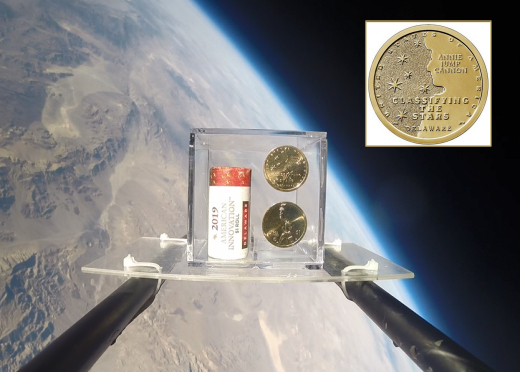
You can have a roll of 25 for $149.95. The students are selling the coins to support their cosmic ray ballooning program. Each roll contains 25 one dollar coins with uncirculated finishes. Cannon is shown on one side and the Statue of Liberty on the other. Individual coins make great Christmas stocking stuffers for young scientists--or give the whole roll as a special gift. Your order comes with a greeting card showing the coins in flight.
Far Out Gifts: Earth to Sky Store
All sales support hands-on STEM education
Realtime Spaceweather Photo Gallery
Free: Spaceweather.com Newsletter