POSSIBLE OUTBURST OF ALPHA MONOCEROTID METEORS: This week, Earth will pass by a stream of dusty debris from an unnamed comet. Forecasters believe the close encounter could cause an outburst of alpha Monocerotid meteors. The time to look is 04:50 UT on Nov. 22nd (11:50 p.m. EST on Nov. 21st). This timing favors observers in western Europe and eastern parts of Canada and the USA. More: full story, sky map.
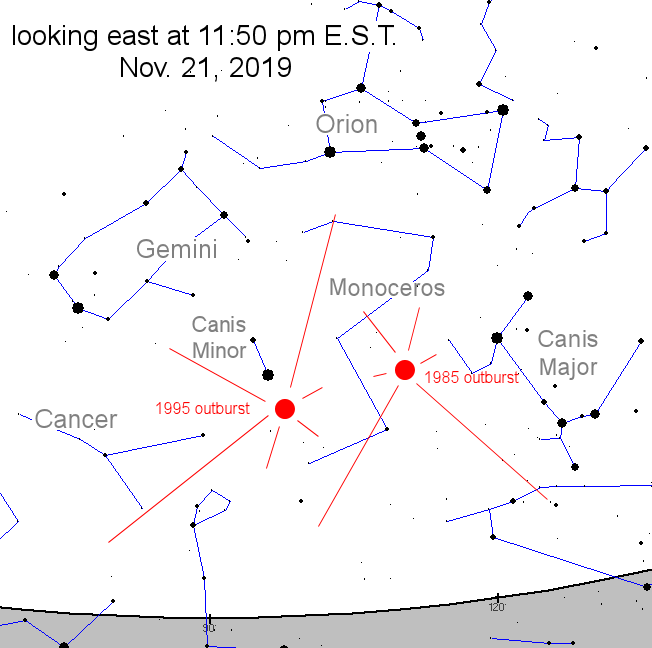
WHO CAN SEE THE METEOR OUTBURST? Tonight, Thursday, Nov. 21st, around 11:50 p.m. EST, Earth will pass by a filament of comet dust. This might produce a brief outburst of alpha Monocerotid meteors. Bill Cooke of NASA's Meteoroid Environment Office has prepared a map showing who in the USA can see the show:

Sky watchers on the east coast are favored. They could potentially see 100 or more meteors during the event. Sky watchers on the west coast, however, are out of luck. The shower's radiant in the constellation Monoceros (the Unicorn) will be below the horizon.
Of course, there's no guarantee anyone will see anything. Only a handful of alpha Monocerotid outbursts have been observed in the past century, which means researchers are still mapping the filament of comet dust. Earth could hit a extra-dense spot, resulting in an amazing display, or pass through a void, producing nothing.
If anything happens we will post it here. So stay tuned!
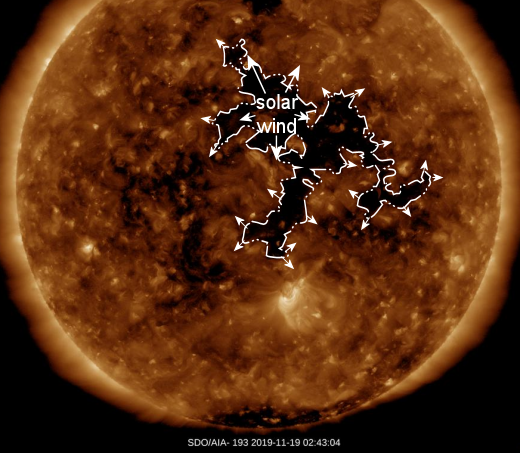
THE SOLAR WIND HAS ARRIVED: Earth is entering a stream of solar wind flowing from a sprawling hole in the sun's atmosphere. First contact with the gaseous material on Nov. 20th produced an outburst of auroras over Scandinavia. Markus Varik sends this picture from Tromsø, Norway:

"Today we greeted some of the most beautiful Night Butterflies I have seen!" says Varik. "The first effects of the solar wind stream have arrived--and I am really, really keen to see what the upcoming days will bring. Maybe a dinosaur, a bear or why not even a unicorn?"
In Abisko, Sweden, off-duty aurora tour guides Oliver Wright and Chris Hodgson rushed outside to photograph the display. "We set up our cameras on the edge of Lake Torneträsk behind some ice-covered trees," says Wright. "I've wanted to take this picture for years."

"The place was lethal walking ... well, more crawling ... on uneven wet ice, above a big drop into the lake with waves crashing below! " says Wright. "Other than that, it was a magic night."
Tonight could be magic as well. NOAA forecasters say there is a chance of G1-class geomagnetic storms on Nov. 21st as Earth moves deeper into the stream. If such a storm materializes, auroras could descend into northern-tier US states such as Michigan and Minnesota. Aurora alerts: SMS Text.

Realtime Spaceweather Photo Gallery
Free: Spaceweather.com Newsletter
THE SUNFLOWER SPACE PENDANT: Are you looking for a far-out gift? Consider the sunflower space pendant. On Oct. 18, 2019, the students of Earth to Sky Calculus launched a cosmic ray balloon to the stratosphere. This cheerful pendant went along for the ride, 109,923 feet high:
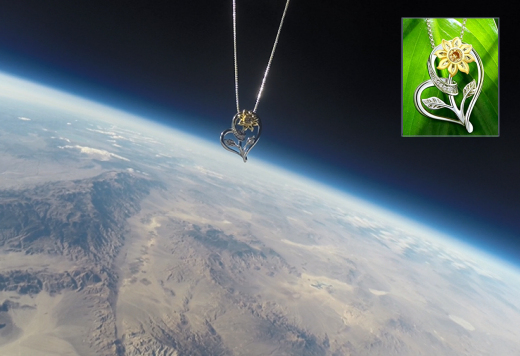
You can have it for $109.92 (its altitude divided by 1000). The students are selling these pendants to support their cosmic ray ballooning program. Each rose gold-plated pendant comes with a greeting card showing the flower in flight and telling the story of its journey to the edge of space and back again. They make great birthday, anniversary and Christmas gifts.
Far Out Gifts: Earth to Sky Store
All sales support hands-on STEM education
Realtime Aurora Photo Gallery
Free: Spaceweather.com Newsletter