ALPHA MONOCEROTID METEOR UPDATE: As reports arrive from Europe, North and South America, a coherent picture of the 2019 alpha Monocerotid meteor shower is emerging. In short, an outburst happened near the predicted time. Visually, it was modest, with experienced sky watchers counting at most 20 to 30 meteors--a far cry from a "storm." Nevertheless, the timing was spot-on, showing that forecasters have a good bead on the location of the meteoroid stream, if not its contents.
Because the outburst was less intense than expected, photographers didn't record many meteors. Here's a rare one flying over the Big Horn Mountains of Wyoming photographed by Kevin Palmer:

"I watched for alpha Monocerotid meteors for a couple hours on Thursday night and counted about 10 meteors," says Palmer. "Most of them were sporadic. Of the 3 meteors I photographed, only one seemed to line up with the radiant. Even though there was no meteor storm, it was still a beautiful night."
At radio wavelengths the outburst may have been more impressive. More than one amateur radio operator using forward scatter techniques noticed an increase in meteor "pings." These were likely caused by a profusion of alpha Monocerotids too faint to see with the unaided eye.
Realtime Spaceweather Photo Gallery
Free: Spaceweather.com Newsletter
VENUS AND JUPITER AT 30,000 FT: Air travelers, if you see someone staring out the window from underneath their jacket, don't call security. It's just Venus and Jupiter. "On the evening of Nov. 16th, we boarded a plane from Christchurch, New Zealand, to the Gold Coast in Australia," says Noeleen Lowndes. "What a wonderful surprise when I looked out my window at 30,000 feet and saw Venus and Jupiter."

"It was absolutely stunning," says Lowndes. "To capture the images I had to put a jacket over my head to block out all the lights from the interior of the plane…I got many strange looks from other passengers, but I just smiled and kept taking pictures :-)"
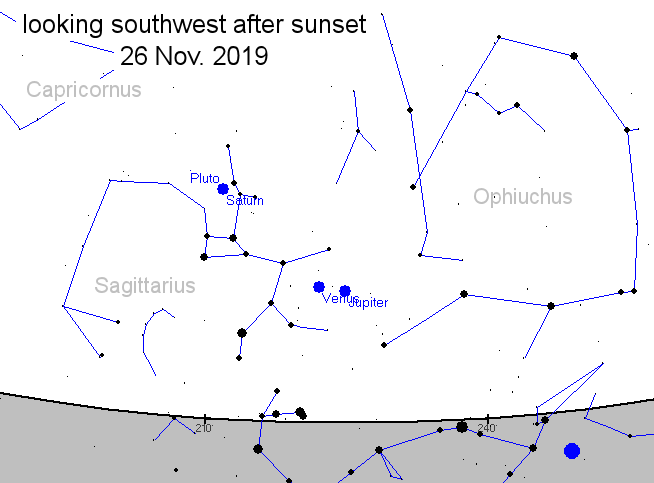
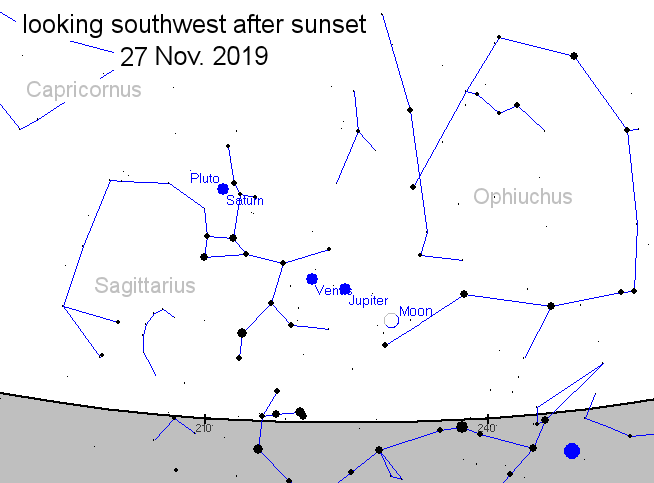
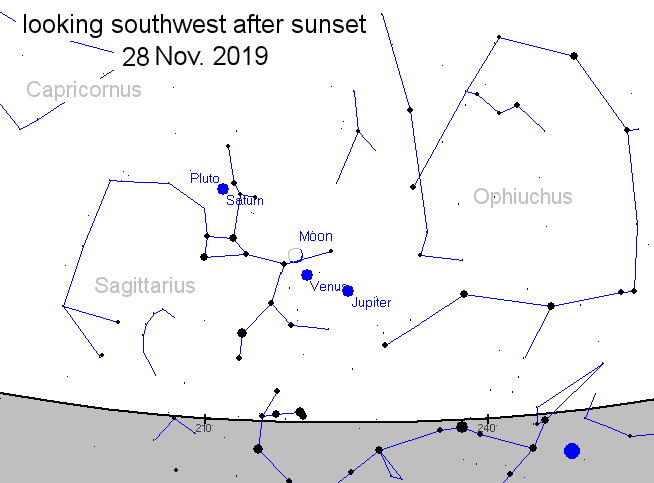
The view is about to get even better. Venus and Jupiter are converging in the sunset sky. At closest approach on Nov. 24th, they will be only 1.4 degrees apart--about the width of your index finger held at arm's length. On Nov. 27th and 28th, the crescent Moon will join the show, forming a celestial triangle that people in the USA will want to go outside and see after Thanksgiving dinner. Sky maps:Nov. 22, 23, 24, 25, 26, 27, 28.
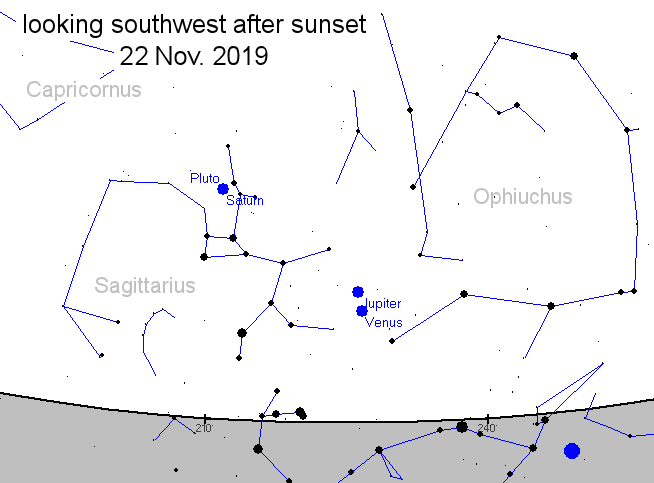
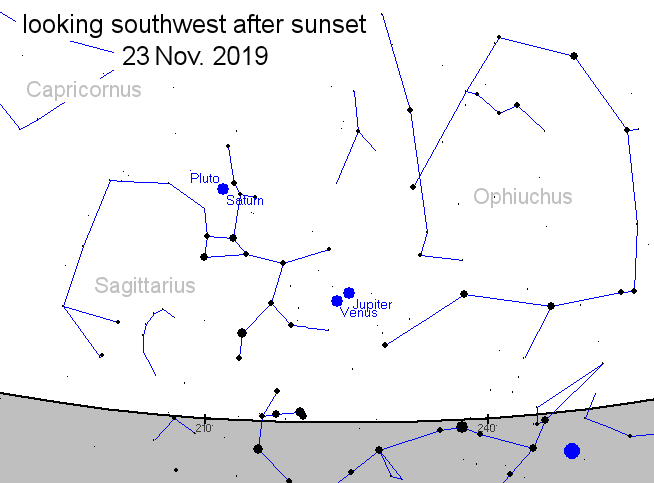
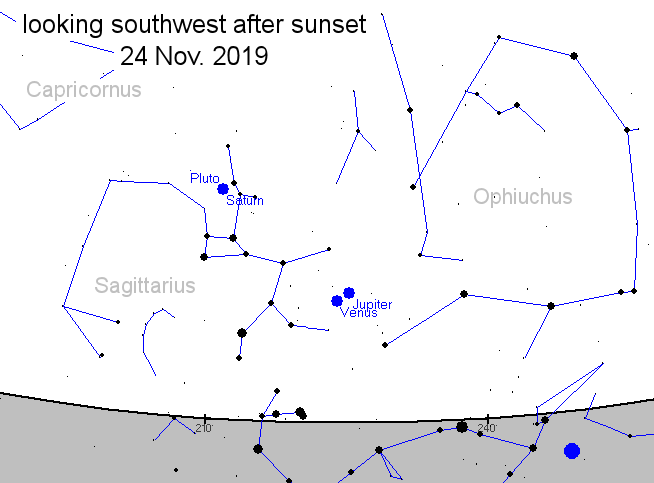
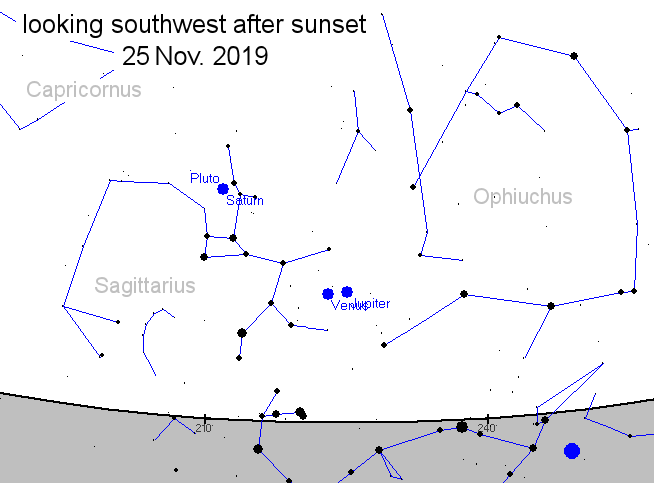
Realtime Spaceweather Photo Gallery
Free: Spaceweather.com Newsletter
THE SUNFLOWER SPACE PENDANT: Are you looking for a far-out gift? Consider the sunflower space pendant. On Oct. 18, 2019, the students of Earth to Sky Calculus launched a cosmic ray balloon to the stratosphere. This cheerful pendant went along for the ride, 109,923 feet high:
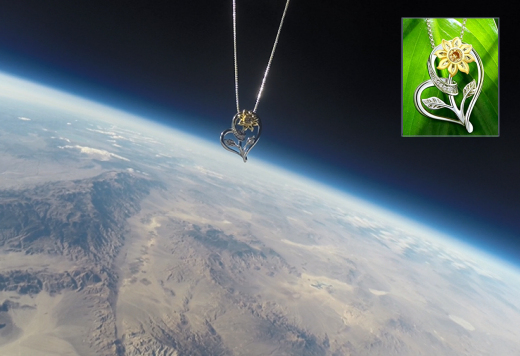
You can have it for $109.92 (its altitude divided by 1000). The students are selling these pendants to support their cosmic ray ballooning program. Each rose gold-plated pendant comes with a greeting card showing the flower in flight and telling the story of its journey to the edge of space and back again. They make great birthday, anniversary and Christmas gifts.
Far Out Gifts: Earth to Sky Store
All sales support hands-on STEM education
GREEN FRAGMENT BREAKS OFF THE SUN: Spoiler alert: The sun is still intact. On Nov. 19th, Mike Kelley was watching the sunset from a California sand dune when a green fragment broke away from the solar disk. He recorded the event with a 1/2500s exposure on his Nikon D90 camera:

"It was a gorgeous green flash," says Kelley. "I saw it from Mad River Beach in northern California."
Pacific beaches are great places to find a green flash. Warm breezes from inland flow out over the cold water, creating temperature gradients in the air above the waves. Those gradients can magnify tiny differences in the atmospheric refraction of red and green light, creating a verdant mirage. If you find yourself on the beach at sunset, take a look!
Realtime Green Flash Photo Gallery
Free: Spaceweather.com Newsletter
Realtime Aurora Photo Gallery
Free: Spaceweather.com Newsletter