A NEW HOLE IN THE SUN'S ATMOSPHERE: A southern hole has opened in the sun's atmosphere and it is spewing solar wind toward Earth. Estimated time of arrival: Nov. 27-28. Arctic auroras are likely when the gaseous material arrives. However, we don't yet know if this newly-opened hole is capable of causing a full-fledged geomagnetic storm. Stay tuned for updates. Aurora alerts: SMS text.

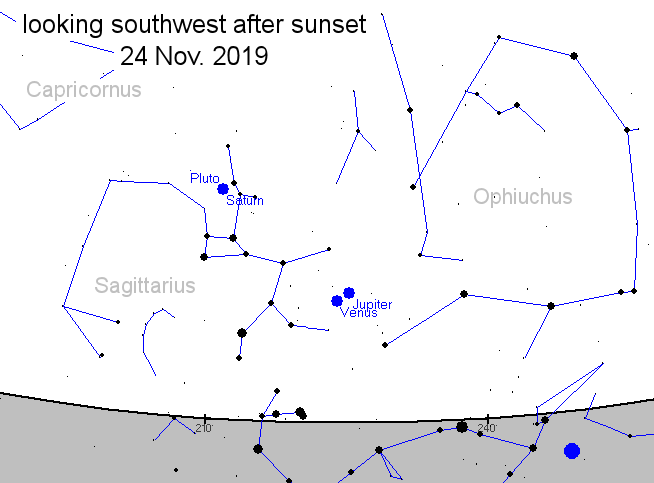
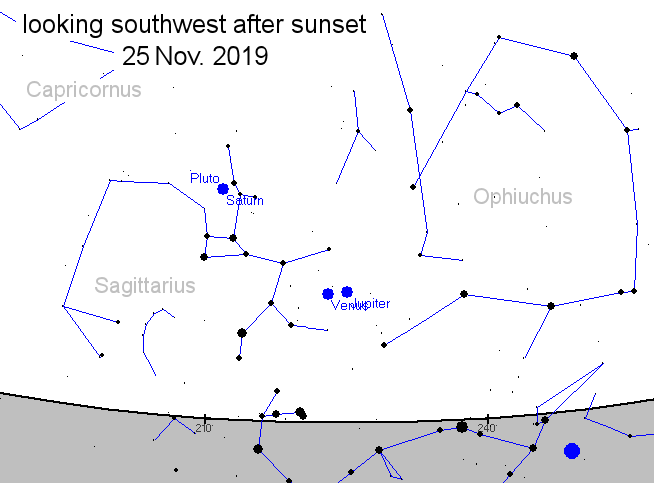
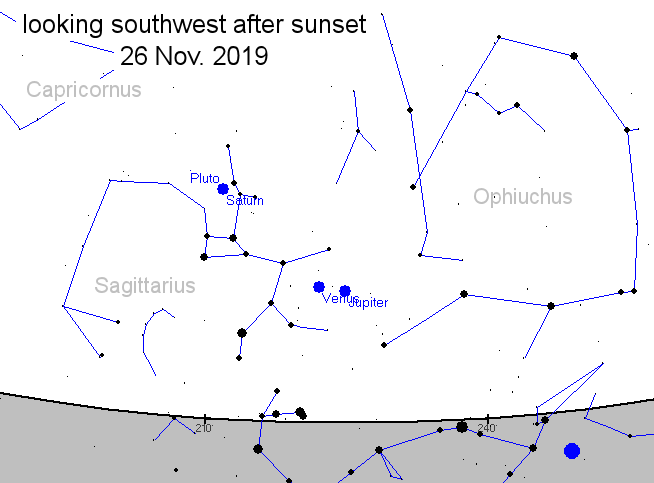
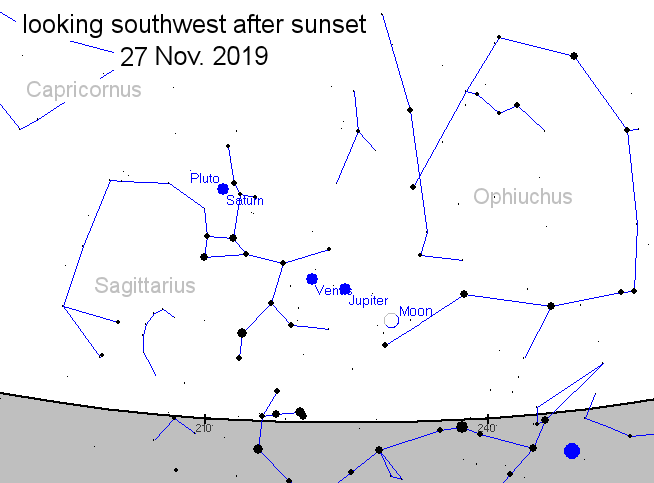
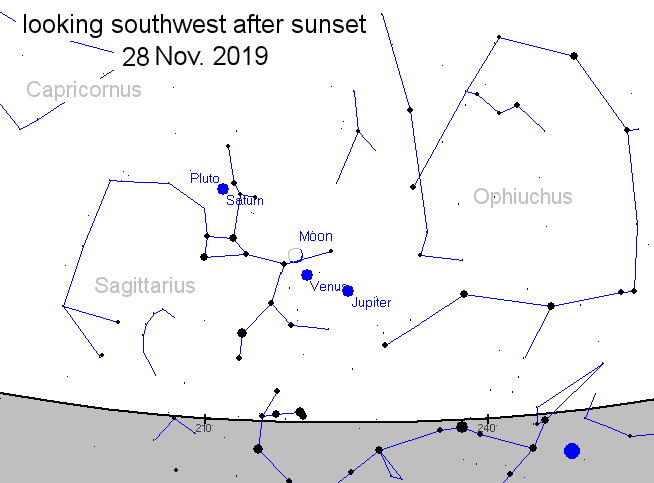
VENUS-JUPITER CONJUNCTION: When the sun goes down tonight, step outside and look southwest. Venus and Jupiter are in conjunction, beaming through the sunset beautifully close together. Juan Carlos Casado photographed the pair last night from Llers in Catalonia, Spain:

"The person's silhouette is my daughter Izar (12 years old), which means 'star' in the Basque language," explains Casado. "Izar is also the name of the star ε Bootis, and is considered one of the most beautiful double stars in the sky."
The two planets were at their closest on Nov. 24th--about 1.4 degrees apart. They are separating now, but slowly, so that they will remain an eye-catching pair for some nights to come. On Nov. 27th and 28th, the whisper-thin crescent Moon will join them, forming a heavenly triangle in the sunset sky. Sky maps: Nov. 24, 25, 26, 27, 28.
Realtime Spaceweather Photo Gallery
Free: Spaceweather.com Newsletter
THE SUNFLOWER SPACE PENDANT: Are you looking for a far-out gift? Consider the sunflower space pendant. On Oct. 18, 2019, the students of Earth to Sky Calculus launched a cosmic ray balloon to the stratosphere. This cheerful pendant went along for the ride, 109,923 feet high:
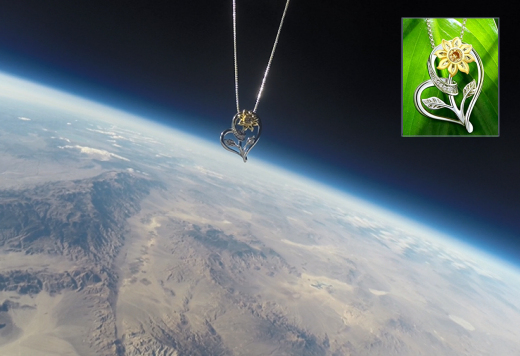
You can have it for $109.92 (its altitude divided by 1000). The students are selling these pendants to support their cosmic ray ballooning program. Each rose gold-plated pendant comes with a greeting card showing the flower in flight and telling the story of its journey to the edge of space and back again. They make great birthday, anniversary and Christmas gifts.
Far Out Gifts: Earth to Sky Store
All sales support hands-on STEM education
STARLINK SATELLITES PHOTOBOMB A METEOR SHOWER: Yes, there was an outburst of alpha Monocerotid meteors on Nov. 22nd. As predicted by forecasters Esko Lyytinen and Peter Jenniskens (NASA/Ames), Earth grazed a filament of comet dust, prompting a modest flurry of meteors to emerge from the constellation Monoceros (the Unicorn). In La Palma on the Canary islands, a Global Meteor Network camera captured the display--and something more. Starlink photobombed the meteor shower:

Video credit: Denis Vida, University of Western Ontario
Dozens of Starlink satellites flew through the camera's field of view, putting on a display that rivaled the meteor shower itself. The score: alpha Monocerotids 90, Starlink 50. And the Starlink satellites were much brighter.
"It was a real eye-opener," remarked Bill Cooke, the lead of NASA's Meteoroid Environment Office, when he saw the video. "This kind of thing could force us to change how we write software to auto-detect meteors."
Starlink is a venture by SpaceX. The idea is to launch 12,000 or more satellites into Earth orbit, surrounding our planet and providing global internet coverage even to people in remote areas. The first batch of 60 Starlink satellites launched in May 2019 surprised astronomers and prompted the International Astronomical Union to issue a statement of concern. Filling the sky with artificial stars might not be good for astronomy, they suggested.

Above: The alpha Monocerotid (AMO) outburst recorded at La Palma. Credit: Denis Vida, University of Western Ontario
The satellites that flew over La Palma during the alpha Monocerotid shower on Nov. 22nd came from a 2nd batch of 60 launched on Nov. 11, 2019. To be fair to Starlink, the train did not stop the camera from successfully recording the shower as shown in the histogram above. However, sharing the sky could become more challenging in the years ahead as Starlink expands from dozens to potentially thousands of satellites.
Meanwhile, congratulations to Lyytinen and Jenniskens for successfully predicting the alpha Monocerotids. They nailed the timing of the encounter. Earth passed by the filament of dust around 0500 UT, within 10 minutes of the forecast. The intensity of the outburst was less than they expected by a factor of 5 to 10. "That could mean we crossed the dust trail further away from the parent comet than we expected, suggesting that the comet is moving away from us," notes Jenniskens.
If you would like to see the Starlink satellites for yourself, flyby predictions are available at Heavens-Above.com.
Realtime Aurora Photo Gallery
Free: Spaceweather.com Newsletter