SOLAR MINIMUM CONDITIONS ARE IN EFFECT: The sun has been without spots for 16 consecutive days--a sign that Solar Minimum is underway. Many people think Solar Minimum is uninteresting. Not so. This phase of the solar cycle brings extra cosmic rays, long-lasting holes in the sun's atmosphere, and a possible surplus of noctilucent clouds. Aurora Alerts: SMS text
IN CASE YOU MISSED IT ... SUNSET PLANETS: For the past few nights, Venus, Jupiter, and the crescent Moon have gathered in the rosy glow of sunset, putting om a beautiful show. Daniele Gasparri photographed them on Nov. 27th from the Atacama desert in Chile:

"The sky of the Atacama desert is so clear and transparent that I actually could see this amazing show reflected in the transparent correcting plate of my telescope," says Gasparri. "Amazing!"
Did you miss the show? It's going to happen again. Mark your calendar for Dec. 28th when the crescent Moon and Venus will gather in the sunset sky for a lovely conjunction less than 1 degree apart. Jupiter won't be with them next time, but the display will be just as satisfying: sky map.

Realtime Spaceweather Photo Gallery
Free: Spaceweather.com Newsletter
SCINTILLATING SIRIUS: Sirius is the brightest star in the sky and, as a result , the most colorful. At this time of year, the Dog Star produces a veritable spray of rainbow colors as it hangs low in the eastern sky after sunset. Roy Spencer of Huntsville, AL, has developed a beautiful way to record it. "I manually jiggled my camera while I was photographing Sirius, spreading its colors around," he explains.

"This de-focused 5 sec exposure was when the star was at elevation of 15 deg," says Spencer.
Astronomers call this phenomenon "scintillation." Also known as "twinkling," it is caused by thermal irregularities in Earth's atmosphere. As packets of relatively warm and cool air drift in front of Sirius, the star's light is refracted. The prismatic action of these air packets produce rainbow colors--especially near the horizon where starlight must pass through many turbulent irregularities to reach the observer.
ANNIE JUMP CANNON IN THE STRATOSPHERE: Pioneering astronomer Annie Jump Cannon invented the modern system of stellar classification. To honor her, the US Mint has created a $1 American Innovation coin featuring Cannon's silhouette and a spray of stars. On Nov. 11th, the students of Earth to Sky Calculus flew some to the stratosphere, 111,221 feet above the Sierra Nevada mountains of central California:
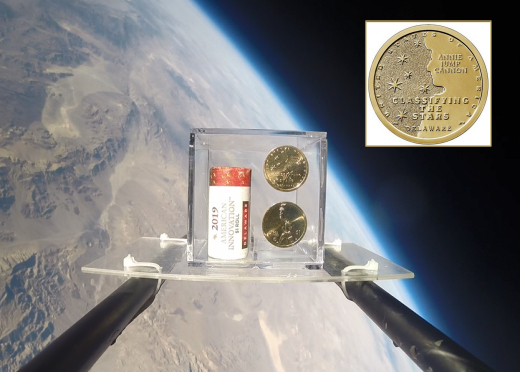
You can have a roll of 25 for $149.95. The students are selling the coins to support their cosmic ray ballooning program. Each roll contains 25 one dollar coins with uncirculated finishes. Cannon is shown on one side and the Statue of Liberty on the other. Individual coins make great Christmas stocking stuffers for young scientists--or give the whole roll as a special gift. Your order comes with a greeting card showing the coins in flight.
Far Out Gifts: Earth to Sky Store
All sales support hands-on STEM education
Realtime Aurora Photo Gallery
Free: Spaceweather.com Newsletter