POSSIBLE GEOMAGNETIC ACTIVITY THIS WEEK: Solar wind flowing from a southern hole in the sun's atmosphere could graze Earth's magnetic field later this week, probably on Dec. 3-4. No geomagnetic storms are expected. However, Arctic auroras will brighten when the solar wind arrives. Aurora Alerts: SMS text

POLAR STRATOSPHERIC CLOUDS: The Arctic season for polar stratospheric clouds has begun. "The rare clouds made their first appearance over Stockholm earlier this afternoon (Dec. 2nd) and shone brightly against the evening sky," reports photographer Peter Rosén, who had no trouble seeing the clouds from the brightly-lit downtown area of Stockholm:

Polar stratospheric clouds are a sign that the Arctic stratosphere is getting cold. Very cold. They require temperatures around -85ºC to form.
The stratosphere is extremely dry, which makes it hard for clouds of any type to form. Only when the air up there becomes extremely cold do widely-spaced water molecules coalesce to form ice crystals--the "stuff" of PSCs. High-altitude sunlight shining through these ice particles produces the clouds' characteristic bright iridescent colors, as shown in this close-up from Peter Rosén:

People who see them generally agree, they are the most beautiful clouds on Earth. "Polar stratospheric clouds far outshine and have much more vivid colours than ordinary iridescent clouds, which are very much poor relations and seen frequently all over the world," writes atmospheric optics expert Les Cowley. "Once seen they are never forgotten."
As the winter solstice approaches and plunges the northern stratosphere into deeper cold, these clouds will appear with increasing frequency. Arctic sky watchers, submit your photos here.
Realtime Spaceweather Photo Gallery
Free: Spaceweather.com Newsletter
THE STRATOSPHERIC CLOUD PENDANT: The most beautiful clouds on Earth are located in the stratosphere: Polar Stratospheric Clouds. Their extraordinary colors inspired this authentic Swarovski pendant--and it has been to the stratosphere! On Nov. 2, 2019, it hitched a ride 109,580 feet high on board an Earth to Sky Calculus cosmic ray balloon:
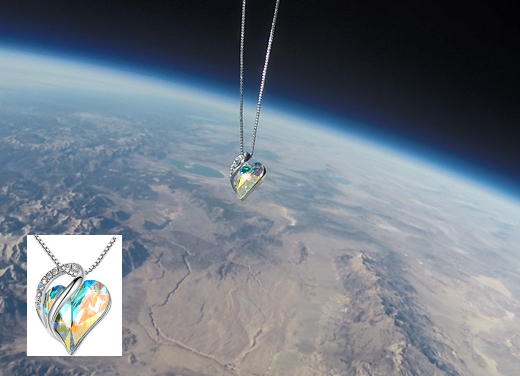
You can have it for $159.95. The students are selling Stratospheric Cloud Pendants to support their cosmic ray ballooning program. Each heart-shaped pendant comes with a card showing it floating through the stratosphere like a real cloud, and telling the story of its journey to the edge of space and back again.
Far Out Gifts: Earth to Sky Store
All sales support hands-on STEM education
Realtime Aurora Photo Gallery
Free: Spaceweather.com Newsletter