COMING SOON: THE GEMINID METEOR SHOWER: Earth is approaching a stream of gravelly debris from "rock comet" 3200 Phaethon, source of the annual Geminid meteor shower. Forecasters expect the shower to peak on Dec. 13-14, right on the heels of a glaring full Moon (Dec. 12). Fortunately, Geminids are rich in fireballs and many of them may be seen in spite of lunar interference. Stay tuned for updates as peak-night approaches.
POLAR STRATOSPHERIC CLOUDS SPREAD TO THE UK: This week's outbreak of polar stratospheric clouds (PSCs) has just gotten bigger. Yesterday, the colorful clouds spread south from the Arctic Circle to the UK. Alan C. Tough photographed them on Dec. 3rd from Elgin, Moray, Scotland:

PSCs don't often appear over Scotland. Tough decided to look when he noticed ozone levels were dropping. "Normally during winter we have ozone levels around 300 Dobson Units (DU)," he says. "Yesterday, however, DU values of less than 220 prompted me to check the sky, very carefully, for PSCs."
It's true. PSCs can destroy ozone.
PSCs form in the lower stratosphere when temperatures drop to a staggeringly-cold -85ºC. High-altitude sunlight shining through tiny ice particles ~10µm wide produce bright iridescent colors by diffraction and interference. But there is more to PSCs than ice. Some polar stratospheric clouds contain very small droplets of naturally occurring nitric and sulphuric acids. These acid droplets kickstart a chain of chemical reactions that wipe out ozone.
Indeed, there does seem to be regional deficit of ozone around the UK. Note the blue patch in this Dec. 1st ozone map from the OMPS instrument onboard the Suomi NPP satellite:

The Dec. 3rd map is not yet available. We will post it later this week. Meanwhile, UK sky watchers should be alert for polar stratospheric clouds after local sunset. No one knows when the outbreak will end.
Realtime Spaceweather Photo Gallery
Free: Spaceweather.com Newsletter
A MOONSTONE AT THE EDGE OF SPACE: Are you looking for a far-out gift? Nothing says "Merry Christmas" like a gem from the edge of space. The students of Earth to Sky Calculus flew this moonstone wrapped in a hand-crafted sterling silver Celtic love knot 35.1 km (115,158 feet) above Earth's surface:
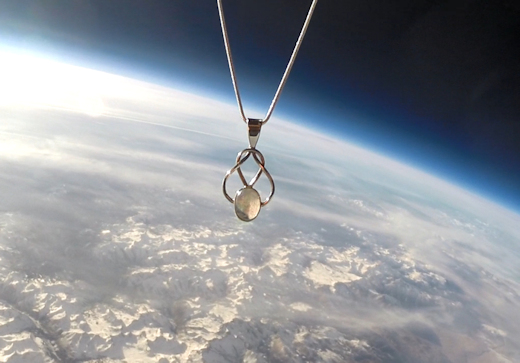
You can have it for $179.95. The students are selling these pendants to support their cosmic ray ballooning program. Each one comes with a greeting card showing the item in flight and telling the story of its journey to the edge of space. All sales support the Earth to Sky Calculus cosmic ray ballooning program and hands-on STEM research.
Far Out Gifts: Earth to Sky Store
All sales support hands-on STEM education
Realtime Aurora Photo Gallery
Free: Spaceweather.com Newsletter