COMING SOON: THE GEMINID METEOR SHOWER: Earth is approaching a stream of gravelly debris from "rock comet" 3200 Phaethon, source of the annual Geminid meteor shower. Forecasters expect the shower to peak on Dec. 13-14, right on the heels of a glaring full Moon (Dec. 12). Fortunately, Geminids are rich in fireballs and many of them may be seen in spite of lunar interference. Stay tuned for updates as peak-night approaches.
PLANETARY WAVE SUPERCHARGES NOCTILUCENT CLOUDS: An atmospheric wave nearly half as wide as Earth itself is supercharging noctilucent clouds (NLCs) in the southern hemisphere. NASA's AIM spacecraft detected the phenomenon in this series of south polar images spanning Nov. 27th through Dec. 2nd:

“This is a clear sign of planetary wave activity,” says AIM principal investigator James Russell of Hampton University, which manages the Aeronomy of Ice in the Mesosphere mission for NASA.
Planetary waves are enormous ripples of temperature and pressure that form in Earth’s atmosphere in response to Coriolis forces. In this case, a 5-day planetary wave is boosting noctilucent clouds over Antarctica and causing them to spin outward to latitudes where NLCs are rarely seen.
On Dec. 1st, Mirko Harnisch saw the clouds from Dunedin, New Zealand:

"I was enjoying the late-evening sky over the Southern Ocean just after 11 pm local time when these wispy blue-ish noctilucent clouds appeared," says Harnisch. "This a rare sighting for my latitude of 45S."
Indeed, it is very rare. Spaceweather.com has been receiving images of NLCs for more than 20 years. This is the first-ever submission from New Zealand or any other mid-latitude site in the southern hemisphere.
Noctilucent clouds over Antarctica are nothing unusual. They form every year around this time when the first wisps of summertime water vapor rise to the top of Earth’s atmosphere. Molecules of H2O adhere to specks of meteor smoke, forming ice crystals 83 km above Earth’s surface.
But these NLCs are different. They’re unusually strong and congregated in a coherent spinning mass.

Above: Temperature and water vapor data from NASA Microwave Limb Sounder, Nov. 27- Dec. 1, 2019
"The planetary wave is responsible," explains AIM science team member Lynn Harvey of the University of Colorado's Laboratory for Atmospheric and Space Physics (LASP). "It is concentrating a mass of cold water vapor in the mesosphere and causing the moisture to pinwheel counterclockwise around the South Pole." Harvey has been tracking the moisture in data from NASA’s Microwave Limb Sounder instruments, shown above. It matches almost perfectly the location of the NLCs.
Because the noctilucent clouds are spinning around with a 5 day period, they could return to New Zealand 5 days after Harnisch saw them–that is, on Dec. 6th. Such a forecast is very uncertain. Nevertheless, sky watchers who wish to try should look west 30 to 60 minutes after sunset. If you see luminous blue-white tendrils hugging the horizon, you may have spotted a noctilucent cloud.
A sharable version of this story is available here.
Realtime Spaceweather Photo Gallery
Free: Spaceweather.com Newsletter
THE SHOOTING STAR SPACE PENDANT: It's simple. It's elegant. And it's been to the edge of space. On Sept. 27th, the students of Earth to Sky Calculus launched a cosmic ray balloon to the stratosphere. This stainless steel "shooting star" pendant hitched a ride, all the way to 108,245 feet:
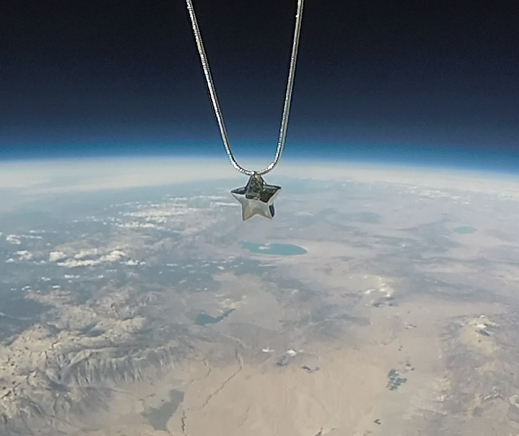
You can have it for $119.95. The students are selling shooting star pendants to support their cosmic ray ballooning program. Each one comes with greeting card showing the item in flight and telling the story of its journey to the edge of space and back again. These make great birthday and Christmas gifts.
Bonus: The star contains a hidden chamber, which you may fill with the ashes of a loved one or anything else you wish to keep close to your heart.

Far Out Gifts: Earth to Sky Store
All sales support hands-on STEM education
Realtime Aurora Photo Gallery
Free: Spaceweather.com Newsletter