WHERE DID ALL THE SUNSPOTS GO? The sun has been blank (no sunspots) for 266 days so far in 2019--including the last 29 days in a row. If this continues for only 3 more days, 2019 will break the Space Age record for blank suns in a calendar year. The previous mark (268 spotless days) was set in 2008 during an historically deep Solar Minimum. The Solar Minimum of 2019 is shaping up to be even deeper. Stay tuned for quiet. Aurora alerts: SMS Text.
GEMINID METEORS VS. THE FULL MOON: Earth is entering a stream of debris from rock comet 3200 Phaethon, source of the annual Geminid meteor shower. The Geminids are often described as the best meteor shower of the year. But this year there's a problem, and here it is:

"The Moon is full," reports Taichi Nakamura, who photographed the luminous orb rising above Miyazaki, Japan, on Dec. 12th.
Lunar glare is nearly overwhelming the Geminids, making it impossible to see a majority of the shower's faint meteors. Forecasters expect the shower to peak on Dec. 13-14. In a moonless year, sky watchers could expect to see dozens of meteors per hour flying from the constellation Gemini high in the midnight sky. This year, rates will be reduced 5-fold or more.
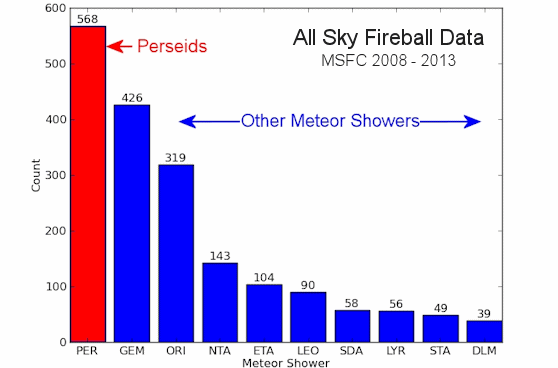
Now for the good news: The shower is relatively rich in fireballs. Debris from 3200 Phaethon is dense and gravelly, less fragile than the comet dust of typical meteor showers. This gives the Geminids a boost in luminosity, allowing the brightest to be seen even under full Moon conditions.
If you would like to try to catch a Geminid fireball, go outside around midnight on Dec. 12-13 or Dec. 13-14 and watch the sky for an hour or so. Worst-case sceneario: You'll get a great view of the Moon.
Realtime Spaceweather Photo Gallery
Free: Spaceweather.com Newsletter
VENUS AND SATURN AT SUNSET: Are you looking for Venus and Saturn? They're easy to find. Just follow the cactus:

Eliot Herman photographed the two planets in conjunction last night over Tucson, Arizona. "It was a really beautiful sight," he says. "Although Venus is much brighter than Saturn, Saturn was beautifully bright as the twilight faded after sunset. They looked great side by side."
The two planets are still close together tonight. To see them, step outside just after sunset and look southwest. Brilliant Venus pops out of the twilight first, followed ~15 minutes later by 1st-magnitude Saturn. The sight of the two planets framed by twilight blue is out of this world. Sky maps: Dec. 11, 12.


Realtime Spaceweather Photo Gallery
Free: Spaceweather.com Newsletter
CHRISTMAS GIFTS FROM THE EDGE OF SPACE: So far in 2019, the students of Earth to Sky Calculus have launched 41 space weather balloons to the stratosphere, measuring cosmic rays over 2 continents and 6 different US states. You can help them pay their helium bill by purchasing a Christmas gift from the edge of space:

Every item in the Earth to Sky Store has flown to the stratosphere alongside an array of cosmic ray sensors. Carried aloft by giant helium balloons, these unique gifts travel above 99.7% of Earth's atmosphere, experiencing space-like blasts of cosmic rays, extreme cold, and a wild ride parachuting back to Earth after the balloon explodes. Even Amazon doesn't carry items this far out.
Don't forget to enter coupon code "XMASRAYS" at checkout for a 10% holiday discount.
Far Out Gifts: Earth to Sky Store
All sales support hands-on STEM education
Realtime Aurora Photo Gallery
Free: Spaceweather.com Newsletter