SOLAR WIND, INCOMING: A hole in the sun's atmosphere is facing Earth and spraying a stream of solar wind in our direction. Estimated time of arrival: Dec. 18th. Geomagnetic storms are not expected. However, Arctic sky watchers should be alert for a brightening of auroras when the gaseous material arrives. Aurora alerts: SMS Text.

SUNSPOTS BREAK A SPACE AGE RECORD: Solar Minimum is becoming very deep indeed. Over the weekend, the sun set a Space Age record for spotlessness. So far in 2019, the sun has been without sunspots for more than 270 days, including the last 33 days in a row. Since the Space Age began, no other year has had this many blank suns.
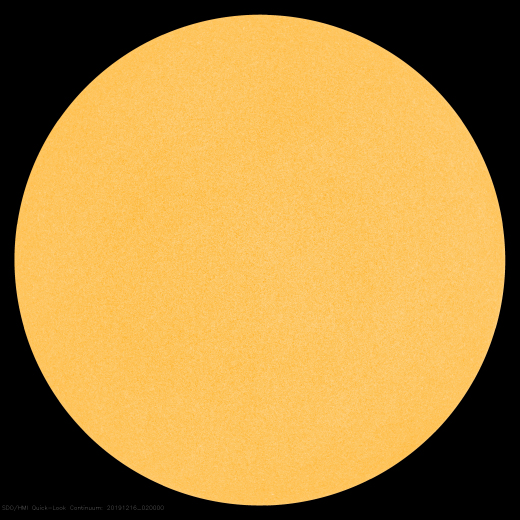
Above: The blank sun on Dec. 16, 2019. Credit: NASA/Solar Dynamics Observatory
The previous record-holder was the year 2008, when the sun was blank for 268 days. That was during the epic Solar Minimum of 2008-2009, formerly the deepest of the Space Age. Now 2019 has moved into first place.
Solar Minimum is a normal part of the 11-year sunspot cycle. The past two (2008-2009 and 2018-2019) have been long and deep, making them "century-class" Minima. To find a year with more blank suns, you have to go back to 1913, which had 311 spotless days.
Last week, the NOAA/NASA Solar Cycle Prediction Panel issued a new forecast. Based on a variety of predictive techniques, they believe that the current Solar Minimum will reach its deepest point in April 2020 (+/- 6 months) followed by a new Solar Maximum in July 2025. This means that low sunspot counts and weak solar activity could continue for some time to come.

Solar Minimum definitely alters the character of space weather. Solar flares and geomagnetic storms subside, making it harder to catch Northern Lights at mid-latitudes. Space weather grows "quiet." On the other hand, cosmic rays intensify. The sun's weakening magnetic field allows more particles from deep space into the solar system, boosting radiation levels in Earth's atmosphere. Indeed, this is happening now with atmospheric cosmic rays at a 5-year high and flirting with their own Space Age record. It's something to think about the next time you step on an airplane. Stay tuned for updates!
Realtime Spaceweather Photo Gallery
Free: Spaceweather.com Newsletter
CHRISTMAS GIFTS FROM THE EDGE OF SPACE: So far in 2019, the students of Earth to Sky Calculus have launched 41 space weather balloons to the stratosphere, measuring cosmic rays over 2 continents and 6 different US states. You can help them pay their helium bill by purchasing a Christmas gift from the edge of space:

Every item in the Earth to Sky Store has flown to the stratosphere alongside an array of cosmic ray sensors. Carried aloft by giant helium balloons, these unique gifts travel above 99.7% of Earth's atmosphere, experiencing space-like blasts of cosmic rays, extreme cold, and a wild ride parachuting back to Earth after the balloon explodes. Even Amazon doesn't carry items this far out.
Don't forget to enter coupon code "XMASRAYS" at checkout for a 10% holiday discount.
Far Out Gifts: Earth to Sky Store
All sales support hands-on STEM education
GEMINID METEORS VS. THE MOON: The Geminid meteor shower peaked this weekend (Dec. 13-14) when Earth passed through a stream of debris from rock comet 3200 Phaethon. The display was almost ruined by the full Moon. Almost. This composite image from Bum-Suk Yeom of Iksan, South Korea, shows that some Geminids were visible in spite of lunar glare:

"On Dec. 14th, I photographed more than a dozen meteors streaking out of the constellation Gemini," says Yeom. "The Moon was there, too--practically sitting on top of the Geminid radiant. This reduced the number of visible meteors, but did not completely eliminate them."
In Cabo Rojo, Puerto Rico, Frankie Lucena also recorded some bright Geminids. In his case, he had to contend with not only the Moon, but also an active thunderstorm. "The thunderclouds and a lightning flash made the display look pretty cool!" he says.

For most observers, the 2019 Geminids were a dud--the Moon won. Next year will be better. Mark your calendar for Dec. 13-14, 2020, when the Geminids coincide with a beautifully dark New Moon.
Realtime Spaceweather Photo Gallery
Free: Spaceweather.com Newsletter
Realtime Aurora Photo Gallery
Free: Spaceweather.com Newsletter