NEW YEAR'S AURORA FORECAST: A minor stream of solar wind flowing from a southern hole in the sun's atmosphere could graze Earth's magnetic field on Jan. 1st or 2nd. Geomagnetic storms are not expected. However, the impact could spark the first polar auroras of 2020. Aurora alerts: SMS Text.
"ONCE IN A LIFETIME" STRATOSPHERIC CLOUDS: A spectacular outbreak of polar stratospheric clouds (PSCs) is underway around the Arctic Circle. "This is a once in a lifetime event," says Chad Blakley, who runs the Lights over Lapland aurora tour service in Abisko, Sweden. "No question, this is the best that any of us have ever seen." Tour guide Paige Ellis took this video showing the clouds' aurora-like colors on Dec. 29th:
"They were so intense that lots of the tourists on the ground thought they were looking at daytime auroras. I had to explain that they were actually clouds in the stratosphere," says Blakley.
Polar stratospheric clouds are newsworthy because normally the stratosphere has no clouds at all. Home to the ozone layer, the stratosphere is arid and almost always transparent. Only when the temperature drops to a staggeringly cold -85C can sparse water molecules assemble themselves into icy stratospheric clouds. PSCs are far more rare than auroras.
"Local villagers in both Abisko and Kiruna who are more than 70 years old confirmed they have never seen anything of the size, scale, or intensity," reports Blakley. "At one point I would say that close to 25% of the sky was filled with the clouds. PSCs in previous winters have been closer to 1% or 2%."
The outbreak has continued on Dec. 30th. "Today I got to see some of the brightest PSCs I've ever seen during all of my years watching the sky," reports Göran Strand, who sends this picture from Jämtland, Sweden:

"They were so bright, they even lit up the surrounding landscape," he marveled.
PSCs are intensely colorful because they are made of a special type of ice. High-altitude sunlight shining through microscopic crystals only ~10µm across produce a bright iridescent glow unlike the lesser iridescence of ordinary tropospheric clouds.
Stay tuned for updates as the outbreak continues.
Realtime Spaceweather Photo Gallery
Free: Spaceweather.com Newsletter
THE STRATOSPHERIC CLOUD PENDANT: The most beautiful clouds on Earth are located in the stratosphere: Polar Stratospheric Clouds. Their extraordinary colors inspired this authentic Swarovski pendant--and it has been to the stratosphere! On Nov. 2, 2019, it hitched a ride 109,580 feet high on board an Earth to Sky Calculus cosmic ray balloon:
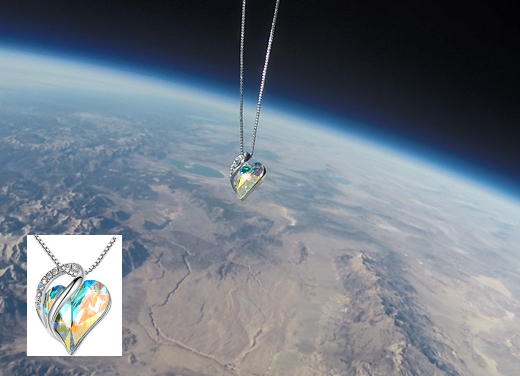
You can have it for $189.95. The students are selling Stratospheric Cloud Pendants to support their cosmic ray ballooning program. Each heart-shaped pendant comes with a card showing it floating through the stratosphere like a real cloud, and telling the story of its journey to the edge of space and back again.
Far Out Gifts: Earth to Sky Store
All sales support hands-on STEM education
Realtime Aurora Photo Gallery
Free: Spaceweather.com Newsletter