CENTURY-CLASS SOLAR MINIMUM: On the sun, 2019 is ending the same way it began--without sunspots. The sun has been blank for 281 days this year. To find a year with more blank suns, you have to go all the way back to 1913 (311 days). This means we are experiencing a century-class Solar Minimum. Forecasters expect these low sunspot counts to continue in 2020. Happy New Year! Aurora alerts: SMS Text.
POLAR STRATOSPHERIC CLOUDS, CONTINUED: A spectacular display of polar stratospheric clouds (PSCs) that began two days ago is still going strong around the Arctic Circle. This picture, taken on Dec. 31st by Per-Anders Gustavsson in Jukkasjärvi, Sweden, shows why some onlookers mistake them for daytime auroras:

"The colors were amazing," says Gustavsson, who drives a tour bus for Visit Abisko. "I was driving by the world-famous Ice Hotel when we saw the clouds. We just had to stop for pictures."
"I've seen a lot of beautiful things during my years in the Arctic," he adds. "This was easily one of the greatest displays I have ever seen."
Polar stratospheric clouds are newsworthy because normally the stratosphere has no clouds at all. The stratosphere is arid and almost always transparent. Only when the temperature drops to a staggeringly cold -85C can sparse water molecules assemble themselves into icy stratospheric clouds. PSCs are far more rare than auroras.
The clouds are even visible at night, as shown in this Dec. 31st photo taken by Fredrik Broms in Kvaløya, Norway:

"Better than New Year fireworks – by far!" says Broms. "What an amazing way to end 2019."
"This really is a rare event," says Chad Blakley, who runs the Lights over Lapland aurora tour service in Abisko, Sweden. "Local villagers in both Abisko and Kiruna who are more than 70 years old confirmed they have never seen anything of the size, scale, or intensity. At one point I would say that close to 25% of the sky was filled with the clouds. PSCs we have seen in previous winters have been closer to 1% or 2%."
Polar stratospheric clouds are intensely colorful because they are made of a special type of ice. High-altitude sunlight shining through microscopic crystals only ~10µm across produce a bright iridescent glow unlike the lesser iridescence of ordinary tropospheric clouds.
Stay tuned for updates as the outbreak continues.
Realtime Spaceweather Photo Gallery
Free: Spaceweather.com Newsletter
THE STRATOSPHERIC CLOUD PENDANT: The most beautiful clouds on Earth are located in the stratosphere: Polar Stratospheric Clouds. Their extraordinary colors inspired this authentic Swarovski pendant--and it has been to the stratosphere! On Nov. 2, 2019, it hitched a ride 109,580 feet high on board an Earth to Sky Calculus cosmic ray balloon:
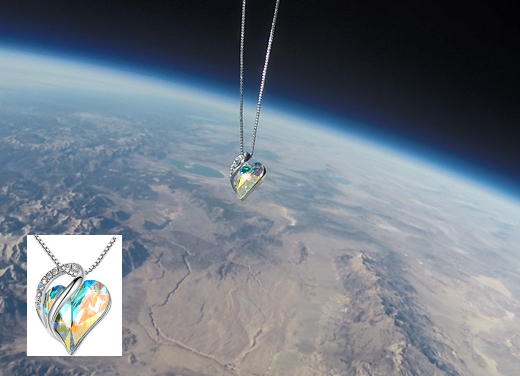
You can have it for $169.95. The students are selling Stratospheric Cloud Pendants to support their cosmic ray ballooning program. Each heart-shaped pendant comes with a card showing it floating through the stratosphere like a real cloud, and telling the story of its journey to the edge of space and back again.
Far Out Gifts: Earth to Sky Store
All sales support hands-on STEM education
Realtime Aurora Photo Gallery
Free: Spaceweather.com Newsletter