QUADRANTID METEOR SHOWER: Earth is approaching a stream of debris from shattered comet 2003 EH1, source of the annual Quadrantid meteor shower. Forecasters expect the shower to peak at 8:20 UT (3:20 a.m. EST) on Saturday, Jan. 4th. The timing favors observers in North America, who could see dozens of meteors streaking out of the obsolete constellation Quadrans Muralis, not far from the Big Dipper: sky map.

THE NEXT SOLAR CYCLE IS COMING: The pace of new-cycle sunspots is definitely intensifying. 2020 is only two days old, and already there is a Solar Cycle 25 active region on the sun. Provisionally numbered AR2755, the sunspot is inset in this magnetic map from NASA's Solar Dynamics Observatory:

We know that AR755 belongs to the next solar cycle because of its magnetic polarity. According to Hale’s Law, sunspot polarities flip-flop from one solar cycle to the next. During old Solar Cycle 24, we grew accustomed to sunspots in the sun’s southern hemisphere having a -/+ pattern. AR2755 is the reverse: +/-, marking it as a member of new Solar Cycle 25.
This is the 3rd consecutive month that Solar Cycle 25 sunspots have appeared: Nov. 2019, Dec. 2019, and now Jan. 2020. The quickening pace of new cycle sunspots does not mean that Solar Minimum is finished. On the contrary, low sunspot counts will likely continue for many months (and maybe even years) to come. However, it is a good sign that Solar Cycle 25 is slowly coming to life. The doldrums won't last forever!
Stay tuned! Aurora alerts: SMS Text.
POLAR STRATOSPHERIC CLOUDS AT NIGHT: The New Year's outbreak of polar stratospheric clouds (PSCs) has become so intense that Arctic sky watchers are seeing them at night. Claudio Comi photographed the pastel clouds alongside a green band of auroras near Kiruna, Sweden on Jan. 2nd:

"At first I thought I was seeing some kind of light pollution from Kiruna," says Comi, who works as a guide for Visit Abisko. "Then I realized--this is different. The colorful clouds were unlike anything I have ever seen before."
Polar stratospheric clouds are rare. Normally the stratosphere has no clouds at all. Only when the temperature drops to a staggeringly cold -85C can sparse water molecules in the stratosphere assemble themselves into icy clouds. Typically, only a small number of these clouds appear during the coldest nights of Arctic winter.
2020 has been special. Some residents of the north say they haven't seen this many PSCs in 70 years. The clouds are so bright and colorful, tourists have been mistaking them for auroras. Comi's side-by-side picture, however, shows that they are easy to tell apart.
Stay tuned for more as the outbreak continues.
Realtime Spaceweather Photo Gallery
Free: Spaceweather.com Newsletter
THE MAGELLAN VENUS PENDANT: Valentine's Day is less than 43 days away. What better way to say "I Love You" than a Venus pendant from the edge of space? This spherical glass necklace, showing NASA Magellan's radar map of the 2nd planet, traveled 104,242 feet high onboard an Earth to Sky Calculus cosmic ray balloon:
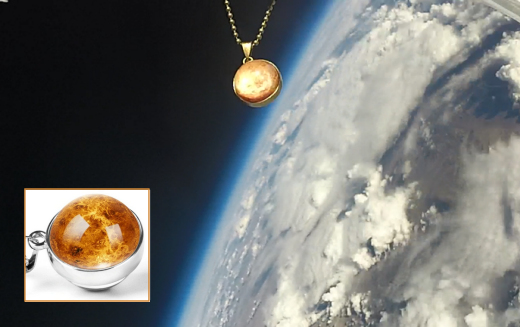
You can have it for $119.95. The students are selling these pendants to support their cosmic ray ballooning program. Each one comes with a card showing it floating through the stratosphere, and telling the story of its journey to the edge of space and back again. They make great Valentine's Day, anniversary and birthday gifts.
Far Out Gifts: Earth to Sky Store
All sales support hands-on STEM education
Realtime Aurora Photo Gallery
Free: Spaceweather.com Newsletter