QUADRANTID METEOR UPDATE: The annual Quadrantid meteor shower peaked this morning, Jan. 4th, during the hours around 0500 UT, according to observers with the International Meteor Organization. The earlier-than-expected peak (3 hours before the forecast) allowed many Europeans to see the show. Constantine Emmanouilidi photographed dozens of Quadrantids before sunrise in Rodokipos, Greece:

"The weather was clear, cold and dry, and this motivated me to go out at -3 Celsius (26.6F) and make a few images just in case..." says Emmanouilidi. "I was not disappointed. I measured a maximum Zenithal Hourly Rate (ZHR) of 125 meteors per hour during the shower's peak."
Earth is now receding from the debris zone of parent comet 2003 EH1. The shower should subside sharply, bringing an end to the first meteor shower of 2020. Browse: meteor photo gallery.
STRATOSPHERIC CLOUDS OVER ICELAND: A New Year's outbreak of polar stratospheric clouds (PSCs) around the Arctic Circle is continuing. The latest sighting comes from Iceland:

"This morning in northern Iceland the sky went crazy!" reports photographer Madelon Dielen. "We have never seen anything like this before."
To capture the scale of the clouds, Dielen took 7 photos and stitched them into a single panorama of the horizon:

"We couldn't believe our eyes!" Dielen says.
Indeed, polar stratospheric clouds like these are almost unbelievable. Normally the stratosphere has no clouds at all. Only when the temperature drops to a staggeringly cold -85C can sparse water molecules in the stratosphere assemble themselves into icy clouds. Typically, only a small number of these clouds appear during the coldest nights of Arctic winter.
Something about the winter of 2020 is different. Some observers say the current outbreak of PSCs is a "once in a lifetime event," bringing clouds of such intensity and color that tourists mistake them for daytime auroras. Where will they appear next? Stay tuned.
Realtime Spaceweather Photo Gallery
Free: Spaceweather.com Newsletter
THE MAGELLAN VENUS PENDANT: Valentine's Day is less than 43 days away. What better way to say "I Love You" than a Venus pendant from the edge of space? This spherical glass necklace, showing NASA Magellan's radar map of the 2nd planet, traveled 104,242 feet high onboard an Earth to Sky Calculus cosmic ray balloon:
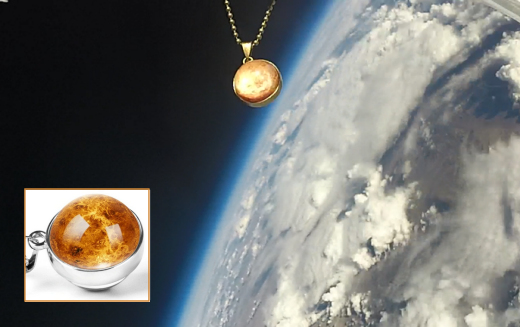
You can have it for $119.95. The students are selling these pendants to support their cosmic ray ballooning program. Each one comes with a card showing it floating through the stratosphere, and telling the story of its journey to the edge of space and back again. They make great Valentine's Day, anniversary and birthday gifts.
Far Out Gifts: Earth to Sky Store
All sales support hands-on STEM education
Realtime Aurora Photo Gallery
Free: Spaceweather.com Newsletter