PENUMBRAL LUNAR ECLIPSE: When the full Moon rises on Friday evening, Jan. 10th, you might notice something odd--a pale shadow darkening the Moon's southern hemisphere. That is the shadow of Earth, and if you can see it, you've spotted a penumbral lunar eclipse. Friday's eclipse will be visible from the Asian side of Earth, but not from the Americas. Watch Larry Koehn's eclipse movie for more information.
UNEXPECTED AURORAS: With no warning, a stream of solar wind hit Earth's magnetic field on Jan. 5th, nearly causing a geomagnetic storm. The unexpected impact sparked bright auroras around the Arctic Circle. Rayann Elzein sends this picture from Utsjoki, Finland:

"A faster-than-expected solar wind stream sparked bright and fast auroras tonight in northern Finnish Lapland," says Elzein. "Standing on the shore of the Teno River, which marks the border between Finland and Norway, we observed in awe the beautiful lightshow, which included quick-moving needles of light and, at one point, a purple fringe."
Three thousand km away in England, the impact of the solar wind was felt in a different way. "My backyard magnetometer recorded vibrations in our local magnetic field," reports Stuart Green, who sends this chart recording of the unrest:

The squiggles in Green's chart represent changes in ground-level magnetic fields caused by the buffeting of solar wind high overhead. "The sensor is buried in my garden about 0.5 meters below the surface in an East/West orientation," he explains. "This allows very sensitive (sub nanotesla) measurements of magnetic declination during geomagnetic storms. The plot shows the change in magnetic flux density in nanotesla occurring between readings every few minutes."
More vibrations are in the offing on Jan. 8th and 9th when another stream of solar wind is due to arrive. The gaseous material is flowing from a minor hole in the sun's atmosphere. Arctic sky watchers may expect bright green auroras mixed with nearly full moonlight. Aurora alerts: SMS Text.
Realtime Aurora Photo Gallery
Free: Spaceweather.com Newsletter
THE MAGELLAN VENUS PENDANT: Valentine's Day is less than 43 days away. What better way to say "I Love You" than a Venus pendant from the edge of space? This spherical glass necklace, showing NASA Magellan's radar map of the 2nd planet, traveled 104,242 feet high onboard an Earth to Sky Calculus cosmic ray balloon:
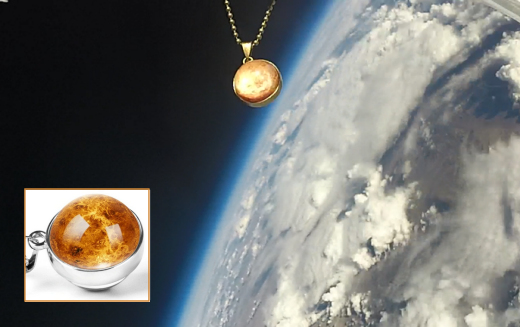
You can have it for $119.95. The students are selling these pendants to support their cosmic ray ballooning program. Each one comes with a card showing it floating through the stratosphere, and telling the story of its journey to the edge of space and back again. They make great Valentine's Day, anniversary and birthday gifts.
Far Out Gifts: Earth to Sky Store
All sales support hands-on STEM education
Realtime Spaceweather Photo Gallery
Free: Spaceweather.com Newsletter