PENUMBRAL LUNAR ECLIPSE: When the full Moon rises on Friday evening, Jan. 10th, you might notice something odd--a pale shadow darkening the Moon's southern hemisphere. That is the shadow of Earth, and if you can see it, you've spotted a penumbral lunar eclipse. Friday's eclipse will be visible from the Asian side of Earth, but not from the Americas. Watch Larry Koehn's eclipse movie for more information.
ELECTRICITY SURGES THROUGH THE SOIL OF NORWAY: Yesterday, Jan. 6th, something unexpected happened in the soil of northern Norway. "Electrical currents started flowing," reports Rob Stammes, who monitors ground currents at the Polarlightcenter geophysical observatory in Lofoten. This chart recording shows the sudden surge around 1930 UT:
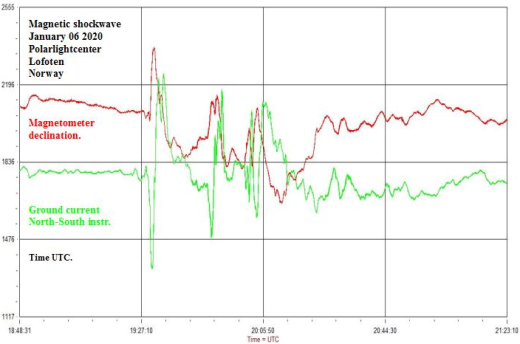
"It seemed to be some kind of shockwave," says Stammes. "My instruments detected a sudden, strong variation in both ground currents and our local magnetic field. It really was a surprise."
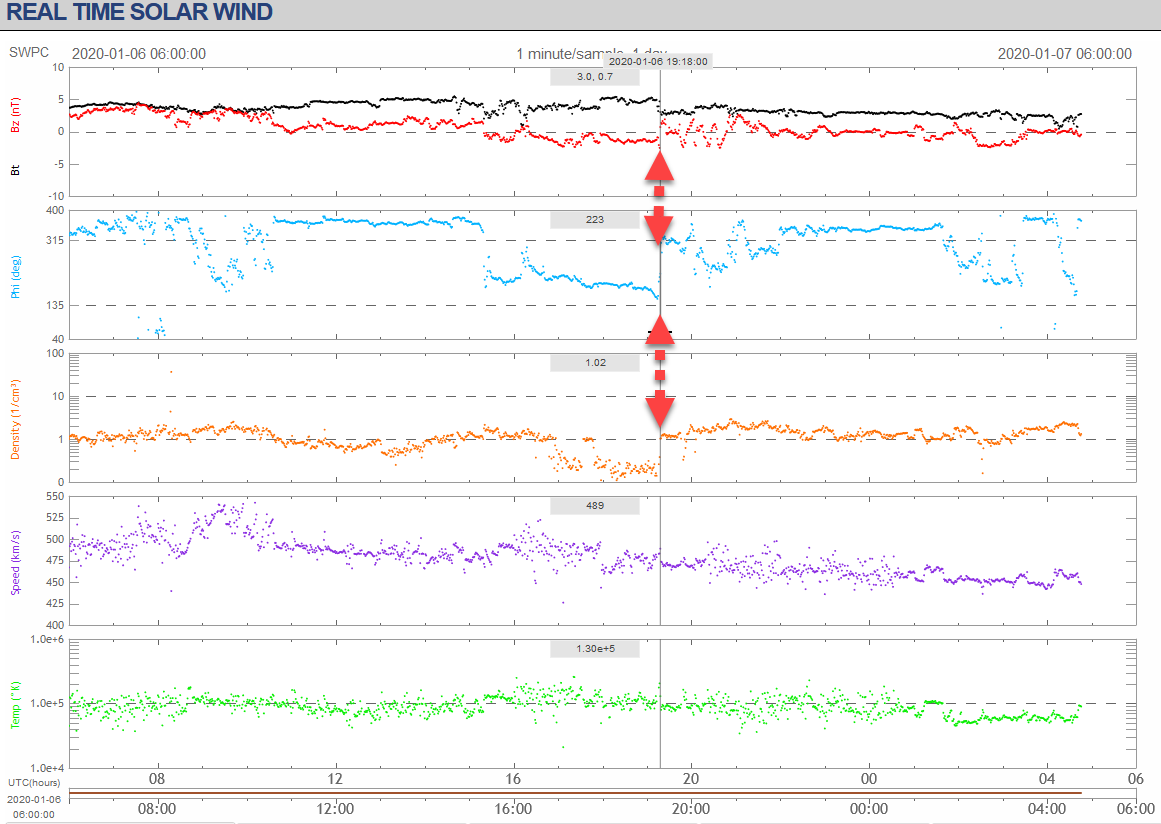
NASA's ACE spacecraft detected something as well. About 15 minutes before the disturbance in Norway, the interplanetary magnetic field (IMF) near Earth abruptly swung around 180 degrees, and the solar wind density jumped more than 5-fold. Earth may have crossed through a fold in the heliospheric current sheet--a giant, wavy membrane of electrical current rippling through the solar system. Such crossings can cause these kind of effects.
While currents flowed through the ground, auroras filled the sky. Rayann Elzein photographed the corresponding outburst of lights from Utsjoki, Finland:
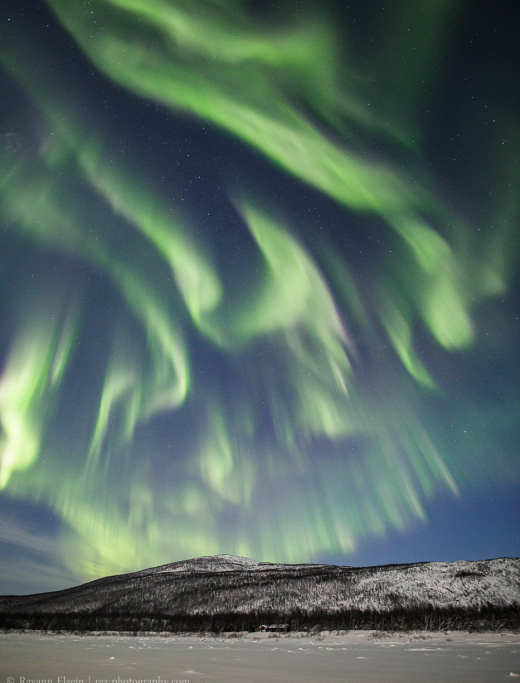
"What a surprise!" says Elzein. "The auroras were sudden and dynamic, with fast-moving green needles and several purple fringes!"
The auroras and ground currents were caused by the same thing: Rapidly changing magnetic fields. High above Earth's surface, magnetic vibrations shook loose energetic particles, which rained down on the upper atmosphere, creating auroras where they struck. Just below Earth's surface, magnetic vibrations caused currents to flow, triggering Rob Stammes' ground sensors.
"We couldn't see the auroras in northern Norway because of cloud cover," says Stammes, a little ruefully. "We had to be satisfied with the electricity underfoot."
Realtime Aurora Photo Gallery
Free: Spaceweather.com Newsletter
SILK SPACE ROSE FOR VALENTINE'S DAY: Valentine's Day is coming, and nothing says "I love you" like a silk rose from the edge of space. On Jan. 4, 2020, the students of Earth to Sky Calculus launched their first cosmic ray balloon of 2020. This rose went along for the ride, traveling 111,424 feet above the Sierra Nevada mountains of central California:
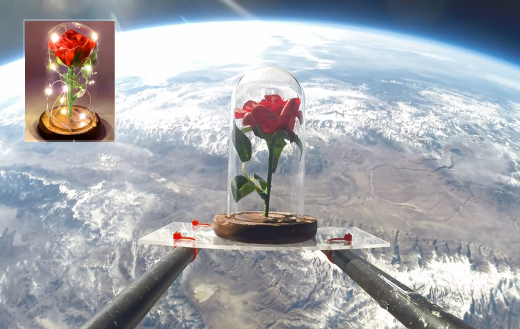
You can have it for $116.65. The students are selling Valentine's space roses to support their cosmic ray ballooning program. Each silk bloom comes with a greeting card showing the rose in flight and telling the story of its journey to the stratosphere and back again. Also included are the glass dome, wooden base, and an LED light kit to make your rose glisten like the stars.
Far Out Gifts: Earth to Sky Store
All sales support hands-on STEM education
Realtime Spaceweather Photo Gallery
Free: Spaceweather.com Newsletter