PENUMBRAL LUNAR ECLIPSE: A pale shadow passed across the face of the full Moon on Jan. 10th. Sky watchers on the Eurasian side of Earth saw it, a penumbral lunar eclipse. This type of eclipse happens when the Moon passes through Earth's faint outer shadow. Penumbral lunar eclipses are easy to overlook, but they can be quite beautiful. See for yourself in Spaceweather.com's Lunar Eclipse Photo Gallery.
THE FAINTING OF BETELGEUSE: One day, perhaps in our lifetimes, perhaps a million years from now, the red giant Betelgeuse will dim a little–and then explode. The resulting supernova will rival the full Moon and cast shadows after dark, completely transforming the night skies of Earth. No wonder astronomers are closely tracking the current "fainting of Betelgeuse."
"Fainting" is an actual astronomical term. It means dimming, the opposite of brightening. And right now, Betelgeuse is definitely fainting.
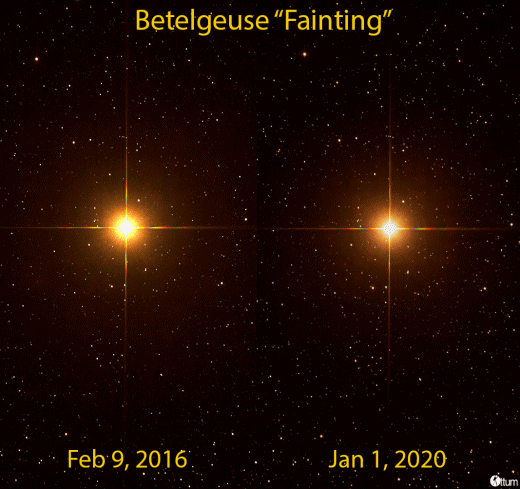
Above: Betelgeuse photographed by Brian Ottum of Animas, New Mexico, 4 years apart: more.
Edward Guinan of Villanova University and colleagues caused a sensation among astronomers last month when they reported "[Betelgeuse] has been declining in brightness since October 2019, now reaching a modern all-time low of V = +1.12 mag on 07 December 2019 UT. Currently this is the faintest the star has been during our 25+ years of continuous monitoring."
Little did they know when they issued their telegram in December that Betelgeuse was about to become even fainter. “On 06 January 2020 UT, the magnitude of Betelgeuse was V = +1.37,” reports Guinan. That’s ~20% dimmer than the "modern all-time low" registered the month before.
This 3-year plot of the Villanova team’s data shows Betelgeuse’s rapid decline:
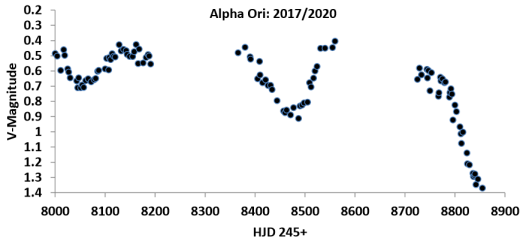
The horizontal axis is Heliospheric Julian Date (HJD). For reference, Jan. 6, 2020, the date of the most recent measurement, has an HJD of 2458855.
The fainting is easy to see with the naked eye. Not long ago, Betelgeuse was the 10th brightest star in the sky. Now it is the 21st. Observers of Orion rising in the east after sunset can’t help but notice that the Hunter’s shoulder is dimmer than it used to be.
Astronomers have long known that Betelgeuse is on the precipice of an energy crisis. It's about to run out of fuel in its core. When that happens, the star will collapse and rebound explosively, producing the first bright supernova in the Milky Way since 1604. Experts in stellar evolution believe Betelgeuse could die at any time during the next million years–a blink of an eye on time scales of astronomy.
Does the current dimming herald that final blast? Probably not. Betelgeuse is a slowly variable star, and this is probably no more than an episode of deeper-than-usual dimming. Of course, one day astronomers will think the same thing … and then the night sky will change forever.
A sharable version of this story is available here.
Realtime Spaceweather Photo Gallery
Free: Spaceweather.com Newsletter
SILK SPACE ROSE FOR VALENTINE'S DAY: Valentine's Day is coming, and nothing says "I love you" like a silk rose from the edge of space. On Jan. 4, 2020, the students of Earth to Sky Calculus launched their first cosmic ray balloon of 2020. This rose went along for the ride, traveling 111,424 feet above the Sierra Nevada mountains of central California:

You can have it for $116.65. The students are selling Valentine's space roses to support their cosmic ray ballooning program. Each silk bloom comes with a greeting card showing the rose in flight and telling the story of its journey to the stratosphere and back again. Also included are the glass dome, wooden base, and an LED light kit to make your rose glisten like the stars.
Far Out Gifts: Earth to Sky Store
All sales support hands-on STEM education
Realtime Aurora Photo Gallery
Free: Spaceweather.com Newsletter