SOLAR WIND, INCOMING: Earth's magnetic field could feel a bump in pressure on Jan. 14th and 15th when a complex stream of solar wind reaches our planet. The gaseous material is a mixture of exhaust from two and perhaps three holes in the sun's atmosphere. No geomagnetic storms are expected, but Arctic sky watchers will likely see an extra dose of green overhead. Aurora alerts: SMS Text.

A NEW KIND OF ASTEROID: Between Mars and Jupiter lies the Asteroid Belt where millions of space rocks orbit the sun. It's where asteroids are supposed to be. And that's why newfound asteroid 2020 AV2 is so strange: It circles the sun entirely inside the orbit of Venus. Russian amateur astronomer Filipp Romanov (Филипп Романов) photographed 2020 AV2 on Jan. 8th:

"Until 2020, no known asteroids had orbits contained within that of Venus," says Romanov. "On 4 January 2020, the Zwicky Transient Facility (ZTF) discovered this one, and I was able to photograph it only 4 days later using a remotely-controlled iTelescope in New Mexico."
There's already a small class of asteroids called "Atiras" (named after the first one confirmed in 2003) that have orbits entirely inside Earth. Fewer than 2 dozen have been found. The discovery of 2020 AV2 takes things a step closer to the sun. Astronomers are tentatively calling its class "Vatiras"--a mashup of Venus and Atiras.
Click to view an interactive orbit of 2020 AV2 from the Jet Propulsion Laboratory:

Researchers don't know much about the population of space rocks in the innermost solar system. The sun's glare makes such objects very hard to discover. The Zwicky Transient Facility is actively surveying the twilight sky, looking for more asteroids like 2020 AV2. Perhaps the inner solar system is where space rocks are supposed to be, too....
Realtime Spaceweather Photo Gallery
Free: Spaceweather.com Newsletter
SILK SPACE ROSE FOR VALENTINE'S DAY: Valentine's Day is coming, and nothing says "I love you" like a silk rose from the edge of space. On Jan. 4, 2020, the students of Earth to Sky Calculus launched their first cosmic ray balloon of 2020. This rose went along for the ride, traveling 111,424 feet above the Sierra Nevada mountains of central California:
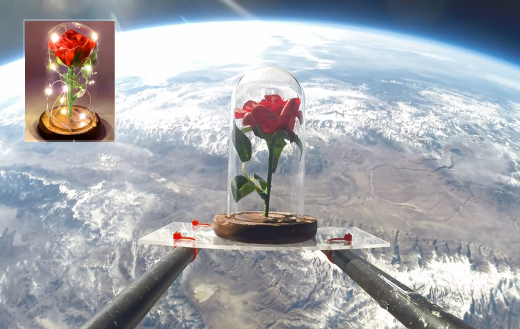
You can have it for $116.65. The students are selling Valentine's space roses to support their cosmic ray ballooning program. Each silk bloom comes with a greeting card showing the rose in flight and telling the story of its journey to the stratosphere and back again. Also included are the glass dome, wooden base, and an LED light kit to make your rose glisten like the stars.
Far Out Gifts: Earth to Sky Store
All sales support hands-on STEM education
Realtime Aurora Photo Gallery
Free: Spaceweather.com Newsletter