SOLAR WIND, INCOMING: Earth's magnetic field could feel a bump in pressure on Jan. 14th and 15th when a complex stream of solar wind reaches our planet. The gaseous material is a mixture of exhaust from two and perhaps three holes in the sun's atmosphere. No geomagnetic storms are expected, but Arctic sky watchers will likely see a surge of auroras when the solar wind arrives. Aurora alerts: SMS Text.

THE SUN SWALLOWS A COMET: A new comet was discovered today, and it's already history. "The first comet discovery of the decade goes to... SOHO!" reports Karl Battams of the Naval Research Lab in Washington DC. During the early hours of Jan. 13th, coronagraphs onboard SOHO (the Solar and Heliospheric Observatory) spotted the tiny comet plunging into the sun, where it rapidly evaporated:

SOHO is the most prolific comet hunter in history. "It's actually quite unusual that it has taken 13 days for SOHO to find a comet," notes Battams. "This is the furthest we've gone into a new calendar year without a discovery since 2008. We're closing in on 3,900 comets discovered, and should comfortably pass 4,000 sometime this year!"
The doomed comet, R.I.P., was a member of the Kreutz family. Kreutz sungrazers are fragments from the breakup of a single giant comet many centuries ago. They get their name from 19th century German astronomer Heinrich Kreutz, who studied them in detail. Hundreds of Kreutz fragments pass by the sun and disintegrate every year--a fact that has helped SOHO pad its totals. In fact, the second comet of the new decade will probably be a Kreutz sungrazer, too. Stay tuned :)
Note: When SOHO discovers a comet, it always has help. A human watching coronagraph images is required to spot the sungrazer. In this case, says Battams, "The comet was noticed by Worachate Boonplod (Thailand) - one of our most successful amateur comet hunters."
Realtime Spaceweather Photo Gallery
Free: Spaceweather.com Newsletter
INFINITY PENDANT FOR VALENTINE'S DAY: Valentine's Day is one month away. Nothing says "I Love You" like an Infinity Pendant from the edge of space. On Jan. 8, 2020, the students of Earth to Sky Calculus launched a cosmic ray balloon. This authentic Swarovski crystal pendant hitched a ride, traveling 113,209 feet above the Sierra Nevada mountains of central California
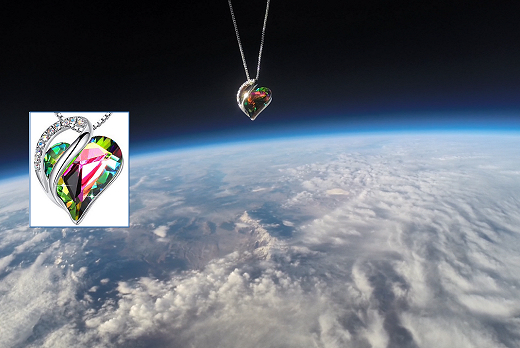
You can have it for $169.95. The students are selling these pendants to support their cosmic ray ballooning program. The glittering heart-shaped crystal is wrapped in a silver-embossed infinity clasp, symbolizing unending love. Each one comes with a romantic card showing the pendant in flight and telling the story of its journey to the edge of space and back again.
Far Out Gifts: Earth to Sky Store
All sales support hands-on STEM education
A NEW KIND OF ASTEROID: Between Mars and Jupiter lies the Asteroid Belt where millions of space rocks orbit the sun. It's where asteroids are supposed to be. However, newfound asteroid 2020 AV2 is out of place: It circles the sun entirely inside the orbit of Venus. Russian amateur astronomer Filipp Romanov (Филипп Романов) photographed 2020 AV2 on Jan. 8th:
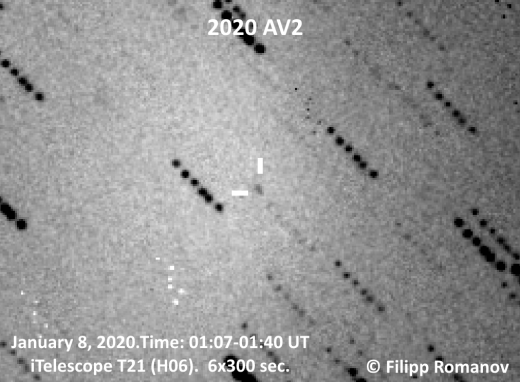
"Until 2020, no known asteroids had orbits contained within that of Venus," says Romanov. "On 4 January 2020, the Zwicky Transient Facility (ZTF) discovered this one, and I was able to photograph it only 4 days later using a remotely-controlled iTelescope in New Mexico."
There's already a small class of asteroids called "Atiras" (named after the first one confirmed in 2003) that have orbits entirely inside Earth. Fewer than 2 dozen have been found. The discovery of 2020 AV2 takes things a step closer to the sun. Astronomers are tentatively calling its class "Vatiras"--a mashup of Venus and Atiras.
Click to view an interactive orbit of 2020 AV2 from the Jet Propulsion Laboratory:
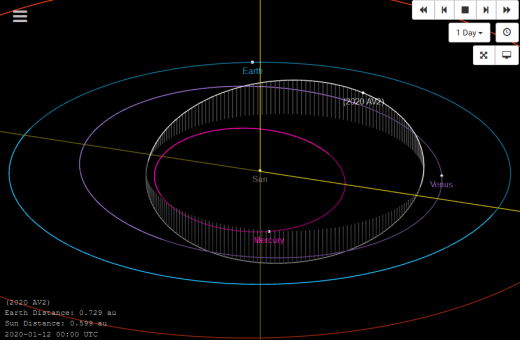
Researchers don't know much about the population of space rocks in the innermost solar system. The sun's glare makes such objects very hard to find. The Zwicky Transient Facility is actively surveying the twilight sky, looking for more asteroids like 2020 AV2. Perhaps the inner solar system is where space rocks are supposed to be, too....
Realtime Aurora Photo Gallery
Free: Spaceweather.com Newsletter