A CHANCE OF SOLAR WIND TODAY: Earth's magnetic field could feel a bump in pressure on Jan. 15th when a complex stream of solar wind reaches our planet. The gaseous material is a mixture of exhaust from two and perhaps three holes in the sun's atmosphere. No geomagnetic storms are expected, but Arctic sky watchers might see a surge of auroras when the solar wind arrives. Aurora alerts: SMS Text.

THE PROBLEM WITH STARLINK: Sunset Crater National Monument in Arizona is a Dark Sky National Park, so David Blanchard thought it would be a good place to photograph the Orion Nebula. "What I didn't count on was Starlink," he says. On Jan. 13th, during his exposure, dozens of Starlink satellites sliced through Orion's famous stellar nursery:

His image, both beautiful and dismaying, highlights the growing conflict between Starlink and astronomy. Not even Dark Sky National Parks can escape their interference.
Starlink is a venture by SpaceX. The idea is to launch 12,000 or more satellites into Earth orbit, surrounding our planet to provide global internet coverage. The first batch of 60 Starlink satellites launched in May 2019 surprised astronomers and prompted the International Astronomical Union to issue a statement of concern. Filling the sky with artificial stars might not be good for astronomy, they suggested.
Since then, additional launches have raised the total to nearly 200 Starlink satellites, with ~1000 more expected by the end of 2020. For the most recent launch on Jan. 6, 2020, SpaceX applied an experimental coating to one of the satellites to dim its brightness. Preliminary observations by some observers suggest the coating makes little difference. Keep trying, SpaceX!
Realtime Spaceweather Photo Gallery
Free: Spaceweather.com Newsletter
INFINITY PENDANT FOR VALENTINE'S DAY: Valentine's Day is one month away. Nothing says "I Love You" like an Infinity Pendant from the edge of space. On Jan. 8, 2020, the students of Earth to Sky Calculus launched a cosmic ray balloon. This authentic Swarovski crystal pendant hitched a ride, traveling 113,209 feet above the Sierra Nevada mountains of central California
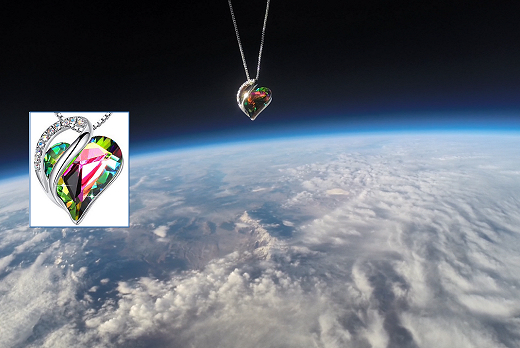
You can have it for $169.95. The students are selling these pendants to support their cosmic ray ballooning program. The glittering heart-shaped crystal is wrapped in a silver-embossed infinity clasp, symbolizing unending love. Each one comes with a romantic card showing the pendant in flight and telling the story of its journey to the edge of space and back again.
Far Out Gifts: Earth to Sky Store
All sales support hands-on STEM education
Realtime Aurora Photo Gallery
Free: Spaceweather.com Newsletter