SOLAR MINIMUM CONDITIONS ARE IN EFFECT: Despite recent signs of life from Solar Cycle 25, solar activity remains low. The sun is blank (no sunspots), and the next stream of solar wind (a minor one) isn't expected until Jan. 19th or 20th. In the nights ahead, auroras probably will be confined to regions very near the Arctic Circle. Aurora alerts: SMS Text.
A MAGNETIC EXPLOSION ON EARTH'S DOORSTEP: Yes, there are explosions in Earth’s magnetic field. They happen all the time. Gusts of solar wind press against Earth’s magnetosphere, squeezing lines of magnetic force together. The lines criss-cross and reconnect, literally exploding and propelling high energy particles toward Earth. Auroras are the afterglow of this process.
On Dec. 20, 2015, such an explosion occurred closer to Earth than anyone had seen before. It has taken researchers 4 years to fully wrap their minds around what happened, and the results were published just this week in the Jan. 13, 2020, edition of Nature Physics.

Above: Auroras sparked by a near-Earth magnetic explosion on Dec. 20, 2015: more.
Lead author Vassilis Angelopoulos of UCLA explains: "Usually, these explosions happen at least 100,000 miles from Earth, far downstream in our planet’s magnetic tail. On Dec. 20, 2015, however, we observed a reconnection event only 30,000 miles away–more than 3 times closer than normal."
It was a case of good luck and perfect timing. NASA's swarm of three THEMIS spacecraft were passing through the area, and they were able to pinpoint the explosion’s location "right on the doorstep" of the geosynchronous satellite belt. This showed reconnection events may pose a previously overlooked threat to Earth-orbiting satellites. The nearby blast caused a strong G2-class geomagnetic storm and intense auroras around the Arctic Circle.


Above: "X" marks the spot of the Dec. 20, 2015, near-Earth magnetic explosion: more.
Angelopoulos estimated the energy involved. "The explosion and subsequent storm delivered as much as ~88 PetaJoules (88 x 1015 Joules) of energy to the near-Earth environment. That’s more than 10 times the energy of the largest US nuclear bomb and about 20 times the energy of a magnitude 7 earthquake."
Before this event, many researchers felt that reconnection at such proximity was impossible. Earth’s nearby magnetic field was too stable for such explosions … or so the thinking went.
"Now we know better," Angelopoulos says"“The THEMIS multipoint observations are iron-clad. It really happened, and this is going to make a big impact on future studies of geomagnetic storms."
A sharable version of this story may be found here.
Realtime Spaceweather Photo Gallery
Free: Spaceweather.com Newsletter
MOONSTONE PENDANT FOR VALENTINE'S DAY: Are you looking for a far-out Valentine's gift? Nothing says "I love you" like a moonstone from the edge of space. The students of Earth to Sky Calculus flew this moonstone wrapped in a hand-crafted sterling silver Celtic love knot 35.1 km (115,158 feet) above Earth's surface:
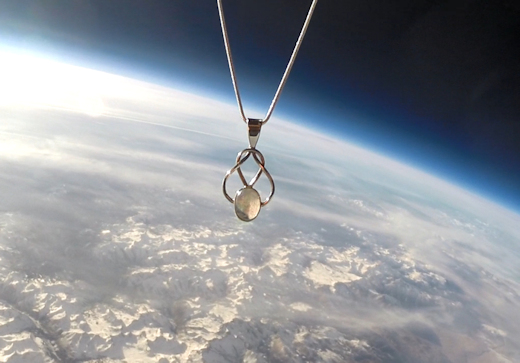
You can have it for $179.95. The students are selling these pendants to support their cosmic ray ballooning program. Each one comes with a greeting card showing the item in flight and telling the story of its journey to the edge of space. All sales support the Earth to Sky Calculus cosmic ray ballooning program and hands-on STEM research.
Far Out Gifts: Earth to Sky Store
All sales support hands-on STEM education
Realtime Aurora Photo Gallery
Free: Spaceweather.com Newsletter