SOLAR MINIMUM CONDITIONS ARE IN EFFECT: Despite recent signs of life from Solar Cycle 25, solar activity remains low. The sun is blank (no sunspots), and the next stream of solar wind (a minor one) isn't expected until Jan. 20th. In the nights ahead, auroras probably will be confined to regions very near the Arctic Circle. Aurora alerts: SMS Text.
SPACEWEATHER.COM IS HEADING FOR SWEDEN: Next week, Spaceweather.com will be in Sweden. We're heading for the Arctic Circle with a small team of students from Earth to Sky Calculus. Our mission: To launch a series of cosmic ray balloons into the polar stratosphere, continuing our 5-year program of atmospheric radiation monitoring around the world.

The last time we visited the Arctic in March 2017 we measured very high levels of cosmic radiation in the stratosphere over Sweden and Norway. Repeat measurements next week will help us understand how radiation levels have changed with the recent deepening of Solar Minimum.
Bonus: The Arctic has recently experienced a colorful outbreak of polar stratospheric clouds, shown above in a photo from Peter Rosen of Kiruna, Sweden. If all goes well, we may be able to photograph these clouds from the inside. Our cosmic ray balloons reach the same altitudes as these clouds and our cameras could record them at point-blank range. Fingers crossed that the outbreak continues!
ONLY IN CANADA: Mark this picture under the category: Things you can do with a camera and a kettle of boiling water. On Jan. 15th, Matthew Wheeler of Robson Valley, British Columbia, found himself outside at sunrise juggling both items. He explains: "It was unusually cold outside, so I decided to try to make ice fog with boiling kettle water. When I got out there nature had already done it better! I photographed a bright sundog through the boiling mist."

This picture was taken with a kettle in one hand, and a Lumix ZS50 in the other, working well below rated temperature," Wheeler says. "The droplet trails were very amusing, zigzagging like sparks from a fire."
In addition to the sundog, Wheeler also witnessed nested sun halos and a V-shaped upper tangent arc--all caused by ice crystals in the freezing Canadian air. "I photographed each one through a drizzle of leaping, steaming water droplets," says Wheeler. "Further experiments with high speed video would be interesting." Stay tuned.
Realtime Spaceweather Photo Gallery
Free: Spaceweather.com Newsletter
INFINITY PENDANT FOR VALENTINE'S DAY: Valentine's Day is less than one month away. Nothing says "I Love You" like an Infinity Pendant from the edge of space. On Jan. 8, 2020, the students of Earth to Sky Calculus launched a cosmic ray balloon. This authentic Swarovski crystal pendant hitched a ride, traveling 113,209 feet above the Sierra Nevada mountains of central California:
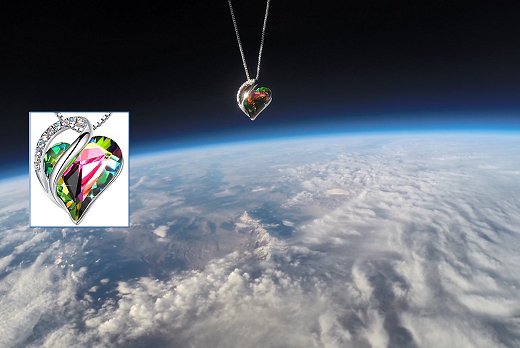
You can have it for $179.95. The students are selling these pendants to support their cosmic ray ballooning program. The glittering heart-shaped crystal is wrapped in a silver-embossed infinity clasp, symbolizing unending love. Each one comes with a romantic card showing the pendant in flight and telling the story of its journey to the edge of space and back again.
Far Out Gifts: Earth to Sky Store
All sales support hands-on STEM education
Realtime Aurora Photo Gallery
Free: Spaceweather.com Newsletter