SOLAR MINIMUM CONDITIONS ARE IN EFFECT: Despite recent signs of life from Solar Cycle 25, solar activity remains low. The sun is blank (no sunspots), and the next stream of solar wind (a minor one) isn't expected until Jan. 20-21. In the nights ahead, auroras probably will be confined to regions very near the Arctic Circle. Aurora alerts: SMS Text.
A SPACE ROCK EXPLODES OVER PUERTO RICO: For the past two weeks, strong earthquakes have been shaking the Caribbean island of Puerto Rico. Yesterday, Jan. 17th, the islanders felt an additional jolt--but this one came from the sky. "Amidst the earthquake swarm that we are currently experiencing here in Puerto Rico, we were also nearly impacted by a giant rock from space," reports Frankie Lucena of Cabo Rojo PR. "The explosion is shown in this weather satellite image from GOES-16."

This event gave Lucena a feeling of deja vu. "Last summer an even bigger space rock exploded near us," he says. "On June 22, 2019, asteroid 2019 MO disintegrated south of the island. Here's a comparison of the satellite images, then vs. now."

Yesterday's fireball produced a loud rumble, was visible in broad daylight, and understandably unsettled many Puerto Ricans already on pins and needles because of the quakes. The explosion may have produced meteorites. However, none of them appears to have landed on the island.
Updates to this story will be posted as we learn more.
Realtime Spaceweather Photo Gallery
Free: Spaceweather.com Newsletter
SPACEWEATHER.COM IS HEADING FOR SWEDEN: Next week, Spaceweather.com will be in Sweden. We're heading for the Arctic Circle with a small team of students from Earth to Sky Calculus. Our mission: To launch a series of cosmic ray balloons into the polar stratosphere, continuing our 5-year program of atmospheric radiation monitoring around the world.

The last time we visited the Arctic in March 2017 we measured very high levels of cosmic radiation in the stratosphere over Sweden and Norway. Repeat measurements next week will help us understand how radiation levels have changed with the recent deepening of Solar Minimum.
Bonus: The Arctic has recently experienced a colorful outbreak of polar stratospheric clouds, shown above in a photo from Peter Rosen of Kiruna, Sweden. If all goes well, we may be able to photograph these clouds from the inside. Our cosmic ray balloons reach the same altitudes as these clouds and our cameras could record them at point-blank range. Fingers crossed that the outbreak continues!
Realtime Spaceweather Photo Gallery
Free: Spaceweather.com Newsletter
INFINITY PENDANT FOR VALENTINE'S DAY: Valentine's Day is less than one month away. Nothing says "I Love You" like an Infinity Pendant from the edge of space. On Jan. 8, 2020, the students of Earth to Sky Calculus launched a cosmic ray balloon. This authentic Swarovski crystal pendant hitched a ride, traveling 113,209 feet above the Sierra Nevada mountains of central California:
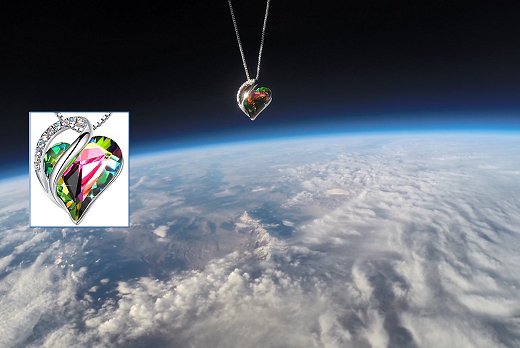
You can have it for $179.95. The students are selling these pendants to support their cosmic ray ballooning program. The glittering heart-shaped crystal is wrapped in a silver-embossed infinity clasp, symbolizing unending love. Each one comes with a romantic card showing the pendant in flight and telling the story of its journey to the edge of space and back again.
Far Out Gifts: Earth to Sky Store
All sales support hands-on STEM education
Realtime Aurora Photo Gallery
Free: Spaceweather.com Newsletter