ARCTIC LIGHT PILLARS: They look like auroras, but they're not. "I saw a brilliant display of light pillars on Jan. 20th," reports Andy Pritchard of Saariselka, Finland. "They were sparkling like static noise."

Pritchard had just finished skiing when the pillars appeared. "We were walking to our cabin and looked back toward the ski slopes to see the lights. They were amazing!"
Light pillars are caused by ice crystals in the air, which intercept manmade lights and spread them into vertical columns. The "sparkling" Pritchard observed was a glinting of light from facets of the blowing, falling crystals. No solar activity is required for the phenomenon. The only ingredients are ice and light bulbs.
Light pillars get their color from the hue of the underlying light bulb. Warm orange corresponds to traditional high pressure sodium lamps, while bright white typically comes from new LED lamps. The slopes in Saariselka appear to be illuminated by a mixture of both.
Realtime Spaceweather Photo Gallery
Free: Spaceweather.com Newsletter
UNDER THE AURORAL OVAL: Heavy snow. Cloudy skies. Almost no solar wind. With conditions like these, no wonder tourists in Abisko, Sweden, didn't expect to see any auroras last night. Then, suddenly, this happened:

"It was a beautiful display!" says Allison Stevenson, who took the picture on Jan. 20th. "I'm a tour guide for Lights over Lapland, and I was leading a group of 10 people," she explains. "At first they didn't believe me when I told them there was a good chance of auroras despite the gloomy forecast. Now they are very happy!"
How did she know? Everyone in Abisko knows. The Arctic village is located underneath Earth's persistent auroral oval--a flickering ring of Northern Lights that waxes and wanes, but never completely goes out. Residents see it, more often than not, thanks to a local meteorological phenomenon called "The Blue Hole of Abisko." Nearby mountains conspire with winds to create a clear patch of sky that can open up even during the gloomiest weather, revealing the auroras overhead. Aurora alerts: SMS Text.
Realtime Aurora Photo Gallery
Free: Spaceweather.com Newsletter
NEUTRONS ON A PLANE: Spaceweather.com and the students of Earth to Sky Calculus have just landed in Stockholm. They'll be in Scandinavia for the next week launching cosmic ray balloons. During the 8 hour flight from the USA to Sweden, the team used bubble chambers to measure neutrons inside the airplane. Here's what one of the chambers looked like midway through the flight:

In the photo, above, each bubble shows where a neutron passed through the chamber and vaporized a superheated droplet. By the time the flight was over, we measured almost 20 uSv (microsieverts) of radiation from neutrons–double the dose from a typical X-ray at your dentist's office.
Where do these neutrons come from? Outer space. When cosmic rays hit Earth's atmosphere, they produce a spray of subatomic debris including neutrons, protons, and alpha particles. Because they are uncharged, neutrons find it relatively easy to reach the ground--passing through airplanes on the way down.
Among the many types of particles that come crashing down through Earth's atmosphere, neutrons are of special interest. They have a knack for interacting with human cells--that is, they are "biologically effective." This quality makes neutrons ironically useful for cancer treatment: Concentrated neutrons beams can kill cancer cells that survive other forms of radiation. Clearly, neutrons on airplanes are important to know about.
Later this week, these same neutron chambers will fly to the polar stratosphere onboard a cosmic ray balloon. X-ray and gamma-ray sensors will go as well, providing a complete profile of low-energy cosmic rays in the atmosphere over this part of the world. Stay tuned.
INFINITY PENDANT FOR VALENTINE'S DAY: Valentine's Day is less than one month away. Nothing says "I Love You" like an Infinity Pendant from the edge of space. On Jan. 8, 2020, the students of Earth to Sky Calculus launched a cosmic ray balloon. This authentic Swarovski crystal pendant hitched a ride, traveling 113,209 feet above the Sierra Nevada mountains of central California:
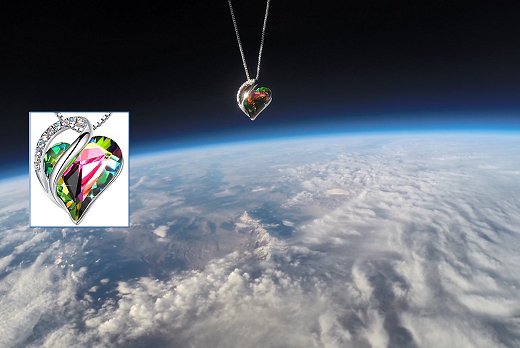
You can have it for $179.95. The students are selling these pendants to support their cosmic ray ballooning program. The glittering heart-shaped crystal is wrapped in a silver-embossed infinity clasp, symbolizing unending love. Each one comes with a romantic card showing the pendant in flight and telling the story of its journey to the edge of space and back again.
Far Out Gifts: Earth to Sky Store
All sales support hands-on STEM education