THE UNPRECEDENTED DIMMING OF BETELGEUSE: Astronomers from Villanova University reported this week that Betelgeuse has continued to dim. The red supergiant's luminosity is now at a 25 year low, stoking speculation that the star is about to collapse and explode. Other explanations are at least as likely. Betelgeuse might be blowing dust from its cool outer layers, creating a haze that dims its own light. Whatever is happening, say the researchers, "the unusual behavior of Betelgeuse should be closely watched."
ARCTIC SPACE WEATHER BALLOON LAUNCH: Spaceweather.com and the students of Earth to Sky Calculus are spending the week inside the Arctic Circle. We're here launching space weather balloons to the polar stratosphere, measuring rising levels of radiation. Today's launch outside Abisko, Sweden,was thrilling. To see why, play the video:
Just before the balloon was ready to fly, a wind squall engulfed the launch site. Team members struggled to control the lively balloon, even diving on the ground to prevent the fragile rubber fabric from touching the faceted snow. Ultimately, the launch was a success.
We've been monitoring atmospheric radiation with global balloon flights for nearly 5 years. Everywhere we've gone--eleven US states, Chile, Norway, Sweden, Mexico, New Zealand--cosmic rays in the atmosphere are intensifying. The sun is to blame. The sun's magnetic field has weakened in recent years due to the onset of Solar Minimum. This means the sun is doing a poorer job protecting us from deep space cosmic rays.
Realtime Aurora Photo Gallery
Free: Spaceweather.com Newsletter
ARCTIC LIGHT PILLARS: They look like auroras, but they're not. "I saw a brilliant display of light pillars on Jan. 20th," reports Andy Pritchard of Saariselka, Finland. "They were sparkling like static noise."

Pritchard had just finished skiing when the pillars appeared. "We were walking to our cabin and looked back toward the ski slopes to see the lights. They were amazing!"
Light pillars are caused by ice crystals in the air, which intercept manmade lights and spread them into vertical columns. The "sparkling" Pritchard observed was a glinting of light from facets of the blowing, falling crystals. No solar activity is required for the phenomenon. The only ingredients are ice and light bulbs.
Light pillars get their color from the hue of the underlying light bulb. Warm orange corresponds to traditional high pressure sodium lamps, while bright white typically comes from new LED lamps. The slopes in Saariselka appear to be illuminated by a mixture of both.
Realtime Spaceweather Photo Gallery
Free: Spaceweather.com Newsletter
INFINITY PENDANT FOR VALENTINE'S DAY: Valentine's Day is less than one month away. Nothing says "I Love You" like an Infinity Pendant from the edge of space. On Jan. 8, 2020, the students of Earth to Sky Calculus launched a cosmic ray balloon. This authentic Swarovski crystal pendant hitched a ride, traveling 113,209 feet above the Sierra Nevada mountains of central California:
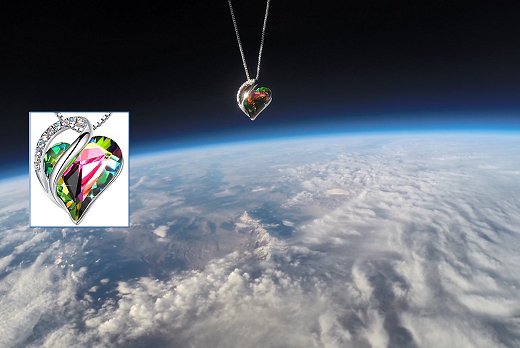
You can have it for $179.95. The students are selling these pendants to support their cosmic ray ballooning program. The glittering heart-shaped crystal is wrapped in a silver-embossed infinity clasp, symbolizing unending love. Each one comes with a romantic card showing the pendant in flight and telling the story of its journey to the edge of space and back again.
Far Out Gifts: Earth to Sky Store
All sales support hands-on STEM education