A NEW SUNSPOT FROM AN OLD SOLAR CYCLE: A new sunspot is emerging in the sun's northern hemisphere. Its magnetic polarity identifies it as a member of old Solar Cycle 24. Such sunspots will become increasingly rare in the weeks and months ahead as old Solar Cycle 24 decays and new Solar Cycle 25 intensifies to replace it. The sunspot poses no threat for strong solar flares. Aurora alerts: SMS Text.

POLAR STRATOSPHERIC CLOUDS: Yesterday, Matt Robinson landed in the airport in Kiruna, Sweden, just inside the Arctic Circle. "I stepped off the plane and immediately noticed incredible clouds overhead," he says. "The colors were unbelievable!" These are polar stratospheric clouds (PSCs):

"The display intensified as I boarded a bus to my hotel," Robinson. "The bus driver wouldn't stop so I had to take these pictures from the back of a moving bus!"
Polar stratospheric clouds are very rare. Normally the stratosphere has no clouds at all. PSCs form when the temperature in the Arctic stratosphere drops to a staggeringly-low -85 C. Then, and only then, sparse water molecules begin to coalesce into tiny ice crystals -- the "stuff" of PSCs. High-altitude sunlight shining through the crystals creates intense iridescent colors.
In a typical Arctic winter, PSCs appear two or three times at most. This winter is different. The clouds have nearly filled Arctic skies on dozens of occasions, with some longtime residents describing it as the best outbreak in a generation. No one knows why.
LUCKY BALLOON LAUNCH: Spaceweather.com is currently in the Arctic, and on Jan. 22nd we launched a high altitude balloon to the stratosphere not far from Kiruna, Sweden. Cameras onboard the balloon's payload recorded the same clouds Robinson saw, capturing perhaps the first-ever images of PSCs from the stratosphere. We're processing the footage now.
Realtime Spaceweather Photo Gallery
Free: Spaceweather.com Newsletter
INTENSE PINK AND GREEN AURORAS: Have you ever read a book by auroral light? This week in Tromso, Norway, you could have. "The auroras were so strong on Jan. 22nd, you could have read a book under their green and pink glow," reports Markus Varik. "My camera's exposure time wasn't even 1 second - it was just 0.5 seconds."

The display was sparked by an impulse of solar wind that hit Earth's magnetic field on Jan. 21st. The shock was small, but effective, causing local geomagnetic storms around the Arctic until Jan. 22nd.
"The pink colors were especially beautiful," notes Varik. "It was a great night!"
The appearance of pink tells us something interesting about the solar wind on Jan. 22nd: it seems to have been unusually penetrating. Most auroras are green–a verdant glow caused by energetic particles from space hitting oxygen atoms 100 km to 300 km above Earth's surface. Pink appears when the energetic particles descend lower than usual, striking nitrogen molecules at the 100 km level and below.
Realtime Aurora Photo Gallery
Free: Spaceweather.com Newsletter
INFINITY PENDANT FOR VALENTINE'S DAY: Valentine's Day is less than one month away. Nothing says "I Love You" like an Infinity Pendant from the edge of space. On Jan. 8, 2020, the students of Earth to Sky Calculus launched a cosmic ray balloon. This authentic Swarovski crystal pendant hitched a ride, traveling 113,209 feet above the Sierra Nevada mountains of central California:
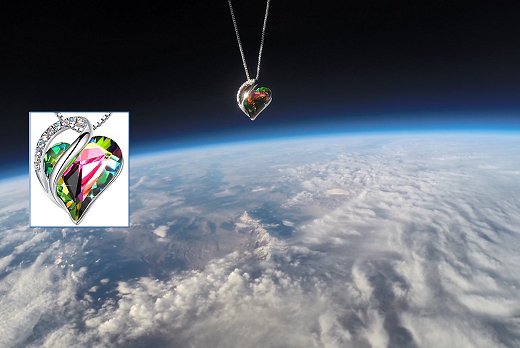
You can have it for $179.95. The students are selling these pendants to support their cosmic ray ballooning program. The glittering heart-shaped crystal is wrapped in a silver-embossed infinity clasp, symbolizing unending love. Each one comes with a romantic card showing the pendant in flight and telling the story of its journey to the edge of space and back again.
Far Out Gifts: Earth to Sky Store
All sales support hands-on STEM education