A NEW SUNSPOT FROM AN OLD SOLAR CYCLE: A new sunspot is emerging in the sun's northern hemisphere. Numbered AR2757, its magnetic polarity identifies it as a member of old Solar Cycle 24. Such sunspots will become increasingly rare in the weeks and months ahead as old Solar Cycle 24 decays and new Solar Cycle 25 intensifies to replace it. AR2757 poses no threat for strong solar flares. Aurora alerts: SMS Text.

POLAR STRATOSPHERIC CLOUDS: For the second day in a row, rare polar stratospheric clouds (PSCs) have appeared over Sweden. "I couldn't believe my eyes when I looked out the window this morning," reports Jordan Herbst of Earth to Sky Calculus, who is in Abisko, Sweden, for a series of cosmic ray balloon launches. "I rushed outside, post-holing through deep snow to set up my camera with a good view of Lapporten." This image shows the clouds floating over Mt. Nissuntjårro:

"Just yesterday I heard about these clouds for the first time--and today I got to shoot an incredible display," he says. "I'm so glad to be here in the Arctic!"
Polar stratospheric clouds are very rare. Normally the stratosphere has no clouds at all. PSCs form when the temperature in the Arctic stratosphere drops to a staggeringly-low -85 C. Then, and only then, sparse water molecules begin to coalesce into tiny ice crystals -- the "stuff" of PSCs. High-altitude sunlight shining through the crystals creates intense iridescent colors.
In a typical Arctic winter, PSCs appear two or three times at most. This winter is different. The clouds have nearly filled Arctic skies on dozens of occasions, with some longtime residents describing it as the best outbreak in a generation.
MORE TO THE STORY: Jordan is a student member of Earth to Sky Calculus. The day before he took these pictures, he helped launch a high altitude balloon directly into a polar stratospheric cloud just north of Abisko. Cameras on the payload photographed the clouds from the stratosphere--a first, we believe. We'll be publishing the balloon footage next week. Stay tuned.
Realtime Spaceweather Photo Gallery
Free: Spaceweather.com Newsletter
INFINITY PENDANT FOR VALENTINE'S DAY: Valentine's Day is less than one month away. Nothing says "I Love You" like an Infinity Pendant from the edge of space. On Jan. 8, 2020, the students of Earth to Sky Calculus launched a cosmic ray balloon. This authentic Swarovski crystal pendant hitched a ride, traveling 113,209 feet above the Sierra Nevada mountains of central California:
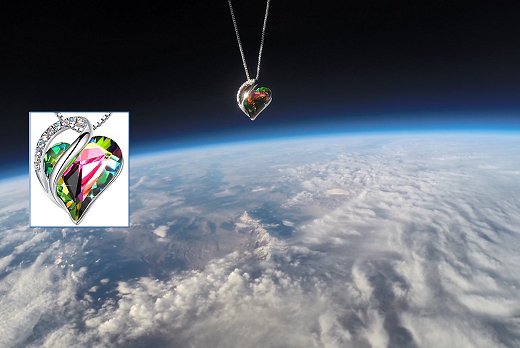
You can have it for $179.95. The students are selling these pendants to support their cosmic ray ballooning program. The glittering heart-shaped crystal is wrapped in a silver-embossed infinity clasp, symbolizing unending love. Each one comes with a romantic card showing the pendant in flight and telling the story of its journey to the edge of space and back again.
Far Out Gifts: Earth to Sky Store
All sales support hands-on STEM education
Realtime Aurora Photo Gallery
Free: Spaceweather.com Newsletter