TWO SOLAR CYCLES ACTIVE AT ONCE: Today, there are two active regions on the surface of the sun, places where strong magnetic fields are bubbling up from below. The magnetic polarity of the regions reveals something interesting: Two solar cycles are active at once. One region belongs to old Solar Cycle 24, the other to new Solar Cycle 25. This is normal. Solar cycles always overlap at their boundaries. It's just the latest sign that change is occurring on the sun. Aurora alerts: SMS Text.

POLAR STRATOSPHERIC CLOUDS, THE GOOD AND THE BAD: This week, Arctic sky watchers have marveled at the latest outbreak of polar stratospheric clouds (PSCs). Some observers call them "daytime auroras" because the clouds' colors rival Northern Lights. It's wonderful--except when it's not. PSCs come in two varieties, the good and the bad, both captured in this Jan. 25th photo taken by Rauno Pakarinen of Pieksämäki, Finland:

The good PSCs are on top, made of harmless water ice, glowing with the striking iridescent colors that have led onlookers to compare them to auroras.
The bad PSCs are on the bottom, a sinister-looking yellow haze. "Bad PSCs", also known as Type I polar stratospheric clouds, are made from tiny droplets of nitric acid, sulfuric acid, and other compounds. The surfaces of these droplets act as catalysts, converting relatively benign forms of man-made chlorine into active free radicals, which can destroy ozone. Bad PSCs make ozone holes, passing harmful UV radiation to the surface of the Earth below.
PSCs, when they do appear, are normally confined to the far north. "Pieksämäki is WAY south of the Lappland, so this is a very rare sighting indeed!!!" says Pakarinen.
Realtime Spaceweather Photo Gallery
Free: Spaceweather.com Newsletter
STARLINK SATELLITES: SpaceX has an idea: Surround the Earth with 42,000 satellites and provide broadband internet to every corner of the globe. The project is called Starlink--and it could destroy the night sky. Starlink satellites are quite bright. En masse, they have the potential to seriously interfere with research-grade astrophotography. Ulrich C. Beinert was flying in an airplane over the Canada-USA border on Jan. 20th when he got an eyeful:

"From the cockpit of an Airbus A380, I witnessed a train of Starlink satellites pass in their eerie formation," says Beinert. "Quick to grab my camera, I caught this shot with eight of the satellites, then watched as dozens more flew past us in the evening sky."
At the moment only ~180 Starlink satellites orbit Earth, yet they are frequently sighted. Now imagine 42,000. Astronomers could have trouble photographing anything without a Starlink satellite passing through the field of view.
Starlink launches will intensify in 2020, with ~1000 more satellites expected by the end of the year. For the most recent launch on Jan. 6th, SpaceX applied an experimental coating to one of the satellites to dim its brightness. However, preliminary observations by some observers suggest the coating makes little difference. Keep trying, SpaceX!
Realtime Spaceweather Photo Gallery
Free: Spaceweather.com Newsletter
INFINITY PENDANT FOR VALENTINE'S DAY: Valentine's Day is less than one month away. Nothing says "I Love You" like an Infinity Pendant from the edge of space. On Jan. 8, 2020, the students of Earth to Sky Calculus launched a cosmic ray balloon. This authentic Swarovski crystal pendant hitched a ride, traveling 113,209 feet above the Sierra Nevada mountains of central California:
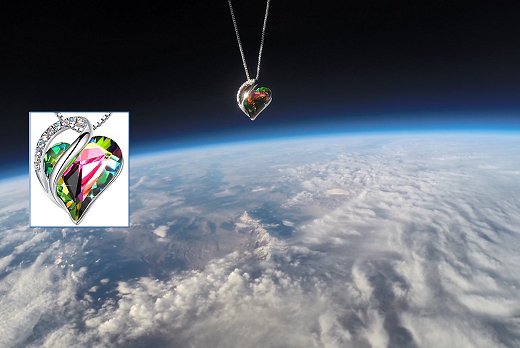
You can have it for $179.95. The students are selling these pendants to support their cosmic ray ballooning program. The glittering heart-shaped crystal is wrapped in a silver-embossed infinity clasp, symbolizing unending love. Each one comes with a romantic card showing the pendant in flight and telling the story of its journey to the edge of space and back again.
Far Out Gifts: Earth to Sky Store
All sales support hands-on STEM education
Realtime Aurora Photo Gallery
Free: Spaceweather.com Newsletter