QUIET WITH A SLIGHT CHANCE OF SOLAR WIND: Solar activity remains very low despite the presence of an old-cycle sunspot (AR2757) in the sun's northern hemisphere. There is a chance that a solar wind stream will hit Earth's magnetic field on Jan. 31-Feb. 1 when a shallow hole in the sun's atmosphere moves into geoeffective position. Enhanced Arctic auroras are possible at that time. Aurora alerts: SMS Text.
A SMALL CRACK IN EARTH'S MAGNETIC FIELD: Last night, a small crack opened in Earth's magnetic field. Solar wind poured in to fuel a quiet display of auroras over Canada. Catalin Tapardel sends this picture from Worsley, Alberta:

"I spent few hours staring at the green glowing band," says Tapardel. "Other than a few shy pillars, there were no major developments in the aurora's structure. Just the usual solar minimum business...."
The crack developed on Jan. 28th when the interplanetary magnetic field (IMF) near Earth tilted south. This partially canceled our planet's north-pointing magnetic field, creating a gap through which solar wind could flow. During Solar Minimum (happening now), we rely on such cracks and gaps to "stoke the fires" of aurora borealis without the usual support of sunspots and solar flares.
Realtime Spaceweather Photo Gallery
Free: Spaceweather.com Newsletter
A SUNSPOT FROM OLD SOLAR CYCLE 24: One day, probably in the year 2020, we will see the very last sunspot of old Solar Cycle 24. In fact, this could be it:

This is AR2757, currently crossing the face of the sun. Martin Wise photographed the sunspot earlier this morning from his backyard observatory in Florida. "Its primary dark core was easy to see among the boiling granules surrounding it," says Wise.
The magnetic polarity of AR2757 identifies it as a "last-gasp sunspot" of old Solar Cycle 24. In recent months, small sunspots from Solar Cycle 25 have been appearing, signaling a transition to the next solar cycle. At the same time, Solar Cycle 24 is dying out. This could be the very last sunspot of the old cycle--or not. We will continue to monitor the situation as 2020 unfolds.
Realtime Spaceweather Photo Gallery
Free: Spaceweather.com Newsletter
INFINITY PENDANT FOR VALENTINE'S DAY: Valentine's Day is less than one month away. Nothing says "I Love You" like an Infinity Pendant from the edge of space. On Jan. 8, 2020, the students of Earth to Sky Calculus launched a cosmic ray balloon. This authentic Swarovski crystal pendant hitched a ride, traveling 113,209 feet above the Sierra Nevada mountains of central California:
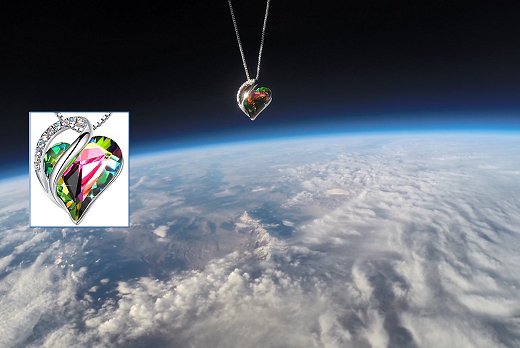
You can have it for $179.95. The students are selling these pendants to support their cosmic ray ballooning program. The glittering heart-shaped crystal is wrapped in a silver-embossed infinity clasp, symbolizing unending love. Each one comes with a romantic card showing the pendant in flight and telling the story of its journey to the edge of space and back again.
Far Out Gifts: Earth to Sky Store
All sales support hands-on STEM education
Realtime Aurora Photo Gallery
Free: Spaceweather.com Newsletter