THE SOLAR WIND IS HERE, BUT ONLY A LITTLE: A minor stream of solar wind is buffeting Earth's magnetic field today. With wind speeds barely exceeding 400 km/s, the stream is not causing geomagnetic storms. Nevertheless, Arctic sky watchers may see an uptick in aurora activity after nightfall. Aurora alerts: SMS Text.
A NEW TYPE OF AURORA--"THE DUNES": A new type of aurora is rippling across Arctic skies. Citizen scientists who discovered it nicknamed it "The Dunes" because of its resemblance to desert sand dunes. A paper published in the Jan. 28th issue of AGU Advances describes the new form and the unexpected physics that causes it.

Above: Aurora dunes over Laitila, Finland, on Oct. 7, 2018. Credit: Pirjo Koski. [more]
Dune-shaped auroras form in a narrow altitude range 80 km to 120 km above Earth's surface. Turns out, this is an extremely hard-to-study layer of Earth's atmosphere. It's too high for weather balloons, and too low for rockets.
"Due to the difficulties in measuring atmospheric phenomena between 80 and 120 km, we sometimes call this region 'the ignorosphere'," says Minna Palmroth, Professor of Computational Space Physics at the University of Helsinki and the lead author of the study.
Sky watchers in the Arctic have been seeing Dunes for years without understanding what they were. A breakthrough came on Oct. 7, 2018, when multiple groups photographed the dunes from widely separated locations in Finland. Maxime Grandin, a postdoctoral researcher in Palmroth's team, analyzed the images, using triangulation techniques to decipher the Dune's geometry.
Conclusion: Dunes are located ~100 km high--smack-dab in the middle of the ignorosphere--and have a pure, monochromatic wavelength of about 45 km.

Above: An artists' concept of a mesospheric bore trapped in a high-altitude waveguide. [more]
The research team believes the Dunes are a "mesospheric bore"--a type of atmospheric gravity wave that springs up from the surface below and gets caught in a thermal waveguide ~100 km high. When solar wind particles rain down on the bore, they illuminate its rippling structure.
The discovery of Dunes may allow researchers to study the ignorosphere as never before. Monitoring Dunes can reveal previously hidden waves and waveguides at the boundary between Earth and space. Aurora photographers, have you seen a Dune? Submit your photos here.
Note: This research was made possible by ordinary people paying close attention to the sky. The first report of aurora dunes in Oct. 2015 came from Mikko Peussa, an aurora photographer in Finland. Next, Matti Helin learned of the phenomenon and managed to get researchers interested. Helin participated in subsequent breakthrough observations, and joined 6 other amateurs (P. Koski, A. Oksanen, M. A. Glad, R. Valonen, K. Saari and E. Bruus ) on the AGU Advances paper.
A sharable version of this story is available here.
Realtime Spaceweather Photo Gallery
Free: Spaceweather.com Newsletter
ARCTIC NORTHERN LIGHTS PENDANT: Valentine's Day is coming. Nothing says "I Love You" like a Northern Lights pendant from the Arctic stratosphere. On Jan. 22, 2020, the students of Earth to Sky Calculus launched a cosmic ray balloon to measure atmospheric radiation inside the Arctic Circle. This pendant hitched a ride, floating more than 75,000 feet above the frozen terrain of northern Sweden:
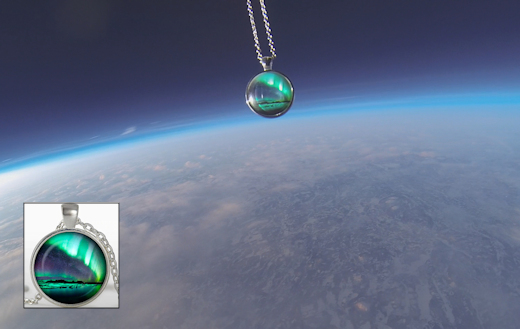
You can have it for $139.95. The students are selling these pendants to support their cosmic ray ballooning program. Each one comes with a romantic card showing the pendant in flight and telling the story of its journey to the edge of space and back again.
Far Out Gifts: Earth to Sky Store
All sales support hands-on STEM education
Realtime Aurora Photo Gallery
Free: Spaceweather.com Newsletter