GEOMAGNETIC UNREST LIKELY TODAY: A solar wind stream is blowing around Earth faster than 500 km/s. This is causing geomagnetic unrest (albeit not geomagnetic storms) around the poles. Arctic auroras are likely on Jan. 31st-Feb 1st in response to this stream. Aurora alerts: SMS Text.
SOUTHERN CALIFORNIA FIREBALL: Last night, Jan. 30th around 10:30 pm PST, a spectacular fireball crawled across the skies of southern California. In Los Angeles and San Diego, millions of people watched it fragment into dozens of pieces high overhead. But what was it? Initial speculation focused on decaying space junk. The slow pace of the fireball combined with its fragmentation--as if parts of a satellite were breaking off in the atmosphere--suggested an orbital decay event. It appears, however, that the fireball was something else entirely.
Bill Cooke of NASA's Meteoroid Environment Office has triangulated data from multiple cameras that picked up the fireball. His conclusion: It did not come from Earth. Instead, the fireball was a small asteroid or comet fragment belonging to the Apollo/Jupiter family. It was orbiting the sun when Earth got in the way, hitting our planet at a speed of 15.5 km/s (~35,000 mph). For comparison, manmade objects in low-Earth orbit typically hit at 7.9 km/s (17,700 mph) when they decay.
Realtime Aurora Photo Gallery
Free: Spaceweather.com Newsletter
STARLINK RADAR ECHOES: Leave it to Starlink. SpaceX's growing constellation of internet satellites is finding new ways to interfere with astronomy. This time it's radar astronomy. On Jan. 29th, Giuseppe Petricca on Scotland's Isle of Lewis was monitoring France's GRAVE space surveillance radar, looking for echoes from meteors. Instead, he got this:

"Each of the red streaks is a reflection from a Starlink satellite," says Petricca. "There are dozens of them!"
GRAVE is located 1500 km southeast of Petricca's radio observatory. He uses a Yagi antenna and a radio receiver tuned to 143 MHz (the operating frequency of the radar) to listen for objects passing over the distant radar. In the past, meteors made most of the echoes, but now Starlink can easily overwhelm the natural meteor rate.
SpaceX has just launched a new batch of 60 Starlink satellites, bringing the total in orbit to ~240. Ultimately, there could be as many as 42,000 Starlink satellites circling Earth. 42,000. Their goal is to provide global, satellite-based internet service. They could also bring an end to ground-based astronomy as we know it. And in the case of radar and radio astronomy, painting the satellites black won't help.
Realtime Spaceweather Photo Gallery
Free: Spaceweather.com Newsletter
ARCTIC NORTHERN LIGHTS PENDANT: Valentine's Day is coming. Nothing says "I Love You" like a Northern Lights pendant from the Arctic stratosphere. On Jan. 22, 2020, the students of Earth to Sky Calculus launched a cosmic ray balloon to measure atmospheric radiation inside the Arctic Circle. This pendant hitched a ride, floating more than 75,000 feet above the frozen terrain of northern Sweden:
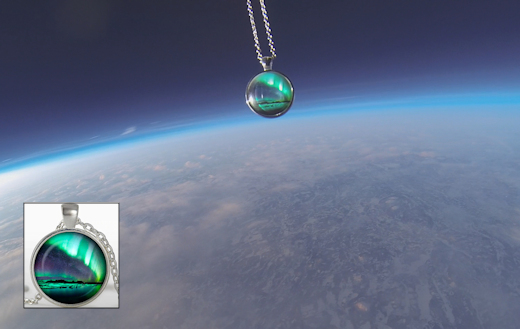
You can have it for $139.95. The students are selling these pendants to support their cosmic ray ballooning program. Each one comes with a romantic card showing the pendant in flight and telling the story of its journey to the edge of space and back again.
Far Out Gifts: Earth to Sky Store
All sales support hands-on STEM educatio