RETURN OF THE BLANK SUN: Decaying old-cycle sunspot AR2757 is rotating off the sun's eastern limb today. Its departure will leave the sun devoid of 'spots. Blank suns are the norm during Solar Minimum. We are in that low phase of the solar cycle now, and it is expected to persist for some time to come.
CORONAL CANYON FACES EARTH: A canyon-shaped hole in the sun's atmosphere is facing Earth and spewing solar wind in our direction. Estimated toime of arrival: Feb. 5th. This extreme ultraviolet image from NASA's Solar Dynamics Observatory shows the structure, which stretches more than 750,000 km from the sun's south pole to the equator:

This is a 'coronal hole'--a region when the sun's magnetic field opens up and allows solar wind to escape. Coronal holes are a primary form of solar activity during Solar Minimum, which is underway now.
The stream of solar wind emerging from this hole will take about 3 days to cross the sun-Earth divide. Geomagnetic storms are not expected. However, Arctic sky watchers should see an uptick in auroras when the gaseous material arrives on Feb. 5th. Aurora alerts: SMS Text.
Realtime Spaceweather Photo Gallery
Free: Spaceweather.com Newsletter
ARCTIC NORTHERN LIGHTS PENDANT: Valentine's Day is coming. Nothing says "I Love You" like a Northern Lights pendant from the Arctic stratosphere. On Jan. 22, 2020, the students of Earth to Sky Calculus launched a cosmic ray balloon to measure atmospheric radiation inside the Arctic Circle. This pendant hitched a ride, floating more than 75,000 feet above the frozen terrain of northern Sweden:
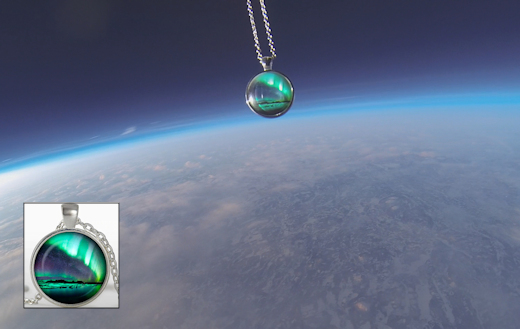
You can have it for $139.95. The students are selling these pendants to support their cosmic ray ballooning program. Each one comes with a romantic card showing the pendant in flight and telling the story of its journey to the edge of space and back again.
Far Out Gifts: Earth to Sky Store
All sales support hands-on STEM education
Realtime Aurora Photo Gallery
Free: Spaceweather.com Newsletter