EXITING THE SOLAR WIND: Earth is exiting a stream of solar wind that sparked a brief but intense outburst of auroras and ground currents in Scandinavia on Feb. 6th. The next stream is due to arrive on Feb. 11th. It is flowing from a northern hole in the sun's atmosphere. Aurora alerts: SMS Text.

THE CONTINUING MYSTERY OF BETELGEUSE: For months, astronomers have been keeping a wary eye on Betelgeuse, the bright red star in Orion's shoulder. What's attracting their attention? All of a sudden, Betelgeuse isn't bright anymore. Its visible luminosity has "fallen off a cliff"--a sign that the star could be on the verge of going supernova.
"The most recent measurements put the visual magnitude of Betelgeuse at about +1.66, the dimmest its been in our 25 years of photometry," says Edward Guinan of Villanova University.
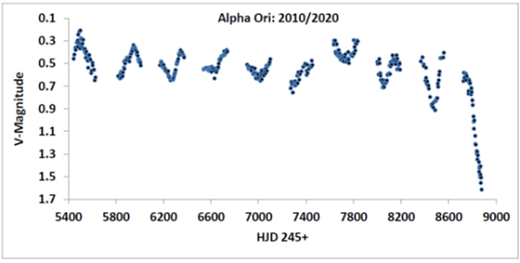
Above: The horizontal axis is Heliospheric Julian Date (HJD). For reference, Jan. 30, 2020, the date of the most recent measurement, has an HJD of 2458879.
Betelgeuse is a highly evolved red supergiant--the type of star that could collapse and explode at any moment. Indeed, the dimming of Betelgeuse could be explained if the star has suddenly contracted to about 92% of its previous radius. But that's not the only possibility. Betelgeuse might be dimmed by a giant starspot--or maybe it is shrouded by an outburst of stardust from its own cool outer layers--or something else entirely. No one knows.
Answers might be forthcoming on Feb. 21st. Astronomers have long known that Betelgeuse is a variable star. It pulsates with many periods, as shown in this Fourier analysis of Betelgeuse's light curve:
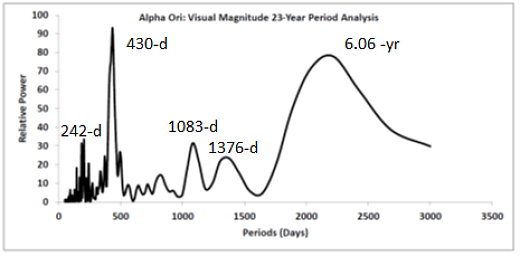
Above: A period analysis of 23 years (1995-2018) of Betelgeuse photometry. Credit: Peranso.
"This shows a dominant (probable pulsation) period of P = 430 days," note Guinan and colleague Richard Wasatonic in a recent Astronomical Telegram. Given this result, "the minimum brightness is expected on 21 (+/-7d) February 2020."
If Betelegeuse starts to bounce back on Feb. 21st, this whole episode might just be a deeper-than-average pulsation, and perhaps the supernova watch can be called off. However, notes Guinan, "even if the 430-day period is still working, this would indicate a minimum brightness near 0.9 mag--much brighter than the current value near 1.6 mag. So something very unusual is going on."
Stay tuned for updates as Feb. 21st approaches.
Realtime Spaceweather Photo Gallery
Free: Spaceweather.com Newsletter
VALENTINE'S GIFTS FROM THE EDGE OF SPACE: Valentine's Day is less than a week away. Nothing says "I love you" like a gift from the edge of space. Everything in the Earth to Sky Store is 10% off from now until Feb. 14th:

Everything in the store has been flown to the stratosphere onboard cosmic ray balloons, which the students of Earth to Sky Calculus launch approximately once a week to monitor atmospheric radiation. All sales support our cosmic ray ballooning program and help launch young scientists into research careers through hands-on STEM education.
At checkout, be sure to enter the coupon code "ILOVESPACE"!
Far Out Gifts: Earth to Sky Store
All sales support hands-on STEM education
Realtime Aurora Photo Gallery
Free: Spaceweather.com Newsletter