SOLAR ORBITER LAUNCHED: On Feb. 10th at 0403 UT, a new sun-watching spacecraft blasted off from Cape Canaveral. The European Space Agency's Solar Orbiter is on a 7-year mission to study and photograph the sun at close range. Among other things, it will capture the first-ever high-resolution images of the sun's poles from inside the orbit of Mercury. The spacecraft is bristling with 10 scientific instruments that could sharply improve space weather forecasting.
RECTANGULAR SUN: No, it's not an alien star system. It's just Rio. Yesterday, Helio C. Vital looked out over the ocean near Rio de Janeiro, Brazil, and saw something out of this world--a rectangular sun:

This image may look fantastical, "but it is quite real," says atmospheric optics expert Les Cowley. "This is an extreme form of a mock-mirage sunset."
Vital describes the conditions: "In our coastal areas, we sometimes get an upwelling of cold water, which cools the air near the sea surface. That's what happened yesterday off the coast of Saquarema, 80km east of Rio. A warm layer of air sat on top of the cold layer, creating a stable temperature inversion."
Cowley continues, "in a situation like this, sunset rays passing across the layers are bent to form a mirage. The strong temperature inversion with ducting, plus possibly several mini inversions, have made multiple sliced images that merged together into the rectangle. An even more extreme mirage of this form is the famous Novaya Zemlya effect."
Realtime Spaceweather Photo Gallery
Free: Spaceweather.com Newsletter
THE CONTINUING MYSTERY OF BETELGEUSE: For months, astronomers have been keeping a wary eye on Betelgeuse, the bright red star in Orion's shoulder. What's attracting their attention? All of a sudden, Betelgeuse isn't bright anymore. Its visible luminosity has "fallen off a cliff"--a sign that the star could be on the verge of going supernova.
"The most recent measurements put the visual magnitude of Betelgeuse at about +1.66, the dimmest its been in our 25 years of photometry," says Edward Guinan of Villanova University.
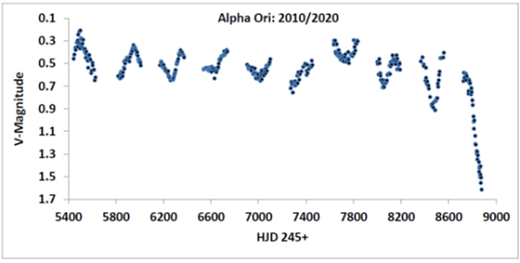
Above: The horizontal axis is Heliocentric Julian Date (HJD). For reference, Jan. 30, 2020, the date of the most recent measurement, has an HJD of 2458879.
Betelgeuse is a highly evolved red supergiant--the type of star that could collapse and explode at any moment. Indeed, the dimming of Betelgeuse could be explained if the star has suddenly contracted to about 92% of its previous radius. But that's not the only possibility. Betelgeuse might be dimmed by a giant starspot--or maybe it is shrouded by an outburst of stardust from its own cool outer layers--or something else entirely. No one knows.
Answers might be forthcoming on Feb. 21st. Astronomers have long known that Betelgeuse is a variable star. It pulsates with many periods, as shown in this Fourier analysis of Betelgeuse's light curve:
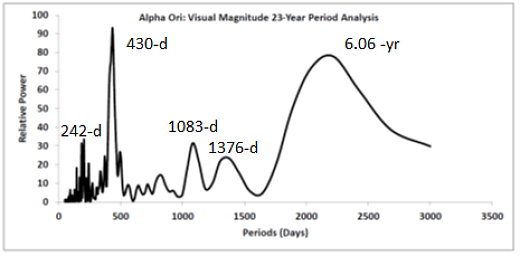
Above: A period analysis of 23 years (1995-2018) of Betelgeuse photometry. Credit: Peranso.
"This shows a dominant (probable pulsation) period of P = 430 days," note Guinan and colleague Richard Wasatonic in a recent Astronomical Telegram. Given this result, "the minimum brightness is expected on 21 (+/-7d) February 2020."
If Betelegeuse starts to bounce back on Feb. 21st, this whole episode might just be a deeper-than-average pulsation, and perhaps the supernova watch can be called off. However, notes Guinan, "even if the 430-day period is still working, this would indicate a minimum brightness near 0.9 mag--much brighter than the current value near 1.6 mag. So something very unusual is going on."
Stay tuned for updates as Feb. 21st approaches.
Realtime Spaceweather Photo Gallery
Free: Spaceweather.com Newsletter
VALENTINE'S GIFTS FROM THE EDGE OF SPACE: Valentine's Day is less than a week away. Nothing says "I love you" like a gift from the edge of space. Everything in the Earth to Sky Store is 10% off from now until Feb. 14th:
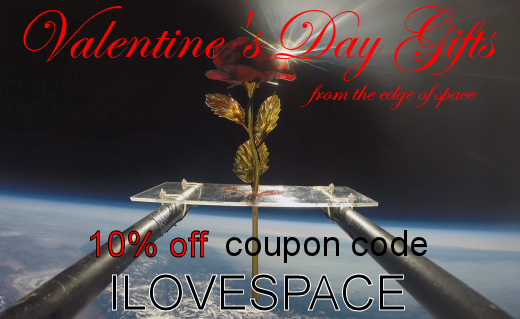
Everything in the store has been flown to the stratosphere onboard cosmic ray balloons, which the students of Earth to Sky Calculus launch approximately once a week to monitor atmospheric radiation. All sales support our cosmic ray ballooning program and help launch young scientists into research careers through hands-on STEM education.
At checkout, be sure to enter the coupon code "ILOVESPACE"!
Far Out Gifts: Earth to Sky Store
All sales support hands-on STEM education
Realtime Aurora Photo Gallery
Free: Spaceweather.com Newsletter